Digital transformation has accelerated the need for seamless user experiences, faster transactions, and highly interactive web applications. However, in the drive to innovate, enterprises often overlook a critical security gap at the very point of user interaction, web forms. This is precisely where formjacking attacks thrive. While organizations continue to strengthen infrastructure, networks, and endpoints, attackers are increasingly targeting login, payment, and data collection forms to silently capture sensitive information without triggering traditional security defenses.
Despite compromising an average of over 4,800 websites each month, formjacking remains relatively under the radar compared to high-profile attacks like ransomware. As the global eCommerce market surges toward an expected $7.3 trillion by 2025, hackers are actively exploiting the growing volume of online transactions, deploying techniques to steal credit card data from unsuspecting users during everyday digital interactions.
Formjacking Attack at a Glance
A form of web skimming attack, formjacking occurs when threat actors inject malicious JavaScript into web pages containing form fields, most commonly login or payment pages. The goal is to intercept and steal sensitive data, such as credit card information, login credentials, and other personal details, at the exact moment users enter them into compromised forms. What makes these web skimming attacks particularly risky is that they operate entirely on the client side, within the user’s browser. Attackers bypass backend systems and capture data at entry before encryption, making detection difficult.
Why is Formjacking Attack a Growing Enterprise Risk?
Despite its apparent simplicity, this attack poses a serious and often underestimated threat to enterprises. It does not rely on complex infrastructure breaches or malware deployment; instead, it targets the most exposed and trusted layer of digital interaction: the user interface. By exploiting this layer, it bypasses many traditional security defenses and creates a direct path to sensitive data.
Here’s a deeper look at why Formjacking is a critical risk for enterprises:
- Expanding Attack Surface Due to Third-Party Dependencies
Modern enterprise applications are built on a complex ecosystem of third-party integrations, ranging from analytics tools and marketing pixels to payment gateways and customer support widgets. While these integrations enhance functionality and user experience, they also significantly expand the attack surface.
Each third-party script loaded onto a website operates with a certain level of trust and access. If any one of these external sources is compromised, attackers can inject malicious code into the application without directly breaching the enterprise’s own infrastructure. This makes third-party scripts one of the weakest links in the security chain.
- Real-Time Data Theft Before Encryption
Formjacking poses one of the greatest risks because it captures sensitive information in real time before encryption and transmission over secure channels like HTTPS. Enterprises often rely on encryption protocols to safeguard data in transit, assuming that this layer is sufficient to prevent interception. However, Formjacking bypasses this protection entirely by targeting data at the point of entry. As users fill out forms, whether for login, payments, or personal information, the malicious script captures the data instantly.
This means that even organizations with strong encryption standards and secure communication channels remain vulnerable. For enterprises handling financial transactions or sensitive customer information, this creates a high-risk scenario with immediate impact.
- Persistent and Hard-to-Detect Threat
Formjacking attacks are designed to remain undetected for as long as possible. Unlike disruptive attacks such as ransomware, which immediately alert organizations to their presence, Formjacking operates silently in the background.
Attackers often use obfuscated code and stealth techniques to avoid detection, making it difficult for traditional security tools to identify anomalies. As a result, enterprises may remain unaware of the breach for weeks or even months, during which large volumes of sensitive data can be exfiltrated.
This persistence amplifies the overall impact of the attack. The longer the malicious code remains active, the greater the scale of data compromise, and the more severe the consequences for the organization.
- Misalignment with Traditional Security Priorities
Many enterprises continue to prioritize perimeter security, endpoint protection, and network defenses, assuming these layers provide comprehensive coverage. However, Formjacking exposes a fundamental gap in this approach. This misalignment leaves enterprises vulnerable, even if they have invested heavily in other areas of cybersecurity. Organizations must extend security to client-side, third-party, and real-time monitoring.
Is your organization equipped to detect and prevent Formjacking before it impacts your customers? Connect with us now and stay one step ahead of hidden threats.
How Formjacking Attacks Work?
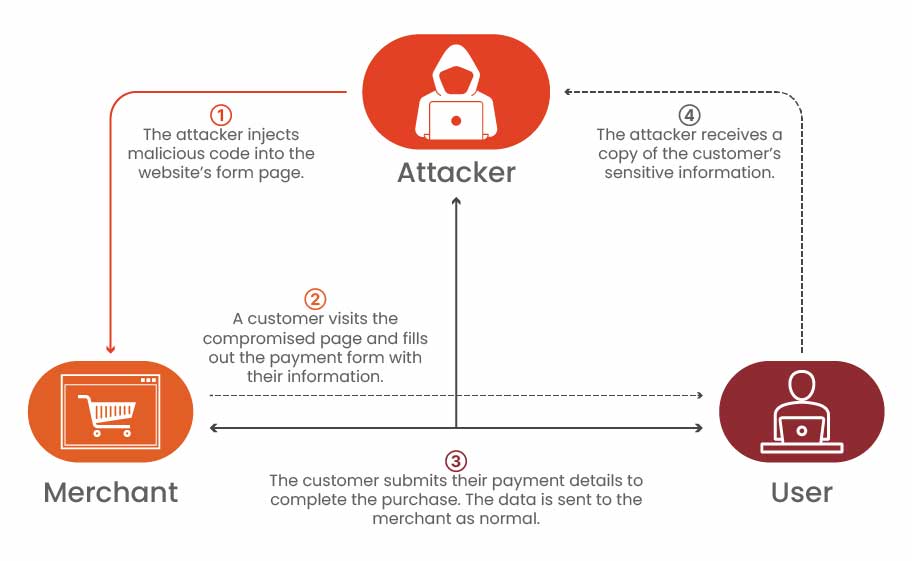
A Formjacking attack unfolds in a seamless and deceptive manner, allowing attackers to steal sensitive information while normal website operations continue uninterrupted.
It begins with the attacker injecting malicious code into the website’s form page, typically a payment or login form, by exploiting vulnerabilities or compromising third-party scripts. Once the page is infected, a customer visits the website and fills in their details as usual, completely unaware of any compromise.
When the user submits the form, the system sends the data to the merchant’s server to complete the transaction. However, at the same time, the malicious script captures the entered information and secretly sends a copy to the attacker. This happens silently in the background, without disrupting the user experience or triggering immediate alerts.
This parallel flow, where legitimate transactions occur alongside hidden data theft, is what makes Formjacking particularly dangerous and difficult for enterprises to detect.
Why is Formjacking Attack Difficult to Detect?
Detecting Formjacking is particularly challenging due to the way these attacks are designed to operate and evade traditional security measures. It runs entirely on the client side, within the user’s browser, making it invisible to conventional server-side controls such as WAFs, intrusion detection systems, and server logs. At the same time, it closely mimics legitimate behavior, transactions appear normal, orders are processed successfully, and no visible errors occur, while sensitive data is silently exfiltrated in the background.
The challenge is further amplified by the heavy reliance on third-party scripts, where each integration adds another layer to the chain of trust, making it difficult to monitor all executing code, especially as scripts frequently change or load dynamically. Additionally, most organizations lack specialized tools to monitor client-side activity, as security assessments typically focus on server-side vulnerabilities, leaving this layer largely unprotected. Advanced formjacking attacks trigger selectively, helping them evade detection and remain hidden for long periods.

Book Your Free Cybersecurity Consultation Today!
Prevention Measures for Formjacking Attack
To effectively mitigate Formjacking risks, organizations must adopt a proactive, multi-layered security approach that secures both server-side and client-side environments.
1) Regularly update and patch software, plugins, and extensions:
Attackers often inject formjacking code into existing website scripts by exploiting vulnerabilities in underlying software. Organizations using third-party platforms like Magento or content management systems such as WordPress need to ensure these systems, along with their plugins and extensions, are always up to date.
Regularly applying security patches helps eliminate vulnerabilities before attackers can exploit them to inject malicious code into forms. Automation makes patch management faster and more reliable than manual updates.
2) Perform regular vulnerability scans and penetration testing.
Perform regular security assessments, including vulnerability scanning and penetration testing, to identify and fix potential weaknesses in your website. Using solutions like AutoSecT, a vulnerability management (VM) platform, helps automate scans, detect risks such as XSS and script injections, and monitor third-party scripts in real time. While automated scans identify common vulnerabilities, penetration testing simulates real-world attacks to uncover deeper issues, especially in critical areas like payment and login forms, ensuring stronger protection against Formjacking.
3) Ensure the use of secure connections.
Using a secure HTTPS connection helps reduce the risk of Formjacking by encrypting data exchanged between users and your server. This makes it harder for attackers to intercept or manipulate information during transmission, protecting against man-in-the-middle attacks. By adding this layer of security, sensitive data such as payment details remains protected and maintains its integrity. HTTPS also verifies that users are interacting with the legitimate website, reducing the risk of spoofed or malicious sites.
4) Get PCI DSS Compliant
Authorize scripts, detect malicious behaviors, and deliver assessment-ready reports to achieve PCI DSS compliance with requirements 6.4.3 and 11.6.1. Gain real-time visibility into unauthorized script activity across your web environment. Continuously monitor and control client-side behaviors to prevent data exfiltration and formjacking attacks. Strengthen your security posture while accelerating your path to successful PCI DSS audits.
Join our weekly newsletter and stay updated
Conclusion
Formjacking is a silent yet critical threat that targets the most trusted layer of digital interaction, web forms, making it difficult to detect and highly impactful for enterprises. As applications grow more complex and rely heavily on third-party scripts, the risk continues to increase. To stay protected, organizations must go beyond traditional security measures and adopt a proactive approach that includes client-side security, continuous monitoring, regular patching, and VAPT supported by solutions like AutoSecT. Strengthening these areas is essential not only to prevent data theft but also to maintain customer trust and ensure long-term resilience against evolving cyber threats.
FAQs
- What types of data are targeted in Formjacking attacks?
Attackers typically target sensitive information such as credit card details, login credentials, personal identification data, and other form-based inputs.
- What role does client-side security play in preventing Formjacking?
Client-side security provides visibility into browser-level activities, helping detect unauthorized scripts and prevent data exfiltration before it reaches attackers.
- What are the early signs of a potential Formjacking attack?
Signs may include unusual script behavior, unauthorized changes in web pages, unexpected outbound traffic, or alerts from client-side monitoring tools