
DPDP Act compliance means meeting every duty the Digital Personal Data Protection Act, 2023 and the DPDP Rules, 2025 place on a Data Fiduciary. Those duties cover consent, notices, security, breach reporting, rights, retention, and vendor contracts. Most duties apply from 13 May 2027. This checklist shows what to build and what evidence to keep.
Each item names the section or rule behind it and the record that proves you did the work. When the Data Protection Board of India asks for proof, a policy without evidence carries little weight.
What DPDP Act Compliance Means for Your Business
DPDP Act compliance applies to any business that decides why and how digital personal data is used. The Act calls that business a Data Fiduciary (section 2(i)). A firm that only handles data on another firm’s orders is a Data Processor (section 2(k)). Payroll vendors and cloud hosts are common examples. The person the data is about is the Data Principal.
Under section 3 of the official DPDP Act, the law covers data collected in digital form. It also covers paper records scanned later. The Act even reaches firms outside India that sell goods or services to people in India. It does not cover data used for personal or household purposes, or data the Data Principal has made public herself.
The Act sets no size limit, so a small clinic has the same core duties as a large bank. Section 17(3) lets the government ease some duties for classes such as startups. The Act also applies on top of sector rules from RBI, SEBI or IRDAI, not instead of them. Teams new to the law can start with this plain-language DPDP explainer.
DPDP Act Compliance Timeline: Where Things Stand in November 2026
The DPDP Act is coming into force in three phases. Each is counted from the date the DPDP Rules were published in the Gazette, 13 November 2025. The first two phases are now live. The third, which carries almost every business duty and the penalty process, starts on 13 May 2027.
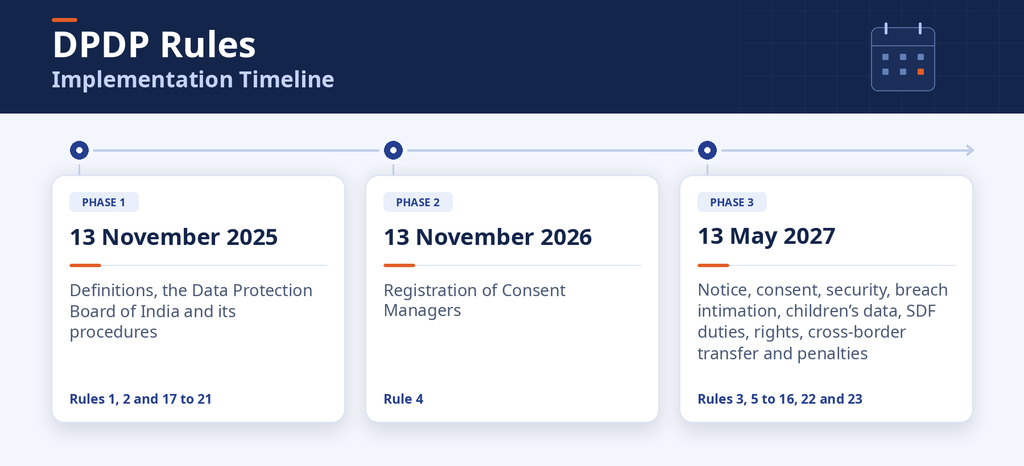
Phase 2 began on schedule, and it is the first DPDP Act compliance milestone businesses have seen in practice. According to the November 2026 PIB release, MeitY opened the DPDP portal for Consent Manager applications. It also confirmed 13 May 2027 as the start date for Data Fiduciary duties. MeitY consulted industry on a shorter window in January 2026, but no change has been notified.
Until May 2027, section 43A of the IT Act, 2000 and the 2011 SPDI Rules still apply. Section 44(2) of the DPDP Act removes section 43A when the third phase starts. For more detail on each stage, see the DPDP phased rollout explained.
The DPDP Act Compliance Checklist at a Glance
Use this table as a working tracker. Each row is one control, the provision behind it, and the evidence to keep.
| # | Checklist item | Provision | Evidence to keep |
| 1 | Confirm applicability and your role | Sections 2, 3 and 17 | Scoping memo with a role for each activity |
| 2 | Build a personal data inventory | Sections 4 and 8(4) | Data map and record of processing |
| 3 | Set a lawful basis for every purpose | Sections 4, 6 and 7 | Purpose register |
| 4 | Rewrite privacy notices | Section 5, Rule 3 | Itemised notices and language versions |
| 5 | Capture consent and honour withdrawal | Section 6 | Consent logs and tested withdrawal flows |
| 6 | Apply children’s consent rules | Section 9, Rules 10 to 12 | Age checks and parental verification records |
| 7 | Implement Rule 6 security safeguards | Section 8(5), Rule 6 | Encryption, access, logging and backup evidence |
| 8 | Prepare for breach intimation | Section 8(6), Rule 7 | Incident runbook and drill reports |
| 9 | Run rights and grievance handling | Sections 11 to 14, Rules 9 and 14 | Request log with response dates |
| 10 | Enforce retention and erasure | Section 8(7), Rule 8 | Retention schedule and deletion logs |
| 11 | Bind every Data Processor by contract | Sections 8(1) and 8(2) | Processor register and signed clauses |
| 12 | Assess SDF and cross-border exposure | Sections 10 and 16, Rules 13 and 15 | SDF assessment and DPIA plan |
The 12-Item DPDP Act Compliance Checklist in Detail
Work through the items in order, because most later controls depend on the data inventory built in item 2. Together, the 12 items cover every DPDP Act compliance duty that applies from May 2027.
1. Confirm Applicability and Your Role
For each data activity, record whether you are a Data Fiduciary, a Data Processor, or both. A SaaS firm, for instance, is often a Data Fiduciary for its own staff and customer data. Yet it is a Data Processor for data its clients upload. Each role carries different duties under the DPDP Act.
Write the answer into a short scoping memo. Name the group firms in scope, any Section 17 exemption, and the person who signed off. If the Board opens an inquiry, the memo shows that scoping was a choice, not a slip. Without it, every later DPDP Act compliance decision rests on a guess.
2. Build a Personal Data Inventory
You cannot protect, delete, or disclose data you have not found. For every system, a personal data inventory records what personal data it holds and whose it is. It also records why you collect it, where it sits, who can access it, and which vendors receive it.
Include the places teams forget: CRM exports in shared drives, support tickets, call recordings, HR spreadsheets, and test databases copied from production. Scanned paper forms count too, because section 3 covers data digitised after collection.
The inventory then feeds most of the checklist. Notices need their list of data, retention needs its storage locations, and vendor contracts need their list of recipients. In short, the inventory is the base of DPDP Act compliance.
3. Set a Lawful Basis for Every Purpose
Section 4 of the DPDP Act allows two grounds for using personal data. One is the Data Principal’s consent. The other is one of the “certain legitimate uses” in Section 7. These uses are narrow. They include data a person hands over for a stated purpose without objecting, disclosures a law requires, court orders, medical emergencies, and set employment purposes.
Unlike the EU GDPR, the Indian law has no broad “legitimate interests” ground. As a result, marketing, profiling, and most analytics will need consent. Build a purpose register that lists each purpose, its legal basis, and the data it uses. Where a purpose relies on section 7, record the exact clause and why it fits. A vague basis will not hold up under questioning.
Join our weekly newsletter and stay updated
4. Rewrite Privacy Notices to the Rule 3 Standard
Under section 5 and Rule 3, every consent request must come with a notice, or follow one. The notice must stand on its own and use plain words. At a minimum, it must contain:
- an itemised list of the personal data you will use;
- the purpose, with a short note on the goods, services or uses it enables; and
- a way to withdraw consent, use rights and complain to the Board.
Section 6(3) adds a language rule. The request must be readable in English or any language in the Eighth Schedule to the Constitution. A long privacy policy in a footer does not meet this bar, so each sign-up form or app prompt needs its own short notice.
Existing customers need a notice too. Section 5(2) says people who consented before the Act came into force must get one as soon as reasonably practicable. For most customers, the notice is the first part of your DPDP Act compliance they will see.
5. Capture Consent and Honour Withdrawal
Under section 6(1), valid consent must be free, specific, informed, unconditional and unambiguous. It needs a clear action and must cover only the data the purpose needs. Pre-ticked boxes fail this test. So does one consent that covers several unrelated purposes. The Act gives its own example: a telemedicine app cannot bundle access to a user’s phone contacts into consent for a doctor’s visit.
Withdrawal must be as easy as giving consent (section 6(4)). After withdrawal, section 6(6) says you and your processors must stop using the data within a reasonable time.
Section 6(10) puts the burden of proof on you: the Data Fiduciary must prove it gave notice and got consent. So keep records of who consented, to which notice version, for what purpose, and when. These records are the core DPDP Act compliance proof for any consent-based purpose.
If you plan to take consent through a registered Consent Manager, watch the Board’s public list. Registration only opened on 13 November 2026, so few options may be live before the deadline.
6. Apply the Children’s Data and Guardian Consent Rules
Under section 2(f) of the DPDP Act, a child is anyone under 18. Before a Data Fiduciary uses a child’s personal data, section 9(1) requires verifiable consent from a parent. Rule 10 asks you to check that the parent is a known adult. You can use identity details you hold, details the person gives, or a virtual token from an authorised source such as a Digital Locker service.
Section 9(3) bans tracking, behaviour monitoring and targeted ads aimed at children. Rule 11 applies the same consent duty to a person with a disability who has a lawful guardian. The Fourth Schedule exempts a few classes, such as clinics and schools, but only for narrow purposes like health care or child safety. If your product could attract users under 18, treat this item as a core part of DPDP Act compliance.
7. Implement the Rule 6 Security Safeguards
Section 8(5) of the DPDP Act requires every Data Fiduciary to take reasonable security safeguards to prevent a personal data breach. Failing this duty carries the highest penalty in the Act. Rule 6 sets the minimum. Your safeguards must include:
- encryption, masking, obfuscation or virtual tokens for personal data;
- access control over the systems you and your processors use;
- logs, monitoring and reviews to spot, investigate and fix unauthorised access;
- steps to keep working after an attack, such as tested backups;
- keeping those logs and personal data for one year, unless another law says otherwise;
- security clauses in contracts with Data Processors; and
- technical and organisational measures, including staff training, that make these safeguards work.
The Board will judge “reasonable” after an incident, based on what you can show. A written access policy does not prove that access is controlled; a quarterly access review with named approvers does.
Masking is a frequent weak point, because live data copied into test systems often keeps real names and phone numbers. Backups need the same care: Rule 6 expects you to keep working after an attack, so test a restore. An ISO 27001 certificate helps, but there are clear gaps ISO 27001 misses, such as consent, notices, and Data Principal rights.
8. Prepare for Breach Intimation: Two Clocks, Not One
The DPDP Act defines a personal data breach broadly in section 2(u). It covers any unauthorised use of personal data, and any accidental leak, change, loss, or destruction that harms its confidentiality, integrity, or availability. A lost laptop or a misdirected email can count.
Rule 7 sets out two duties. First, tell each affected Data Principal without delay, in plain words, what happened, the likely impact, what you are doing, and whom to contact. Second, inform the Board without delay, then file a detailed report within 72 hours of becoming aware of the breach. The Board can allow more time on a written request. That report covers the facts, causes, fixes, and the notices sent to people.
A second clock runs at the same time. CERT-In’s Directions of 28 April 2022 require covered entities to report specified cyber incidents within 6 hours. So one ransomware attack can require a CERT-In incident report within hours, a Board report within three days, and a sector regulator’s report as well. Breach readiness is where DPDP Act compliance is tested under pressure.
Build one runbook for all three reports. Name who confirms that personal data is affected, who drafts each notice, and who signs off. Because the 72-hour report asks for the causes of the breach, a root cause review is part of compliance, not an optional extra. Test the runbook in a tabletop drill before May 2027.
9. Run Data Principal Rights and Grievance Redressal
Data Principals hold four rights under sections 11 to 14 of the DPDP Act. They can access a summary of their data and who received it. They can ask for correction and erasure, use a grievance process, and nominate someone to act for them after death or incapacity. Under section 13(3), a Data Principal must use your grievance process before she can approach the Board.
Rule 14 requires you to publish how to make a request and which identifier you need, such as a customer number. You must respond to grievances within 90 days at most. Section 8(9) and Rule 9 also require you to publish a contact for data questions. For an SDF, that contact is the Data Protection Officer.
Log every request with its date, identity check, decision, and response date. A clean log shows that your DPDP Act compliance works in practice, not only on paper.
10. Enforce Retention and Erasure Limits
Section 8(7) of the DPDP Act requires a Data Fiduciary to erase personal data when consent is withdrawn, or the purpose is served, whichever comes first. The exception is data another law requires you to keep. Your processors must erase it too.
Rule 8 and the Third Schedule set fixed periods for large platforms. The rule covers e-commerce and social media platforms with at least 2 crore registered users in India, and gaming platforms with at least 50 lakh. They must erase data three years after the user last engaged. They must warn the user at least 48 hours before erasure.
Rule 8(3) pulls the other way. You must keep personal data, traffic data, and processing logs for at least one year, even if the user deletes the account. Your retention schedule therefore needs a minimum and a maximum for each data type, and each legal hold named.
11. Bind Every Data Processor by Contract
Section 8(1) of the DPDP Act makes the Data Fiduciary liable for work done on its behalf, whatever the contract says. Section 8(2) lets you use a Data Processor only under a valid contract, and Rule 6(1)(f) says that contract must cover security safeguards.
Every vendor that touches personal data needs clauses on security, breach notice, deletion, sub-processor approval, and audit rights. Set the vendor’s breach notice period short enough to fit your own 72-hour report. A vendor with 7 days to report an incident leaves you no way to meet the deadline.
The risk is real. IBM’s 2026 Cost of a Data Breach Report found that supply chain compromise caused 15% of breaches in India. Only two attack routes were more common. Because third-party data breaches are hard to contain, keep a vendor register ranked by the data each vendor holds. Without signed clauses, your DPDP Act compliance stops at your own network.
12. Assess Significant Data Fiduciary Exposure and Cross-Border Transfers
Under section 10, the government can name any Data Fiduciary, or a group of them, as a Significant Data Fiduciary (SDF). It looks at the volume and sensitivity of the data, the risk to Data Principals, and risks to sovereignty, elections, state security, and public order.
An SDF must appoint a Data Protection Officer based in India and hire an independent data auditor. Under Rule 13, it must also run a Data Protection Impact Assessment (DPIA) and an audit every year. Rule 13 also requires checks on algorithmic software and lets the government keep some data inside India.
For other firms, section 16 allows data to leave India, except to countries the government blocks by notice. Rule 15 adds conditions on sharing data with foreign states. If you hold large volumes of health or financial data, plan as if SDF duties could apply. A notification can widen the scope of DPDP Act compliance quickly and leave little time to hire a DPO and an auditor.

Book Your Free Cybersecurity Consultation Today!
Data Fiduciary Obligations Compared With Data Processor Duties
Data fiduciary obligations under the DPDP Act sit with the Data Fiduciary, not the vendor. The Act writes almost no direct duties for a Data Processor. Instead, the processor’s duties arise through the contract, and the fiduciary stays answerable to the Board for both.
| Duty | Data Fiduciary | Data Processor |
| Comply for all processing, including by processors (section 8(1)) | Fully liable | Bound through the contract |
| Security safeguards (section 8(5), Rule 6) | Required | Required by contract |
| Breach intimation (section 8(6), Rule 7) | Notifies the Board and people | Alerts the fiduciary |
| Erasure (section 8(7)) | Erases and makes processors erase | Erases on instruction |
| Contact person and grievances (sections 8(9) and 8(10)) | Required | Not required |
For DPDP Act compliance, the result cuts both ways. A Data Fiduciary cannot hand its duties to a vendor. A SaaS or IT services firm acting as a processor will have these duties passed down by its clients.
DPDP Penalties: The Schedule and How the Board Decides
DPDP penalties are set out in the Schedule to the Act, which lists a maximum for each type of breach.
| Breach | Provision | Maximum penalty |
| Failure to take reasonable security safeguards | Section 8(5) | ₹250 crore |
| Failure to notify the Board or Data Principals of a breach | Section 8(6) | ₹200 crore |
| Breach of children’s data obligations | Section 9 | ₹200 crore |
| Breach of Significant Data Fiduciary obligations | Section 10 | ₹150 crore |
| Breach of a voluntary undertaking | Section 32 | Up to the amount for the original breach |
| Breach of any other provision | Any | ₹50 crore |
| Breach of a Data Principal’s own duties | Section 15 | ₹10,000 |
Under Section 33, the Board can impose a penalty only after an inquiry finds a significant breach and the person gets a hearing. The Board weighs how serious the breach was, how long it lasted, and what data it hit. It also weighs repeat breaches, any gain made, steps taken to limit harm, and whether the penalty is proportionate. Penalties go to the Consolidated Fund of India, and appeals go to the Telecom Disputes Settlement and Appellate Tribunal (TDSAT).
The Board itself is still being set up. MediaNama reported in November 2026 that the Centre had told the Kerala High Court the Board was constituted but not yet functional. Even so, the penalty process starts on 13 May 2027, and the cost goes beyond fines. IBM’s 2026 report puts the average breach cost in India at ₹25.5 crore, with regulatory non-compliance among the top three factors that raise it.
A Six-Month DPDP Act Compliance Plan to 13 May 2027
About six months remain before the main DPDP obligations apply. The plan below spreads the 12 checklist items across that window.
| Month | Focus | Checklist items | Output by month end |
| December 2026 | Scope and discovery | 1, 2 | Scoping memo and data inventory |
| January 2027 | Lawful basis and consent | 3, 4, 5, 6 | Purpose register, new notices, consent records |
| February 2027 | Security safeguards | 7 | Rule 6 gap list with owners and dates |
| March 2027 | Breach response and vendors | 8, 11 | Joint runbook, tabletop drill, processor register |
| April 2027 | Rights and retention | 9, 10 | Request channel, retention schedule, deletion jobs |
| May 2027 (before the 13th) | Evidence review | 12 and all | SDF assessment and an evidence file per item |
An outside gap assessment in December shortens the rest of the plan. Kratikal’s DPDP compliance team reviews your processing against the Act and the Rules. Each gap becomes a task with an owner and a date. The DPDP Act sets up no certification scheme, so the aim is readiness you can show the Board, not a certificate.
Make DPDP Act Compliance Provable Before May 2027
DPDP Act compliance is judged on evidence. When the Board asks how you got consent, protected data, or reported a breach, the answer has to be a record you can produce. Work through the 12 items in order, keep the evidence named in the tracker, and test each control once before the deadline.
For an independent view of where you stand, a DPDP readiness assessment from Kratikal maps your processing against the Act and the Rules. You get a clear list of gaps, owners, and dates, so your team spends the remaining months fixing problems instead of finding them.
FAQs
A DPDP compliance assessment is a gap review. It compares how your business really uses personal data with the duties in the DPDP Act and Rules. It covers scope, consent, notices, security, breach response, rights, retention, and vendors. The result is a list of gaps, each with an owner, a priority, and a deadline.
To get DPDP compliant, map the personal data you hold and set a lawful basis for each purpose. Then rewrite notices and consent flows, put the Rule 6 safeguards in place, and build a breach runbook. Add a rights process, a retention schedule and updated vendor contracts. Keep evidence for each step, because the Board will ask for proof, not policies.
The DPDP Act covers only digital personal data, while the EU GDPR also covers paper filing systems. DPDP has no broad legitimate interests ground and no special category of sensitive data. GDPR fines can reach €20 million or 4% of global annual turnover, whereas DPDP uses fixed limits of up to ₹250 crore.
The maximum penalty under the Digital Personal Data Protection Act is ₹250 crore for failing to take reasonable security safeguards under section 8(5). Failing to report a breach, or breaking the rules on children’s data, can each cost up to ₹200 crore. The Data Protection Board sets the final amount after an inquiry.
Yes. The DPDP Act applies to any business that handles digital personal data, because it sets no size limit. Section 17(3) lets the government exempt notified startups from some duties, such as notice, erasure, and the right to access information. Until such a notification is issued, plan to meet the full checklist.