Cyber threats are changing faster than the evolution of security testing. New frameworks and services are released constantly, and each introduces new potential attack vectors. Security tests and assessments are typically done at certain intervals, leaving windows of opportunity for malicious attackers to compromise a system. This is where agentic AI pentesting comes in. Security tests can’t cover all possible attack vectors and instead rely on agents to explore and test attack surfaces. Likewise, agents use AI to reason about attacks and formulate plans. However, these plans are general and flexible to adapt to new information. Security teams can use agentic AI systems for faster assessments, coverage of a wider attack surface, and more frequent security validations. Agentic AI is also able to extract and integrate information from other systems to create a more holistic approach to security assessment and testing. But what is agentic AI pentesting? And how is it different from traditional penetration testing? What are some of the challenges and barriers to the greater adoption of agentic AI in security? How is agentic AI transforming the cybersecurity field?
What Is Agentic AI Pentesting?
For example, an AI agent testing a web application may discover an exposed API endpoint. Rather than reporting this and moving on to the next issue, the agent may analyze the authentication requirements of the endpoint, analyze other related endpoints, perform access control tests, and make an assessment of the risk level of the issue. This type of testing brings added flexibility to traditional penetration testing. Agents can work across several phases of testing and analyze issues in a contextual manner.
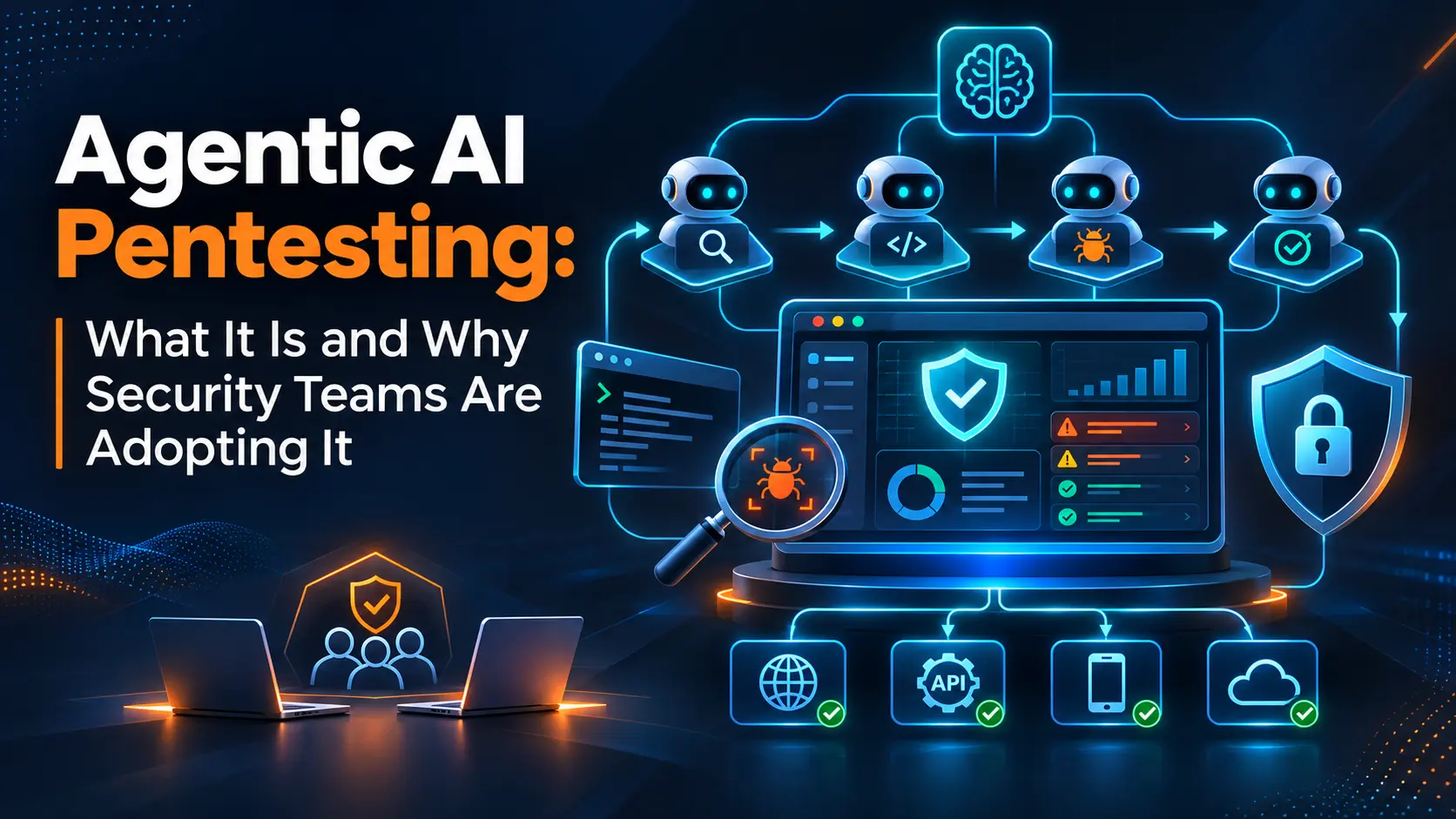
An example of an agent-based testing environment is shown below:
- Reconnaissance Agents: Discover assets, services, endpoints and possible entry points.
- Vulnerability Discovery Agents: Assess weaknesses in applications, APIs, networks and infrastructure.
- Exploitation Agents: Test and evaluate the level of vulnerability.
- Analysis Agents: Connect findings and analyze attack paths.
- Reporting Agents: Summarize findings and suggest remediation.
These agents can work independently or interact with one another. Human security professionals define the scope of testing, validate critical findings and make important decisions.

Book Your Free Cybersecurity Consultation Today!
How Does Agentic AI Pentesting Work?
Agentic AI Pentesting works by deploying a set of agents that work within the constraints defined by security personnel and use a set of tools to perform testing in a structured manner.
Define the Testing Scope and Objectives
Security teams define the applications, APIs, cloud resources, and networks to be tested. They also establish permissions, restrictions, and testing objectives. Agents use these instructions to create a controlled testing plan.
Perform Automated Reconnaissance
Agents look for information about the target environment and analyze that information to determine what targets to attack. They find information about hosts, ports, API endpoints, technologies, and services. Agents update their plans to incorporate newly discovered assets.
Identify Potential Vulnerabilities
Agents analyze the assets they discover for weaknesses, such as SQL injection and XSS, as well as broken access controls and authentication. They consider the information from the different tools at their disposal to identify higher-order vulnerabilities.
Validate Vulnerabilities and Explore Attack Paths
Agents test to see if they can exploit the vulnerabilities they discover. They look to see if there are multiple, seemingly unrelated, vulnerabilities that, when combined, create a larger vulnerability. They must make sure to stay within the authorized scope of testing.
Generate Reports and Recommend Remediation
Agents write reports about the vulnerabilities they find, including what the asset is, what the vulnerability is, how the vulnerability was discovered, how severe the vulnerability is, how the vulnerability was exploited, and how to fix it. They then organize the reports and present them to the customer.
Why Are Security Teams Adopting Agentic AI Pentesting?
Increased Cloud adoption, API integration, and fast software release cycles are expanding attack surfaces. Traditional testing may not keep up. According to a study, 87% of surveyed organizations were either piloting, undergoing tests, or using agentic AI for pentesting. Additionally, 64% of the respondents were in favor of an agent-led approach with human oversight.
There are five primary reasons for the accelerated adoption of agentic AI for pentesting:
Faster Vulnerability Discovery
AI agents can perform repetitive tasks such as reconnaissance, evaluate endpoints for vulnerabilities, and assist in the development of testing frameworks. This frees up security professionals to concentrate on higher-order problems such as designing and implementing remediation strategies.
Larger Attack Surface Coverage
Modern organizations manage a number of different types of assets such as websites, mobile and other types of applications, and infrastructure. A system powered by agentic AI can test for vulnerabilities in these environments and recommend improvements.
Continuous Security Validation
Agentic AI pentesting enables continuous assessment of the security of applications and infrastructure. This is especially important as the application and infrastructure are continuously updated and changed.
Less Manual Work
AI systems can perform reconnaissance, gather evidence, and create reports. This frees up the security professionals to design and perform complex tests and analyze vulnerabilities.
Advanced Understanding of Attack Paths
Individual vulnerabilities, when examined in isolation, may not pose a great risk to the organization. However, a combination of individual vulnerabilities may pose a significant risk. A system powered by agentic AI can evaluate and recommend remediation actions for such vulnerabilities.
Key Features of an Agentic AI Pentesting Platform
Not all AI pentesting platforms provide agentic capabilities. A scanner that generates reports using AI doesn’t qualify as an autonomous testing system.
There are several key functionalities expected of a competent AI-powered pentesting platform:
Autonomous Testing and Planning
A high-level understanding of the goals of a test should help the system break them down into smaller tasks and pursue a course of action to test them. It should be capable of changing its approach based on new information.
Integration With Security Tools
AI agents can’t do much without integrations with the right security tools. These may include network scanners, web application scanners, API testing tools, and Vulnerability Assessment and Management (VAM) tools. Using these integrations, agents can gather technical data and perform surrogate testing.
Vulnerability Validation
A good platform can differentiate suspected vulnerabilities from confirmed security issues. It should gather evidence and describe under what conditions a vulnerability can be reproduced. This helps reduce false positives, and security teams can focus on real security issues.
Attack Path Analysis
The platform should identify potential attack paths and/or build relationships among vulnerabilities.
This can help determine how an attacker may be able to move from an initially less secure system to a more protected or sensitive system.
Human Oversight and Reporting
Security teams should have the capability to control testing (like approving sensitive actions), direct the testing (like overruling an agent’s decision), or review the agent’s decisions. It should also generate human-readable reports and actionable insights for the security teams.
These features distinguish a true AI-powered pentesting platform from an automated vulnerability scanning tool.
How Kratikal’s AutoSecT Supports Agentic AI Pentesting
AutoSecT doesn’t use one AI model to do everything. It runs a pipeline of AI agents, each with a specific job, so a vulnerability only reaches your team after it has been mapped, exploited, vetted and explained.
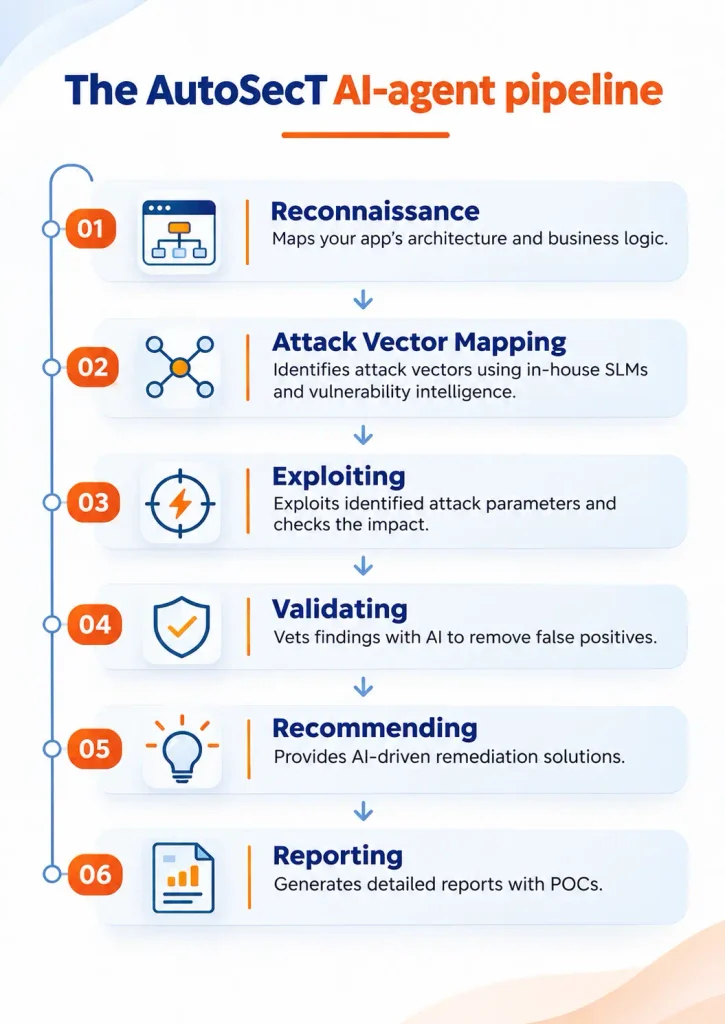
The AutoSecT AI-agent pipeline
- Agent 01: Reconnaissance. Maps your app’s entire architecture to understand its business logic, so testing reflects how your application really works.
- Agent 02: Attack vector mapping. Identifies attack vectors using Kratikal’s in-house SLMs combined with known vulnerability intelligence.
- Agent 03: Exploiting. Exploits the attack parameters it has identified and checks the impact, so you know what an attacker could actually do.
- Agent 04: Validating. Performs AI-based false-positive vetting with the help of in-house SLMs, so only genuine findings move forward.
- Agent 05: Recommending. Provides AI-driven remediation solutions against each AI-verified vulnerability finding.
- Agent 06: Reporting. Generates detailed reports with POCs, in multiple formats based on your requirements.
Because exploitation and validation happen before anything lands on your dashboard, your analysts spend their time fixing confirmed risks instead of chasing false alarms. Every verified finding comes with a fix recommendation, and the final report includes proof of concept, which helps developers reproduce the issue and gives auditors the evidence they ask for.
Alongside the agents, AutoSecT adds real-time exploit validation in its AI-driven agentic network vulnerability scanner, automated scanning, risk prioritization and centralized vulnerability management. The result is a short, ranked list of actionable risks and a stronger security posture, without the manual effort of traditional pentesting.
Join our weekly newsletter and stay updated
FAQs
- What is agentic AI pentesting?
Agentic AI pentesting employs independent AI agents to perform and direct pentesting activities. These agents can perform recon, identify vulnerabilities, validate attack paths, and create reports with minimal human intervention.
- How is agentic AI pentesting different from automated vulnerability scanning?
Automated vulnerability scanning frameworks are restricted to defined rules to discover known weaknesses. In contrast, agentic systems can analyze and deduce reasoning for testing objectives, assess and evaluate tools and findings, and modify their approach based on new information.
- Will agentic AI affect human penetration testers?
No, while agentic AI can automate testing activities and processes, other aspects of testing that involve business logic, vulnerability analysis and risk assessment will still require human pentesting.
- What vulnerabilities can AI agents identify?
Agents may identify SQL injection, cross-site scripting, broken access controls, weak authentication, API vulnerabilities and other security misconfigurations. Of course, the scope is bound by the tools, permissions and test cases.
- Is an AI pentesting platform safe for production environments?
Yes, it can be used for production environments, especially with additional protections. Scope restrictions, least-privilege access, rate limits, monitoring and other protections need to be enabled during production testing.
- What should organizations look for in an AI pentesting platform?
Organizations should check for autonomous testing, the validation of vulnerabilities, attack path analysis, integrations with security tools, and comprehensive reporting.
- Does agentic AI pentesting enable continuous security testing?
Yes, repeatable processes can be automated to test applications and infrastructure. Although the testing itself would be continuous, monitoring and governance would be essential to ensure validation of the testing processes.