It is common for businesses to migrate their data storage, applications, and services to the cloud. Migrating to the cloud, however, will not keep your services secure. There are multiple ways data can be exposed, including development misconfiguration and/or use of unprotected credentials.
Many security lapses in a cloud environment are due to lack of good security practices. Cloud breaches are caused by multiple, often the same, vulnerabilities, including weak access controls. Exposing a vulnerability is something that happens frequently and is a major cause of a breach.
Understanding actual incidents that have happened to other organizations helps in identifying threats that could also happen to your organization and prepares you to respond to them. It illustrates the value of assessing your organization’s cloud security.
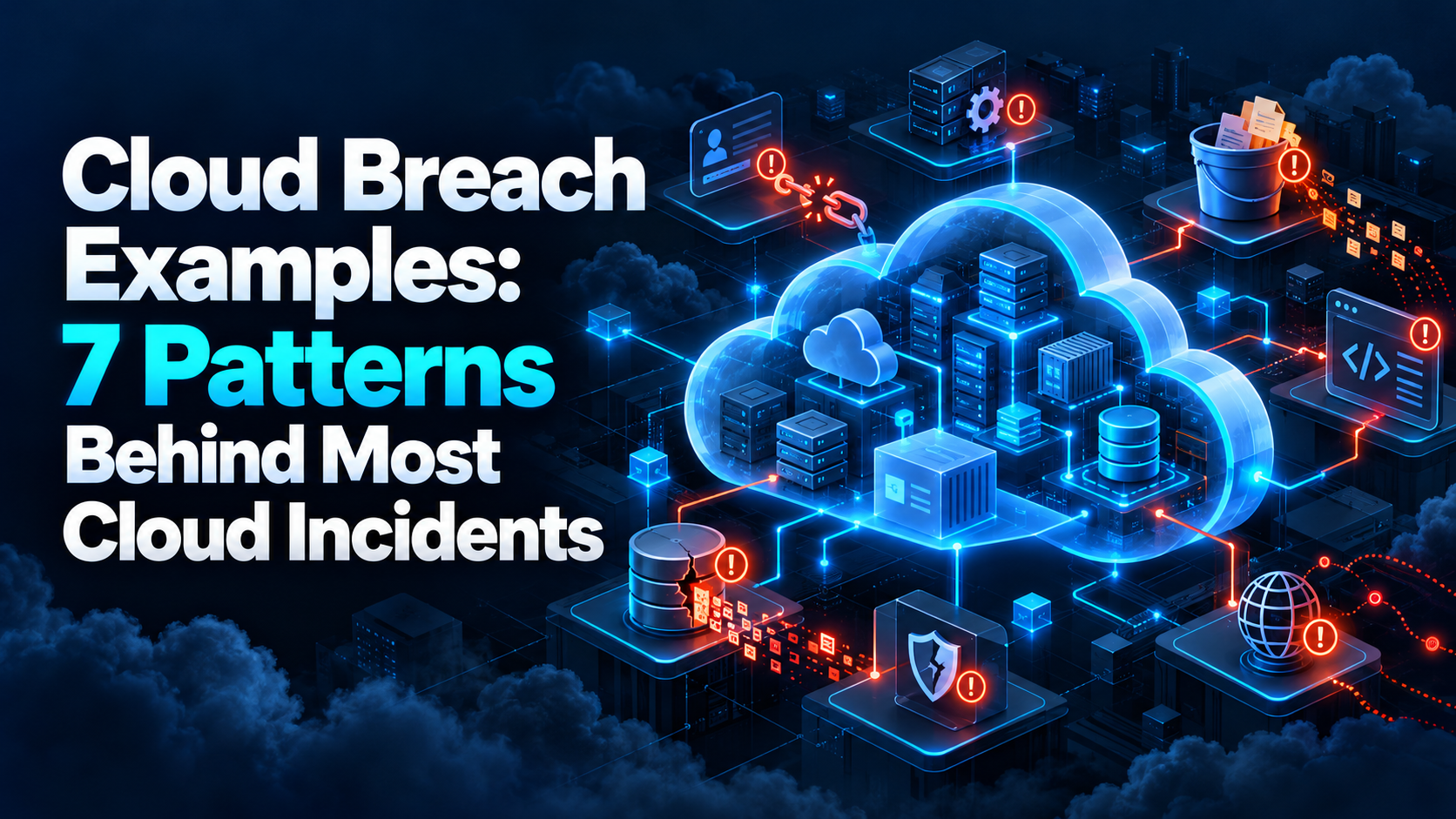
Cloud Breaches Examples: 7 Patterns Behind Most Cloud Incidents
Here is the top 7 list that your cloud environment needs saving from:
Misconfigured Cloud Storage Exposes Sensitive Data
Many companies deploy cloud environments and store their data using cloud storage services. If cloud storage settings are not properly configured, however, files containing sensitive data may be made available to all users.
Common causes for cloud misconfigurations include:
- Public access enabled on storage buckets without a valid business need.
- Weak access policies that allow excessive permissions.
- Missing encryption for sensitive information.
- Inadequate reviews of storage configurations.
Stolen Credentials Give Cyberattackers Access to Cloud Breaches
There are many types of credentials used to gain access to cloud resources (i.e., user accounts, service accounts, API keys, access tokens, etc.). User accounts, service accounts, keys and tokens access cloud resources. If these are compromised, cyber attackers need not exploit weaknesses in cloud applications to gain access to resources.
Things that may indicate compromises include the following:
- Public access to API keys.
- Shared administrator accounts.
- Unrestricted access keys.
- MFA not enabled.
- Access from unusual or remote locations.

Book Your Free Cybersecurity Consultation Today!
Excessive Permissions Allow Deeper Cloud Breaches
There are differing levels of impact for compromised accounts, and one of those factors is how broad that account’s access is. Users, applications, and services that have elevated permissions are ripe for attack, as cyber attackers will take advantage of high permissions to access protected resources.
Reviews of access control are prudent to ensure permissions are aligned with changing business requirements.
Insecure APIs Expose Cloud Applications
APIs connect and integrate users, services, and systems. They can be used to perform unauthorized actions and provide access to information that should be protected.
What Causes APIs to be Insecure?
Weak input validation, excessive exposure of data, and issues are some of the reasons why APIs may be insecure. An API may allow a customer service representative to retrieve records of another customer by changing the account identifier in the API request.
How Can Cloud Security Teams Prevent Cloud Breaches Linked to API?
- Require strong authentication for sensitive endpoints.
- Verify authorization for every relevant request.
- Validate inputs and reject unexpected values.
- Apply rate limits to reduce abuse.
- Log suspicious API activity.
- Log and audit requests for suspicious activities.
Vulnerable Cloud Workloads Create Entry Points
Vulnerabilities may be present in cloud-based virtual machines or containers. A workload may be using an out-of-date OS and/or application software. A container may be run with unneeded and unrestricted privileges. An administration interface may be exposed.
Common Cloud Workload Weaknesses
- Outdated operating systems and software packages.
- Containers running with unnecessary privileges.
- Exposed management interfaces.
- Unsecured databases and development servers.
- Insecure default configurations.
Poor Monitoring Delays Breach Detection
It is important to implement controls to reduce the attack surface area, but there will always be ways to evade those controls. Continuous monitoring of the environment should reduce the time it takes to discover cloud breaches.
Why Do Cloud Incidents Go Undetected?
Cloud environments generate large volumes of logs. If logging is incomplete or alerts are poorly configured, important events can disappear among routine activities.
Common gaps leading to cloud breaches include:
- Disabled or incomplete audit logging.
- Missing alerts for suspicious account activity.
- Limited visibility across multiple cloud accounts.
- Logs that are not retained long enough for investigations.
- No clear incident response process.
Weak Cloud Security Testing Leaves Gaps Unnoticed
It is important to test cloud environments to determine security configuration and identify misconfigurations, but other threats may still exist. Automated tools may be unable to find business logic errors.
Why Are Routine Security Checks Not Always Enough to Stop Cloud Breaches?
Although services in a cloud environment are distributed, they can be modularized. Each modular service can be developed and tested independently for security. However, cyber attackers can exploit latent combined weaknesses to gain access to safer areas.
A cyber attacker may use an exposed service account to gain access to a protected area. For example, if a user account has been granted unconstrained access to that area, and the storage resource that contains protected information is also secured improperly. Each of the components in this example can be checked to determine if they contain a security risk and be ruled as secure, when in fact they can form a combination of weaknesses.
How To Stop Cloud Breaches?
There are multiple ways to stop cloud breaches. The most effective of them are cloud PTaaS and incorporating an AI-driven Pentesting and VM Platform, AutoSecT. Let’s understand each of these cloud breach prevention solutions in detail:
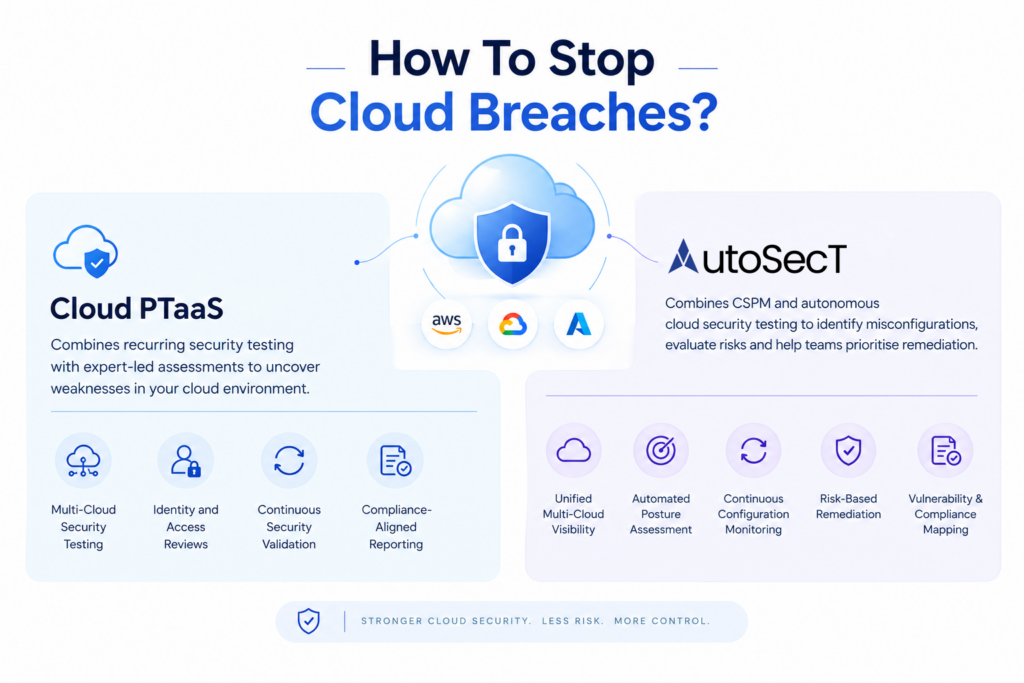
Cloud PTaaS
Cloud PTaaS combines recurring security testing with expert-led assessments to uncover weaknesses in cloud infrastructure, access controls, and configurations across AWS, GCP, and Azure.
- Multi-Cloud Security Testing: Assess cloud environments across AWS, GCP, and Azure through a unified testing approach.
- Identity and Access Reviews: Identify excessive permissions, risky IAM roles, and misconfigured cross-account trust relationships.
- Continuous Security Validation: Detect configuration changes and security gaps that emerge between scheduled assessments.
- Compliance-Aligned Reporting: Map identified weaknesses to relevant security and compliance requirements to support remediation and audit readiness.
CSPM and Autonomous Cloud Pentesting by AutoSecT
AutoSecT helps organisations strengthen cloud security through Cloud Security Posture Management (CSPM) and autonomous cloud security testing. It identifies cloud misconfigurations, evaluates security risks, and helps teams prioritise remediation across AWS, GCP, and Azure.
- Unified Multi-Cloud Visibility: Monitor security configurations across AWS, GCP, and Azure from a single platform.
- Automated Posture Assessment: Identify misconfigurations and deviations from security best practices and compliance benchmarks.
- Continuous Configuration Monitoring: Detect changes in cloud resources, storage permissions, and access policies that could introduce new risks.
- Risk-Based Remediation: Analyse findings to help security teams prioritise issues based on their severity and potential business impact.
- Vulnerability and Compliance Mapping: Connect cloud security findings with relevant compliance requirements to support risk management and audit preparation.
Join our weekly newsletter and stay updated
Conclusion
Cloud breaches often stem from preventable security gaps, including misconfigured storage, compromised credentials, excessive permissions, vulnerable workloads, and inadequate monitoring. Addressing these risks requires more than routine configuration checks. Organisations must continuously assess their cloud environments, validate potential attack paths, and prioritise vulnerabilities based on their actual impact. Cloud PTaaS, combined with CSPM and autonomous cloud pentesting through AutoSecT, can help identify security weaknesses across AWS, GCP, and Azure. A proactive, risk-based approach helps businesses strengthen cloud security, reduce exposure, and protect sensitive data.
FAQs
- What is a cloud breach?
A cloud breach is the unauthorized access and possible theft of data hosted on a cloud service. This usually occurs when organizations fail to implement adequate security controls, leaving insecure interfaces, unpatched vulnerabilities, overly permissive access controls, and insufficient monitoring unaddressed.
- What are the common reasons for cloud security breaches?
Possible causes are misconfigured cloud services, insufficient controls over access and use of cloud services, and absence of monitoring and logging. Weaknesses in controls and absence of oversight over services are major causes for breaches.
- How do AWS cloud breaches occur?
It may occur due to S3 buckets that are configured to be publicly readable, excessively permissive IAM policies, insufficient configurations of workloads and applications, and exposed keys.
- How do misconfigured cloud storage services lead to data breaches?
Incorrect storage permissions can expose sensitive files to unauthorised users. Public access settings, weak access policies, and inadequate configuration reviews increase the risk of data exposure.
- How can organisations prevent AWS, Azure, and GCP cloud breaches?
Organisations can reduce cloud breach risks through least-privilege access, MFA, secure storage configurations, regular vulnerability assessments, continuous monitoring, and timely remediation.
- What role does IAM play in cloud security breaches?
Identity and Access Management (IAM) controls who can access cloud resources. Excessive permissions, compromised credentials, and misconfigured roles can allow attackers to access sensitive data and critical systems.
- Why is continuous cloud security monitoring important?
Continuous monitoring helps detect configuration changes, suspicious account activity, and emerging vulnerabilities. It improves visibility across cloud environments and helps security teams respond to potential threats faster.
- How does Cloud Security Posture Management (CSPM) help prevent cloud breaches?
CSPM identifies cloud misconfigurations, insecure permissions, and deviations from security benchmarks across cloud environments. It helps organisations prioritise risks and maintain stronger security configurations.
- What is Cloud PTaaS, and how does it help prevent cloud security breaches?
Cloud Penetration Testing as a Service (PTaaS) combines recurring security testing with expert-led assessments to uncover exploitable weaknesses in cloud infrastructure, identity controls, and applications before attackers can exploit them.
- How does AutoSecT help organisations strengthen cloud security?
AutoSecT supports cloud security through CSPM and autonomous cloud security testing across AWS, GCP, and Azure. It helps identify misconfigurations, monitor security posture, assess risks, and prioritise remediation based on potential impact.