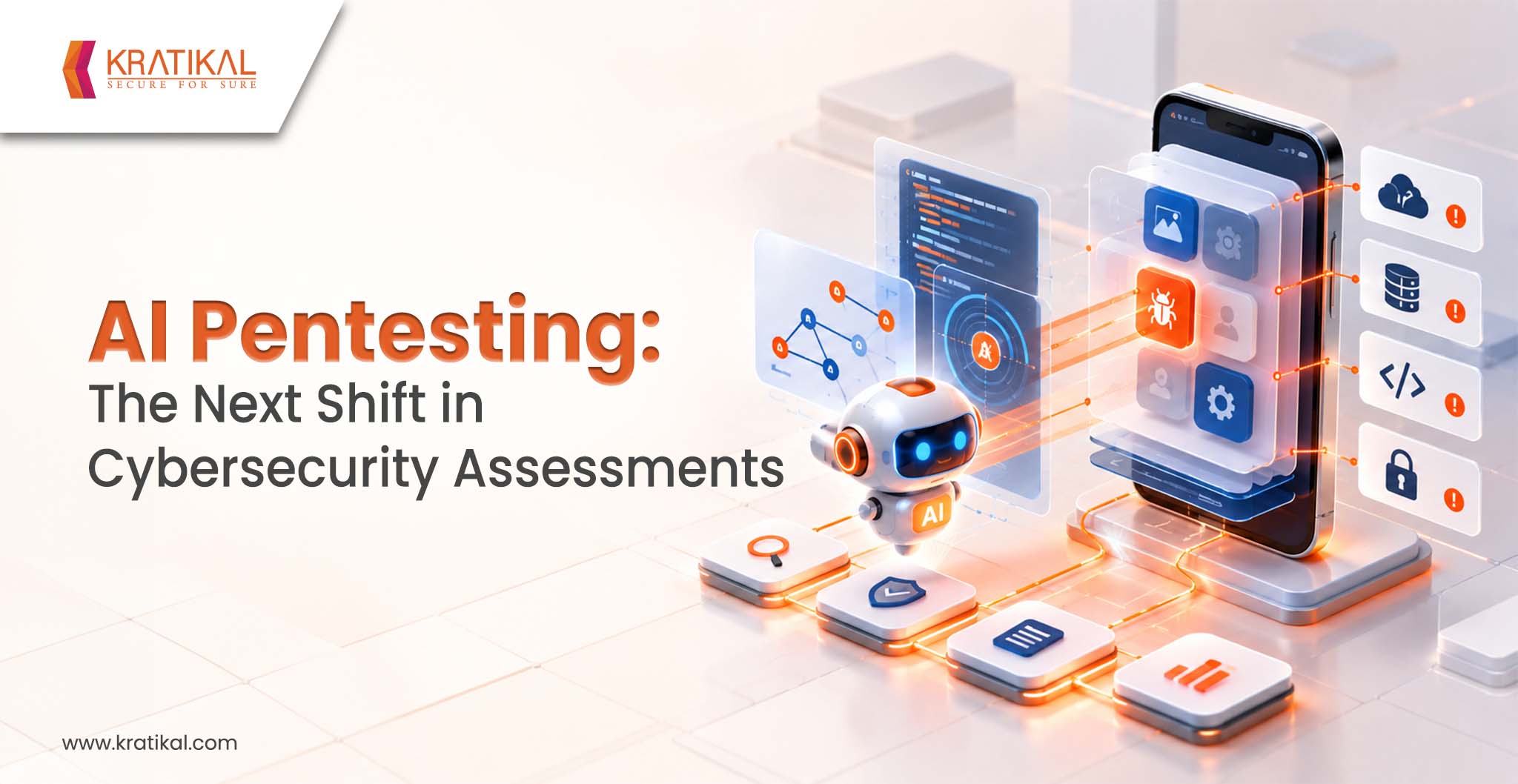
Artificial intelligence is changing how organizations build, deploy, and operate digital systems. From AI-powered applications and large language models (LLMs) to autonomous AI agents connected with APIs, databases, cloud platforms, and enterprise workflows, the attack surface is becoming more dynamic. This shift is also changing how security teams approach penetration testing. Traditional penetration testing remains essential for identifying vulnerabilities across applications, APIs, networks, cloud environments, and infrastructure. However, AI-enabled systems introduce attack scenarios that require more than conventional vulnerability discovery. AI penetration testing combines security testing techniques with AI-specific adversarial testing to evaluate how models, applications, integrations, and agents behave when exposed to malicious or unexpected inputs.
Overview on AI Penetration Testing
AI penetration testing is the use of artificial intelligence to plan, run, and analyse simulated attacks against an organisation’s applications, networks, cloud environments, and APIs. Traditional penetration testing depends almost entirely on human testers working through reconnaissance, scanning, exploitation, and reporting by hand. AI penetration testing keeps that same attack lifecycle but uses intelligent automation to speed up and scale each stage.
It is different from a basic vulnerability scanner. A scanner checks systems against a list of known signatures and produces a long report. AI-driven testing goes further: it learns from the environment, chains weaknesses together the way a real attacker would, prioritises what is actually exploitable, and adapts its approach based on what it finds. The result is an assessment that behaves less like a checklist and more like a persistent, thinking adversary.
How Is AI Penetration Testing Changing Cybersecurity Assessments?
AI penetration testing is transforming security assessments by combining automated testing, adaptive attack simulations, and expert validation to uncover risks across AI models, applications, APIs, and connected environments.
From point-in-time tests to continuous assessment
A traditional pentest is a snapshot. The moment a new feature ships or a cloud setting changes, that snapshot is out of date. AI penetration testing makes continuous testing realistic, running assessments whenever code is deployed or infrastructure changes. Security moves from an annual event to an ongoing process that keeps pace with development.
Faster and Smarter Reconnaissance
Reconnaissance is often the most time-consuming part of a test. AI tools can map an organisation’s external attack surface in a fraction of the time, discovering forgotten subdomains, exposed services, shadow IT, and leaked credentials. Because the AI correlates this data automatically, testers start the engagement with a far clearer picture of where the real risk sits.
Realistic Attack Path Discovery
Attackers rarely rely on a single vulnerability. They chain small weaknesses together, such as a misconfigured permission, a reused password, and an unpatched service. AI penetration testing excels at modelling these attack paths, showing how an outsider could move from an exposed asset to critical data. This gives security teams context that isolated vulnerability lists simply cannot provide.
Risk-based prioritisation instead of alert overload
One of the biggest frustrations with conventional assessments is noise. Teams receive hundreds of findings with little guidance on what matters. AI models weigh exploitability, business impact, and asset value to rank issues by genuine risk. Developers can then fix the few problems that would actually lead to a breach, rather than chasing low-impact alerts.
Scaling across complex, modern environments
Organisations run hybrid clouds, containers, microservices, mobile apps and hundreds of APIs. Manually testing all of it, at the depth it deserves, is rarely possible within budget. AI penetration testing scales across these environments, giving consistent coverage without multiplying headcount.
Want to take AI pentesting beyond vulnerability detection? AutoSecT helps security teams validate risks, identify attack paths, and prioritize remediation.
Book Your Free Cybersecurity Consultation Today!

Key Benefits For Organizations
From faster detection to better risk prioritisation, AI penetration testing can help organisations build a more proactive security assessment strategy.
- Shorter time to detection: Vulnerabilities are found closer to when they are introduced, reducing the window attackers have to exploit them.
- Better use of expert time: Automation handles repetitive tasks, freeing skilled testers to focus on business logic flaws and creative attack scenarios.
- Lower cost per assessment: Frequent, automated testing costs less over time than scheduling repeated large manual engagements.
- Clearer, actionable reporting: AI-generated reports can include prioritised findings, attack path visuals and tailored remediation guidance for developers.
- Stronger compliance posture: Continuous evidence of testing supports frameworks such as ISO 27001, PCI DSS, SOC 2 and data protection regulations that expect regular security validation.
Limitations: Why Human Expertise Still Matters
AI penetration testing is powerful, but it is not a replacement for human ethical hackers. AI can struggle with complex business logic, such as abusing a discount workflow or bypassing an approval process, because these flaws depend on understanding how a business is meant to work. It can also produce false positives, or miss context that an experienced tester would spot immediately.
There are governance concerns too. Automated tools must operate within a clearly defined scope so they do not disrupt production systems or touch assets the organisation does not own. Sensitive data uncovered during testing must be handled carefully. The most effective model is therefore hybrid: AI provides speed, scale and consistency, while human experts provide judgement, creativity, validation and accountability.
Best Practices for Adopting AI Penetration Testing
A successful AI penetration testing strategy requires the right combination of technology, security expertise, defined scope, and continuous validation.
- Define scope and rules of engagement clearly.
Specify which assets, environments, and techniques are in scope before any automated testing begins.
- Combine AI with manual validation.
Have certified testers verify critical findings and investigate business logic that automation cannot fully assess.
- Integrate testing into the development pipeline.
Trigger assessments within CI/CD workflows so issues are caught before release.
- Track remediation, not just findings.
Measure how quickly vulnerabilities are fixed and retest to confirm closure.
- Choose a trusted partner.
Work with a provider that is transparent about its methodology, protects your data, and aligns testing with recognised standards such as OWASP and NIST.
Join our weekly newsletter and stay updated
Conclusion
AI penetration testing is changing cybersecurity assessments by making security testing more adaptive, scalable, and continuous. By combining intelligent automation with attack-path analysis, exploitability validation, and risk-based prioritisation, organisations can gain deeper visibility into vulnerabilities across modern digital environments.
However, AI-driven testing works best when paired with human expertise. Security professionals remain essential for validating findings, understanding business logic, assessing impact, and making informed remediation decisions. As organisations adopt AI applications, APIs, cloud environments, and autonomous agents, integrating AI penetration testing into continuous security practices can help them identify and address risks before they become exploitable weaknesses.
FAQs
- How does AI penetration testing help reduce false positives?
AI-driven platforms can analyse findings in context, correlate related vulnerabilities, and validate whether identified weaknesses are exploitable. However, findings should still be reviewed and validated by security professionals, particularly for high-impact vulnerabilities.
- Does AI penetration testing help with compliance requirements?
It can support security validation and provide assessment evidence relevant to frameworks and standards such as ISO 27001, PCI DSS, and SOC 2. However, penetration testing alone does not establish compliance with any framework.
- What is the difference between AI penetration testing and an AI-powered vulnerability scanner?
An AI-powered vulnerability scanner primarily focuses on detecting potential vulnerabilities. AI penetration testing can go further by simulating attack scenarios, validating exploitability, correlating vulnerabilities, and analysing potential attack paths.
- What makes AI penetration testing useful for modern attack surfaces?
Modern environments often include APIs, cloud services, containers, mobile applications, third-party integrations, and AI systems. AI penetration testing can help security teams assess these interconnected environments at greater speed and scale.
- What should an AI penetration testing report include?
A comprehensive report should include identified vulnerabilities, severity and risk context, affected assets, evidence or proof of exploitability where applicable, attack paths, business impact, and actionable remediation recommendations.