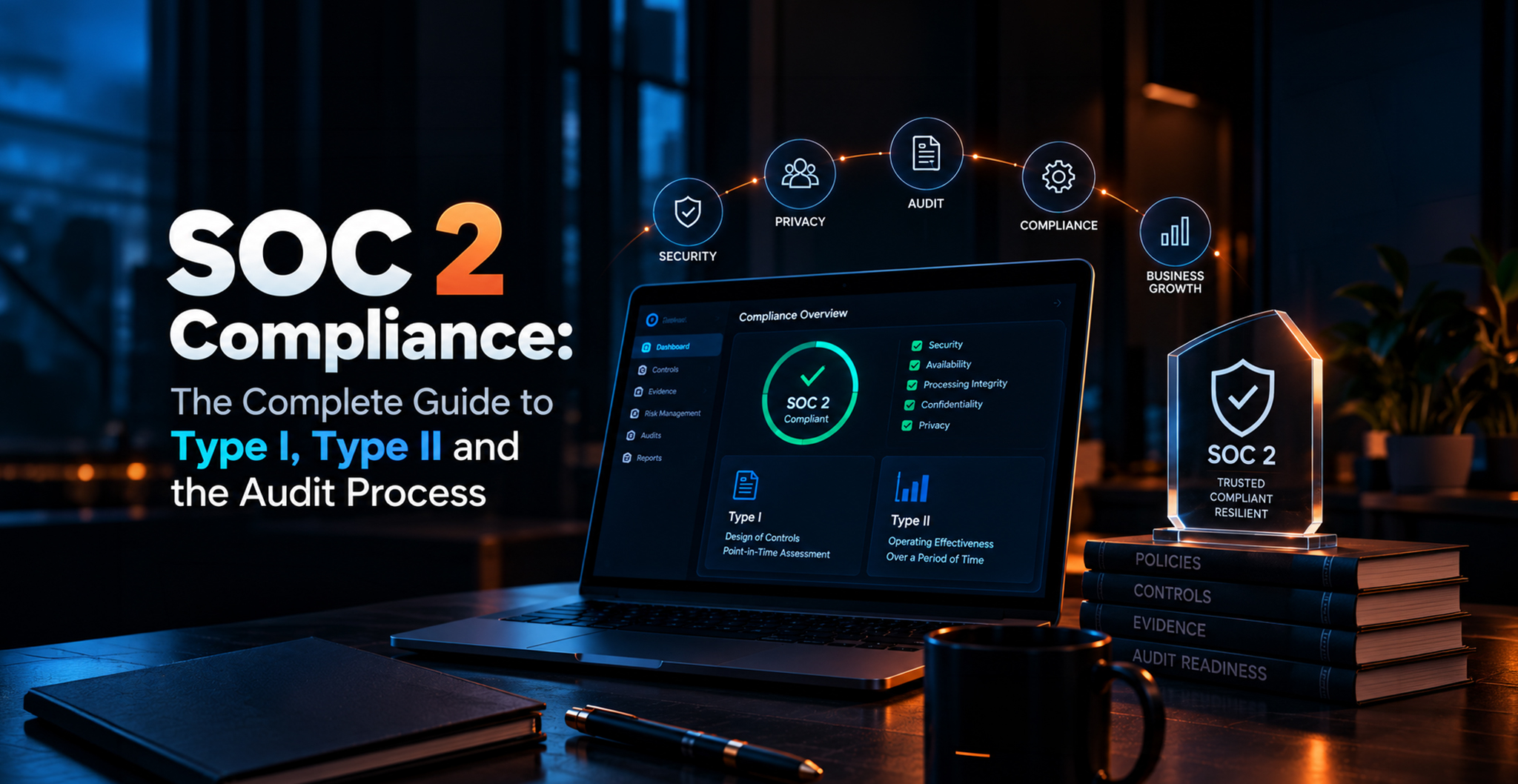
Protecting customer data is a key component of winning customer trust for a business. Security assurance is now a necessity when potential customers, partners, or enterprise buyers evaluate a company prior to engaging in business. By addressing customer data protection and managing system controls, service organizations can rely on SOC 2 compliance for structure. The American Institute of Certified Public Accountants (AICPA), the developer of SOC 2, is concerned with Security, Availability, Processing Integrity, Confidentiality, and Privacy. While SOC 2 compliance is useful, it can be challenging for new companies when terms like Type I, Type II, Trust Service Criteria, and audit evidence are used. Additionally, a SOC 2 report is more of a business assurance report than a traditional certification. While it is commonly referred to as SOC 2 certification, SOC 2 compliance describes the audit. The difference between Type I and Type II reports is covered in this guide along with the audit process. This guide addresses the generally understood meaning behind SOC 2 compliance, the difference between Type I and Type II reports, and the main stages of the audit process.
What is SOC 2 Compliance?
SOC 2 is termed System and Organization Controls 2. It is designed for service organizations managing or processing customer information. According to the AICPA, a SOC 2 examination reports on controls relevant to Security, Availability, Processing Integrity, Confidentiality, or Privacy.
In simple terms, SOC 2 compliance involves establishing and maintaining controls that address an organization’s security risks and commitments. These controls can cover access management, security monitoring, incident response, vendor management, change management, and data protection.
The process also requires organizations to document their systems and controls. An independent auditor then evaluates the relevant controls and issues a SOC 2 report. Although businesses commonly use the phrase SOC 2 Certification, SOC 2 results in an attestation report rather than a certification.
Why Does SOC 2 Compliance Matter?
In today’s world, security is one of the biggest factors in an organization’s decision on whether to choose you as a vendor. SOC 2 compliance can help organizations demonstrate their security practices through an independent report. It can also reduce the need to answer repeated security questionnaires during vendor assessments.
Key benefits include:
- Building trust with customers and partners.
- Supporting enterprise sales and vendor reviews.
- Identifying gaps in security controls.
- Improving internal security processes.
- Creating clearer ownership of compliance activities.
The Five SOC 2 Trust Services Criteria
- Security
Security relates to the protection of systems and information against unauthorized access or use, and unauthorized disclosure, modification, or destruction. Access controls, authentication, monitoring, and incident response controls fall within this domain.
- Availability
Availability focuses on whether systems remain operational according to the organization’s commitments. Backup, disaster recovery, monitoring, and incident management can support this criterion.
- Processing Integrity
Processing Integrity is concerned with whether information is processed accurately, completely, and on time.
- Confidentiality
Privacy is about protecting information that has been classified as confidential. Access restrictions and encryption are typical control areas.
- Privacy
Privacy relates to the collection, use, retention, disclosure, and disposal of personal information. Security is the most common criterion for SOC 2 reports. Other criteria can be included based on the organization’s services and commitments.
SOC 2 Type 1 vs Type 2: What Is the Difference?
What Is SOC 2 Type I?
A Type I report evaluates whether relevant controls are suitably designed and implemented at a specific point in time. It provides an initial view of an organization’s control environment.
What Is SOC 2 Type II?
A Type II report evaluates controls over a defined period. It examines not only whether controls are appropriately designed but also whether they operated effectively during that period. For example, an auditor can review evidence showing that reviews of access, monitoring of security, and/or other controls changed at a minimum during the entire evaluation period.
SOC 2 Type I vs Type II Comparison
| Factor | SOC 2 Type I | SOC 2 Type II |
| Evaluation | Specific point in time | Defined period |
| Main focus | Control design and implementation | Design and operating effectiveness |
| Evidence | Evidence around examination date | Evidence collected over time |
| Assurance | Initial assurance | Ongoing assurance |
| Complexity | Generally lower | Generally higher |
Which SOC 2 Report Does Your Business Need?
The right report depends on what the business needs to demonstrate. A Type I report may suit an organization that has recently established its controls and needs to provide initial assurance. A Type II report may be more suitable when customers want evidence that controls operated consistently over time.
Businesses should consider:
- Customer and contractual requirements
- Existing security maturity
- Audit scope
- Ability to collect evidence
- Expectations of enterprise buyers
The goal is to select the report that matches actual business and customer needs.
The SOC 2 Audit Process
The formal evaluation of SOC 2 is preceded by various preparations. The SOC 2 audit process can be generally divided into four major sections.
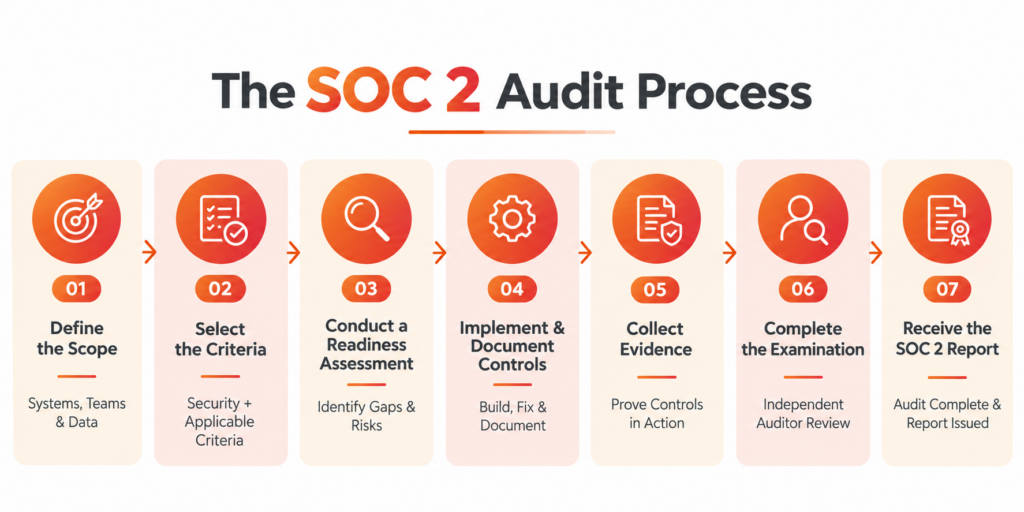
- Define the Scope
Defining the systems, applications, and teams involved and the data targeted for evaluation are vital to determining what the audit will cover.
- Select the Criteria
Security is a prerequisite for a SOC 2 report. From there, an organization must decide if the other criteria (Availability, Processing Integrity, Confidentiality, Privacy) apply to the organization.
- Conduct a Readiness Assessment
A readiness assessment may help identify gaps that will impact the audit. Gaps are identified by reviewing policies, procedures, and controls. Common gaps include access, documentation and evidence reviews, and vendor control assessments.
- Implement and Document Controls
After the review, the gaps that were identified are filled, and the controls are put into place and documented.
These may include:
- Access management
- Security awareness training
- Incident response
- Change management
- Vendor risk management
- Risk assessments
- Collect Evidence
Evidence demonstrates that controls exist and, for Type II, operated during the review period.
Examples include access review records, training records, security logs, incident records, risk assessments, and policy documents.
- Complete the Examination
An independent auditor reviews the system description, management assertions, controls, and supporting evidence. For Type I, the focus is on controls at a specific date. For Type II, the auditor also evaluates operating effectiveness over the defined period.
- Receive the SOC 2 Report
Once completed, the auditor issues the SOC 2 report, at which point an organization may provide the report to its customers and other relevant parties.
How Long Does SOC 2 Compliance Take?
The time required to achieve SOC 2 compliance varies. It depends on the existing internal controls of an organization; the audit scope; the chosen criteria; the resources of an organization; and the type of report to be issued.
A company with mature security processes may have fewer gaps to address. A business starting from scratch may need to develop policies, implement controls, assign owners, and establish evidence collection processes.
Type II can also require more time because controls must be evaluated over a defined period.
Drata’s research reports that enterprises in its customer dataset reached readiness in 602 days, while emerging teams took 829 days. However, this data comes from Drata’s own customer base and should not be treated as a market-wide average.
Common SOC 2 Challenges
Organizations can face several problems during preparation. The most common challenges of SOC 2 Compliance tend to be poor documentation, unclear ownership, and inconsistent evidence.
Common challenges include:
- Unclear audit scope
- Incomplete security policies
- Inconsistent evidence collection
- Manual compliance tracking
- Unclear control ownership
- Outdated procedures
A business can have excellent security practices and still fail if it can neither document nor provide evidence of those practices.
Join our weekly newsletter and stay updated
Is SOC 2 Certification Required?
There are few laws that necessitate SOC 2 certification for a business. Enterprise customers and business partners often require a SOC 2 report before starting business with a service provider. The distinction between certification and attestation is important. The auditor reports on an audit performed by an independent CPA.
Customer expectations often make SOC 2 compliance a critical part of doing business for cloud service companies, software companies, data processors, etc., despite a lack of a legal obligation to do so.
Why Do Businesses Hire Kratikal for SOC 2?
Compliance is no easy task, as it needs expertise and long-term experience to manage. The right partner makes it easy. Being one of the best cybersecurity firms in India, we have served over 650 SME and enterprises. Our focus is on improving our clients’ security and reducing cyber risks. The end goal is always to help our clients navigate SOC 2 compliance in a seamless and stress-free manner.
Book Your Free Cybersecurity Consultation Today!

Conclusion
System and Organization Controls 2 (SOC 2) compliance helps service organizations address the needs of potential customers by showing how the organization protects the security and privacy of their data. SOC 2 compliance strengthens customer trust, facilitates enterprise-level sales, and builds an organization’s information security processes.
To plan for SOC 2 compliance, it is important to understand the difference between Type I and Type II. Type I reviews controls in reference to a given period of time, whereas Type II reviews control effectiveness over a given period. Achieving a SOC 2 audit goes beyond last-minute document preparation.
FAQs
- What is SOC 2 compliance?
Controls are examined and developed for the Trust Services Criteria.
- What is the difference between SOC 2 Type I and Type II?
The key difference in SOC 2 Type 1 vs Type 2 is the examination period. Type I analyzes controls at a specific time, while Type II analyzes their operating effectiveness over a specific period.
- Is SOC 2 certification mandatory?
No, SOC 2 certification is not mandatory. However, a business’s customer or business partner may request a SOC 2 report.
- How long does a SOC 2 audit take?
The length of an engagement depends on the organization’s security maturity, the scope of controls, and the type of report being issued.
- Who performs a SOC 2 audit?
An independent service auditor performs the examination. Organizations generally work with qualified CPA firms or audit practitioners.
- Which companies need SOC 2 compliance?
SOC 2 compliance is required for businesses involved in SaaS, cloud, service, and other technology development services that manage customers’ data.
- What are the five SOC 2 Trust Services Criteria?
The five Trust Services Criteria incorporate Security, Availability, Processing Integrity, Confidentiality, and Privacy. Security is the basis of all the criteria, and the others are decided based on the organization’s services and commitments.
- How often should a company undergo a SOC 2 audit?
This is determined by the expectations of the company’s customers, the conditions of the contracts, and the company’s compliance program. In any case, it is common for companies to keep controls in place at all times and to have reports generated for them on a continuous basis.