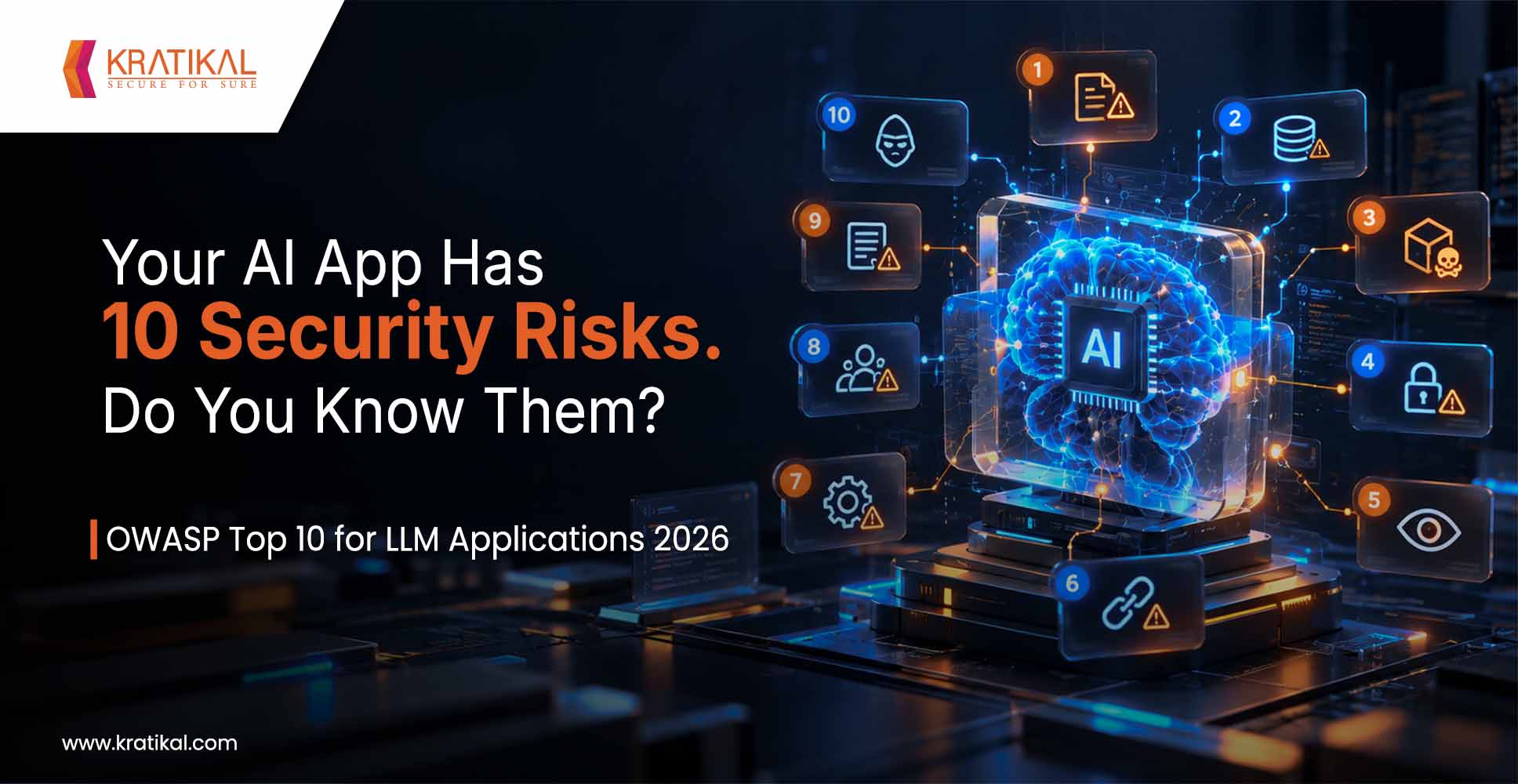
Large language models now do much more than chat. They read your inbox, query your databases, write production code, and call cloud APIs. Each new capability makes an LLM-powered application more useful, and each one also gives an attacker a new way in. The OWASP Top 10 for LLM Applications 2026 is the community’s latest map of where these systems are breaking. This guide covers what changed, what each risk means, and how to defend against it.
Why Does the OWASP LLM Top 10 List Look Different?
Every earlier OWASP LLM Top 10 was built on expert opinion. For 2026, the project tested that opinion against evidence for the first time. The team reviewed thousands of documented AI security incidents and compared them with what practitioners said they feared most. The final ranking blends both: the community vote carries most of the weight, and the incident data acts as a corrective. It can move an entry up or down a tier, but it can’t rewrite the list on its own.
The comparison exposed some blind spots. Prompt injection is a good example. Security teams consider it the biggest threat, yet it appears relatively rarely in public incident records. OWASP doesn’t treat this as a sign the risk is overstated. It reflects how much effort organizations already spend fighting injection. The threat is everywhere; it just gets stopped more often before it becomes a headline. It keeps the top spot.
Misinformation tells the opposite story. Practitioners ranked it as a minor concern, but real-world incidents show it causing harm far more often than expected. This is especially true when a model’s confident but wrong answer triggers an automated decision or action.
OWASP LLM Top 10 2026
The 2026 edition highlights the top security risks affecting LLM applications:
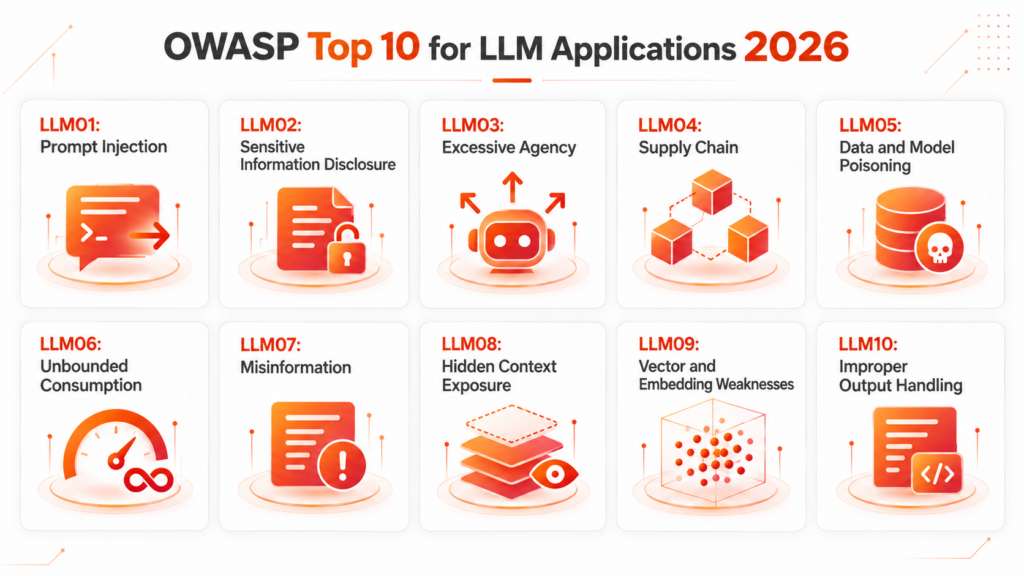
LLM 01: 2026 Prompt Injection
Prompt injection happens when any input changes the model’s behavior in ways the developer did not intend. That input can be a user message, a retrieved document, tool output, an image, audio, or stored memory. The root problem is architectural. LLMs see instructions and data as the same stream of tokens, so there is no equivalent of a parameterized query.
Attacks can be direct, such as jailbreaks or instruction overrides typed by a user. They can also be indirect, with hidden instructions planted in web pages, emails, RAG passages, or bug-tracker issues. The 2026 edition highlights some newer techniques:
- Invisible Unicode characters that smuggle instructions or data out of the system
- Adversarial perturbations hidden in images or audio
- Payloads written in low-resource languages to slip past filters
- Memory poisoning that carries an attack across sessions
Defense: Prompt injection cannot be fully prevented, so rely on layered controls. Keep sensitive actions outside the model, validate outputs, sanitize inputs, and require human approval for high-impact actions. Regularly test defenses against evolving attack techniques.
LLM02: Sensitive Information Disclosure
This risk covers confidential or regulated data leaking through any channel, not just the final answer. Leaks can come from tool-call arguments, reasoning traces, logs, embeddings, and even side channels such as response latency or token length. OWASP describes four phases where disclosure occurs:
- Training time: memorized data resurfaces in outputs.
- Inference time: live context leaks, such as system prompts, RAG chunks, or another session’s data.
- Pipeline time: fine-tuning or telemetry copies sensitive data into derived artifacts.
- Observation time: attackers infer facts from measurable behavior without seeing any content.
Defence: Scrub PII when data is ingested. Send providers only the fields a task needs. Enforce authorization inside the retrieval query itself. Never store secrets in system prompts. Use trained classifiers alongside regex for redaction.
LLM03: Excessive Agency
When an LLM can call tools, a hallucination or an injected instruction can become a harmful real-world action. OWASP identifies three root causes: excessive functionality, excessive permissions, and excessive autonomy. A typical example is a read-only summarization tool that connects with a database identity that also has UPDATE and DELETE rights.
Defense: Give the agent only the tools it needs, and keep each tool’s functions minimal. Avoid open-ended tools such as raw shell access. Run actions in the user’s own security context. Require human confirmation for high-impact operations. Enforce authorization in downstream systems rather than trusting the model to decide.
LLM04: Supply Chain
The LLM supply chain includes pre-trained models, datasets, LoRA adapters, conversion pipelines, and on-device deployments. Key risks include:
- outdated or vulnerable components
- licensing exposure
- tampered models with hidden backdoors, which can persist even in formats considered safe, such as ONNX
- “slopsquatting,” where attackers register package names that coding assistants hallucinate, so unverified AI-suggested dependencies install malicious code
Defense: Vet suppliers carefully. Maintain signed SBOMs extended to AI components (AIBOMs, CycloneDX ML-BOM). Red-team third-party models before adoption. Confirm that AI-suggested packages actually exist and are the intended ones.
LLM05: Data and Model Poisoning
Poisoning manipulates data or model artifacts to plant backdoors, bias, or hidden weaknesses. It can happen during pre-training, fine-tuning, embedding creation, or RAG ingestion. Unlike an ordinary bug, it can’t simply be patched; fixing it may require retraining or replacing the model. Research cited in the guide found that as few as 250 poisoned documents could compromise models ranging from 600 million to 13 billion parameters, regardless of dataset size.
Defense: Track data and model lineage with signing and verification. Validate all incoming data. Isolate RAG sources behind trust boundaries. Monitor training and outputs for drift or anomalies.
LLM06: Unbounded Consumption
The core issue is cost asymmetry: an attacker can trigger expensive computation while spending almost nothing. Reasoning models with large output budgets, multimodal inputs, and agent loops all amplify the risk. Beyond denial of service and runaway bills, this category also covers model theft through large-scale querying.
Defense: Go beyond requests-per-second limits:
- Rate-limit on tokens per minute and estimated cost per request.
- Set hard spending caps that actually halt inference, not just alerting thresholds.
- Add circuit breakers for agent loops.
- Monitor cost attribution continuously.
LLM07: Misinformation
This entry saw the biggest gap between perception and evidence. The risk isn’t only that a model is wrong. It is that a fluent, confident answer gets trusted and acted on. In agentic systems, false state or reasoning feeds directly into tool calls, so a wrong answer becomes a wrong action.
Defense: Ground claims in authoritative, current sources before acting on them. Adopt “claim-check-act” patterns that separate generation from execution. Validate tool-call preconditions. Rely on groundedness checks rather than the model’s own confidence.
LLM08: Hidden Context Exposure
This category replaces System Prompt Leakage. It covers the extraction of anything hidden in the model’s context, including system prompts, developer instructions, tool schemas, and retrieved policy text. The key mindset is to assume hidden context will be discovered. Severity depends on what you put there. Embedded credentials, or relying on prompt secrecy as your authorization mechanism, turns a minor leak into a critical one.
Defense: Keep secrets out of prompts entirely. Enforce security-critical behavior and authorization through deterministic systems outside the model.
LLM09: Vector and Embedding Weaknesses
Any system that uses similarity search to decide what the model sees has a new trust boundary. This includes RAG, vector-backed memory, and semantic caches. OWASP sums up the four main failure modes this way:
- Poisoning makes the system wrong.
- Inversion makes it leak.
- Jamming makes it silent.
- Access-control failures make it indiscriminate.
Defense: Enforce tenant scoping inside the index query, and apply access control at the chunk level. Normalize content before embedding it. Track the provenance of every vector. Keep content of different trust levels in separate indexes.
LLM10: Improper Output Handling
LLM output passed unchecked to downstream systems can lead to XSS, CSRF, SSRF, SQL injection, or remote code execution. This category now also covers the insecure code that AI assistants generate at scale.
Defense: Treat the model like any untrusted user and apply zero-trust principles:
- Validate model output before it reaches backend functions.
- Apply context-aware encoding for HTML, JavaScript, and SQL.
- Use parameterized queries for any database operation involving model output.
- Enforce strict Content Security Policies.
Join our weekly newsletter and stay updated
Putting the OWASP LLM Top 10 into Practice
Knowing the ten risks is only the first step. The real value of AI application security comes from building these practices into how your team designs, ships, and monitors AI applications. These four practices are a strong place to start.
- Map The Attack Surface
Understand what your application can access, what data the model sees, what actions it can take, and where its output goes. Check if it can access private data, process untrusted content, and communicate externally. If all three are possible, the risk of a serious breach increases. Removing even one can reduce the risk.
- Enforce least privilege and treat model output as untrusted.
Most high-impact LLM incidents became serious because the model had more access than it needed. Give agents only the tools they require, scope each tool’s permissions tightly, and run actions under the end user’s identity rather than a shared admin account. Keep credentials and authorization logic in application code, never in prompts. Validate every model response against strict schemas before a downstream system acts on it, and require human approval for anything irreversible or high-impact.
- Secure the AI supply chain and control consumption.
Keep an inventory of every model, dataset, adapter, and dependency using an AI Bill of Materials. Verify signatures and sources, and never install a package an AI coding assistant suggests without confirming it is legitimate. At the same time, protect your resources with token-based rate limits, hard spending caps that actually stop inference, and circuit breakers for agent loops, so one user or runaway workflow can’t drain your budget or take down the service.
Book Your Free Cybersecurity Consultation Today!

Conclusion
The OWASP LLM Top 10 2026 is the first edition backed by both practitioner consensus and real-world incident data. Its message is consistent across all ten entries: assume the model will eventually be manipulated, and design the system so that manipulation can’t turn into a real exploit. Start with the top of the list, work through all ten, and treat least privilege, deterministic enforcement and output validation as the baseline for any AI application.
FAQs
- Why should organizations pay attention to the OWASP LLM Top 10 2026?
It helps organizations identify key security risks in AI applications and build appropriate controls into their AI adoption strategy.
- What role does AI governance play in securing LLM applications?
AI governance helps organizations establish controls for data access, model usage, permissions, monitoring, accountability, and security throughout the AI lifecycle.
- What is the first step toward implementing the OWASP LLM Top 10 in an organization?
Start by mapping the AI application’s attack surface, including its data sources, permissions, tools, external connections, and downstream actions.
- What should be considered before deploying an LLM-powered application?
Security teams should evaluate its data access, permissions, integrations, attack surface, and potential misuse scenarios before deployment.
- What happens when an AI model has access to sensitive systems?
A manipulated or incorrect model response can trigger unauthorized actions, making strict permissions and downstream authorization essential.
- How can sensitive information be protected when using LLM applications?
Sensitive data should be minimized, access-controlled, securely processed, and protected across prompts, RAG sources, embeddings, logs, and outputs.
- What security controls should be applied to AI-generated actions?
Actions should be validated against strict rules, authorized outside the model, and subject to human approval when they are high-impact or irreversible.