
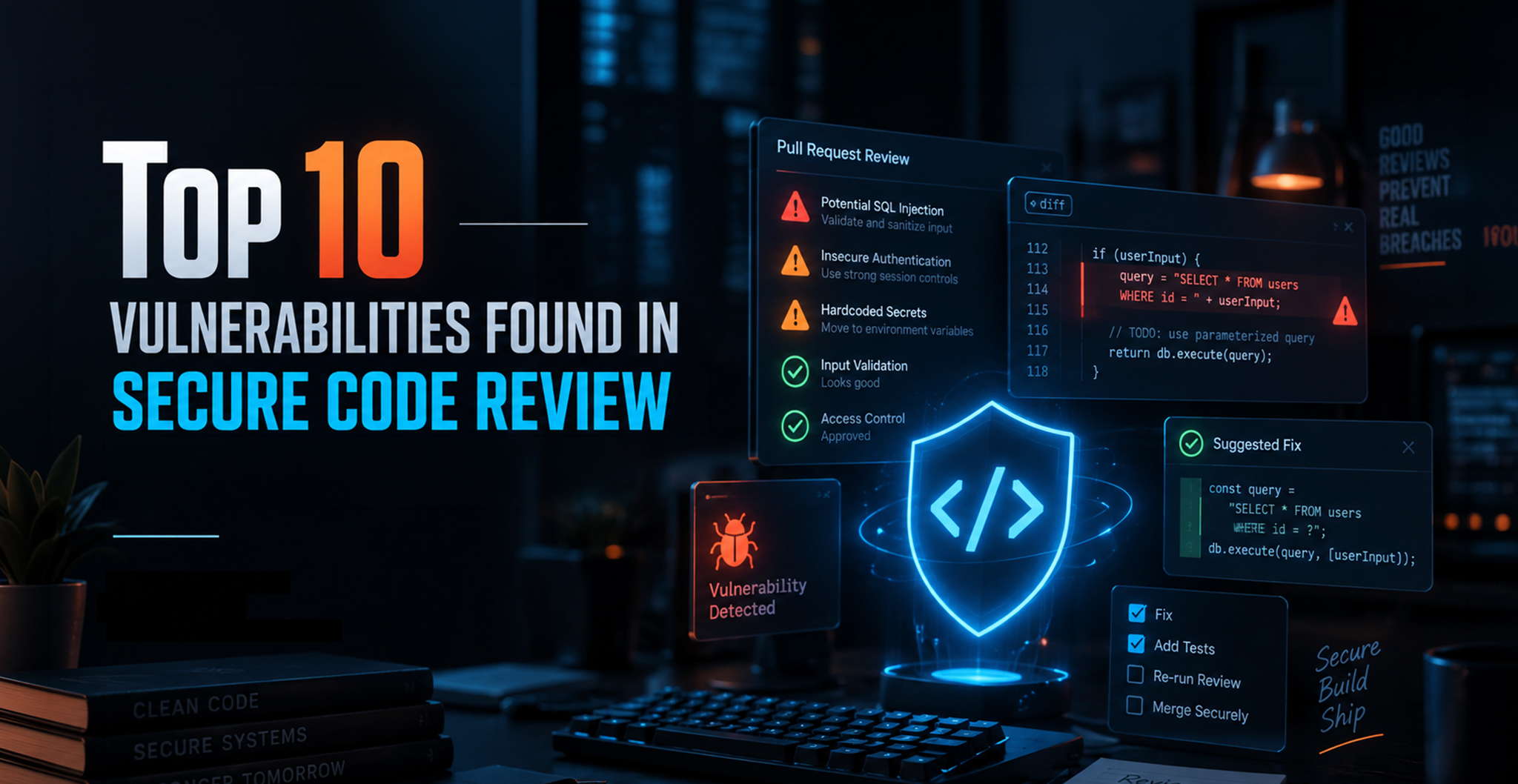
A Secure Code Review analyzes an application’s source code from an attacker’s perspective. Reviewers look for paths that could lead to unauthorized access, stolen data, greater privileges, and compromised systems. OWASP guidance focuses on things like the bunching of coding issues such as injection flaws, authorization and session problems, and bugs that lead to the leakage of information. There are numerous advantages to performing regular secure code tests: Vulnerabilities are identified and resolved prior to the application being released. The cost associated with fixing security flaws is significantly reduced. Developers become more security-conscious. Secure coding practices are adopted, and security and compliance needs are met. Ultimately, the attack surface is reduced. The aim is not to identify flaws. The aim is to ensure the same security weaknesses are not introduced in other development projects.
Top Vulnerabilities Found in Secure Code Review Findings
1) SQL Injection
An SQL injection attack occurs when an application does not validate input and, as a result, is able to modify or delete data stored in the database. This can be prevented through the use of parameterized queries and prepared statements, least-privilege permissions for databases, and avoiding the use of dynamic SQL. Testing the code for security can help identify potential issues with SQL query development.
2) Cross-Site Scripting (XSS)
XSS occurs when malicious scripts are injected into forms, comments, search fields, or other input fields. Once injected, the scripts can steal a user’s session cookies or impersonate the user. The best defense against XSS includes context-dependent output encoding, sanitization of unsecured input, secure framework controls, and a Content Security Policy. A Secure Code Review should track user-controlled data as it moves to an output displayed in a browser.
3) Broken Access Control
Users are able to access parts of the system or perform actions that they are not allowed to do with broken access control. For example, ownership checks may be missing, and an attacker may be able to access another customer’s data by changing an ID in a URL.
4) Hardcoded Credentials and Secrets
Token secrets, passwords, and other credentials may be hardcoded in the source code. These may be exposed when code is pushed to a repo or when code is deployed, and attackers may be able to access your system. Repo secrets scanning is also a good practice. An automated code review should check for secrets that may be exposed.
5) Insecure Authentication Logic
Insecure session validations, predictable tokens, and weak password mappings may result in attackers being able to authenticate or steal an account fraudulently. For session validations and mappings, use secure tokens and implement a protected password reset flow. Also, employ strong password hashes and multi-factor authentication. Review the entire journey of an authenticated user rather than reviewing individual mappings.
Join our weekly newsletter and stay updated
6) Insecure Deserialization
Some applications transform serialized external data into objects. Deserializing manipulated data can change the behavior of the application or cause it to perform unauthorized operations. Avoid deserializing unsecured data if possible. Use safe formats, validate data, ensure the integrity of the data, and restrict the types of objects that can be deserialized.
7) Improper Input Validation
Data is opened by applications from various sources including users, APIs, files, and other services. Inadequate input validation can lead to injection attacks and other common coding vulnerabilities. Accepted formats should be defined, and validations should be used. Data should be validated to the correct type and length. Unanticipated values should be rejected. Consistently validate input forms and APIs. Secure code reviews should track unsecured data throughout the application.
8) Security Misconfiguration in Code
Direct application code can contain insecure settings such as debug mode, verbose errors, disabled certificate validation, and other insecure defaults. Development and production configurations should be separated. Debugging should be disabled in development. Secure defaults should be used. During secure code testing, configuration files should be reviewed.
9) Insufficient Error Handling and Information Leakage
Errors containing too much information can reveal the type of database, server, and framework in use. Attackers can use this information to plan their attacks. Error messages should be simple so that users don’t gain extra information. Protected logs should contain errors, stack traces should be hidden, and logs should not contain credentials or other sensitive information.
10) Insecure Cryptographic Implementation
Even the strongest encryption can be rendered useless due to an incorrect implementation. Outdated algorithms, weak random number generation, hardcoded keys, and invalid certificate validation are just a few of the implementation errors that can occur.
Book Your Free Cybersecurity Consultation Today!

Kratikal Can Conduct Secure Code Review For You
At Kratikal, we help our clients locate hidden risks in their applications at an early stage of the development process, thus improving their application security. We perform a comprehensive review of our clients’ applications by combining expert manual reviews with intelligent automated scans.
Our experts review your code to locate defects such as improper handling of sensitive data, defects in authentication, logic injection, and configuration errors. With us as your security partner, you gain a reliable, thorough review process that is aligned with the compliance requirements and protects your applications from threats that are continually changing.
Conclusion
Typically, an application security incident stemming from a development error occurs when a minor coding mistake goes unnoticed during the implementation phase. Some of these coding mistakes can create business risks such as SQL injection, Cross-Site Scripting (XSS), broken access control, exposed secrets, and insecure authentication. Structured Secure Code Reviews allow development teams to identify these issues prior to an attack.
Security reviews, however, cannot serve as a final gate in the development process. They must be integrated throughout the entire development process. Early identification and resolution of common coding vulnerabilities can be achieved through the use of automated tools, combined with secure code testing, manual reviews, and penetration testing, as well as training for developers. This allows organizations to improve the overall security of their applications.
FAQs
- What is secure code testing?
Secure code testing is the analysis of application source code to find security concerns that attackers can exploit. This can be done through automated tools or manually.
- How is secure code testing different from penetration testing?
Secure code testing focuses on the application’s source code. Penetration testing examines a running application and attempts to identify exploitable security weaknesses.
- What vulnerabilities are commonly found during a Secure Code Review?
Common findings include SQL injection, XSS, broken access control, insecure authentication, exposed credentials, poor input validation, and cryptographic flaws.
- Can automated tools do the job of manual code review?
No, the two serve different purposes. Though automated tools can do a quick analysis of code, manual review is necessary for application-specific risks, business logic, and authorization.
- Why is input validation important?
Input validation helps to ensure that an application does not process malicious or unknown data, and helps to reduce the risk of injection attacks, XSS, and other similar attacks.
- When should secure code testing occur?
It should happen throughout the software development lifecycle and the CI/CD process, and during major releases.
- How can developers avoid common code vulnerabilities?
This can be achieved by secure coding standards, input validation, and protected secrets, as well as secure authentication, review of dependencies, and routine code reviews.