
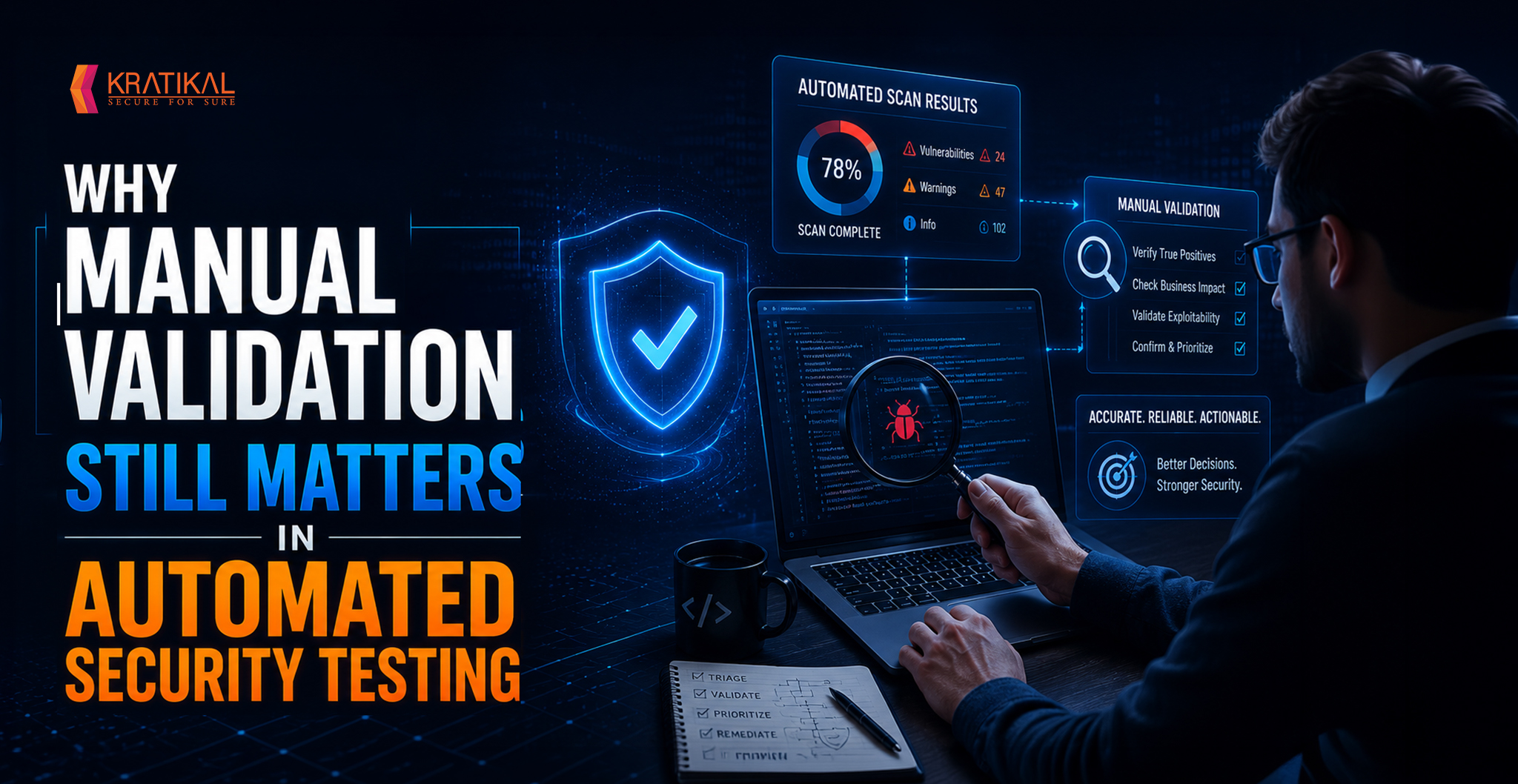
Now, organizations deploy software several times a day, and each new feature, API, or cloud deployment may add new security concerns. Security professionals can no longer manually test applications for security issues after each deployment. Consequently, automated security testing is now a foundational component of security programs. Automated security platforms enable security teams to identify and remediate security concerns faster and improve the coverage, breadth, depth, and quality of their security efforts. It helps identify security issues earlier in the development lifecycle and streamline security testing so that organizations can incorporate security requirements within their DevSecOps-enabled continuous integration and continuous deployment (CI/CD) pipelines. Automated testing platforms, by design, must follow step-by-step instructions, patterns, or signatures and, as a result, cannot fully understand an application’s behavior or how a user may interact with it.
Manual testing is essential to security testing because it augments automated security testing, validates automated security findings, and uncovers threats that automated testing platforms may miss. This is why manual security testing, when combined with automated security testing, provides a much more comprehensive and clear evaluation of an organization’s overall security posture.
Automated Testing and Security
Automated tests are now a necessity due to the increasing sophistication of digital settings. Today’s organizations have to deal with web apps, mobile apps, APIs, cloud workloads, and dispersed infrastructure. Automated tests allow security teams to move as quickly as development teams. Organizations scan their environments after every release instead of waiting for quarterly or annual assessments. This approach identifies vulnerabilities much faster.
Automated tests also deliver consistent and predictable results. They help development teams identify vulnerabilities before code is deployed, making security issues less costly and less time-consuming to address.
Book Your Free Cybersecurity Consultation Today!

Why Automation Alone Cannot Find Every Security Risk
Automated testing has limits. Technical flaws are only one part of what secures an asset – processes, user behavior, and attacker intent matter just as much, and scanners can’t evaluate any of those.
Take an online shopping app: a scanner will confirm the payment page is secure and inputs are validated, but it won’t catch a manipulated API request changing the discount value right before checkout.
Or a financial app requiring two-person approval for large transactions: if an attacker crafts requests to bypass one approval step, a scan is unlikely to catch it. These are business logic flaws, not unpatched vulnerabilities and they only surface when someone tests the workflow the way an attacker would.
Why Manual Pentesting Is Essential to Close the Gap
Business logic flaws need a human attacker mindset to find, this is exactly where manual pentesting matters alongside manual functional testing. A pentester doesn’t just run checks; they chain steps together the way a real adversary would.
For instance, a user might access another user’s data via a specific sequence of API calls that is invisible to scanners due to how the requests are structured, but still discoverable through manual probing. The same applies to session management, access control, and authorization flaws in multi-step processes.
Skipping manual pentesting risks a dangerous false negative: assuming an app is secure just because a scan came back clean, when the riskiest flaws were never within the scanner’s reach.
The Importance of Manual Testing
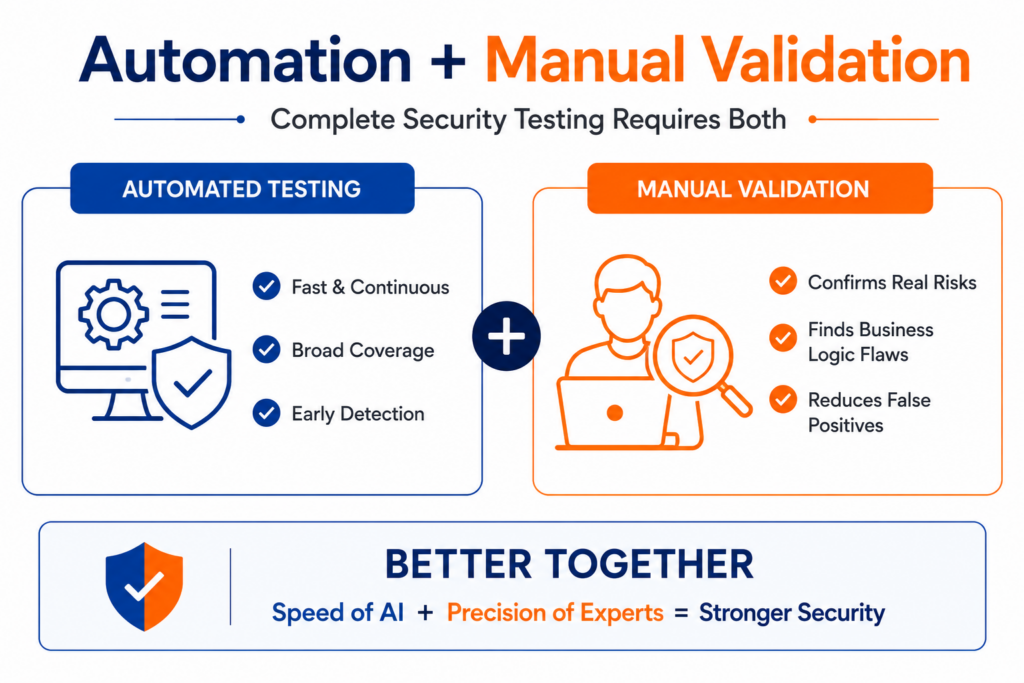
Automation is excellent for efficiency. However, adding the human component through manual testing enables security teams to make better, more secure decisions.
1. It Verifies the Real Security Risk
Vulnerability reports are only helpful if the findings are true. Security analysts need to ensure issues can be exploited as reported. This entails verifying the application’s behavior and reviewing the provided evidence. Afterward, they will assess if there is any business risk due to the vulnerability. This gives developers greater confidence in the final report and minimizes unnecessary effort to fix reported issues.
2. It Discovers Vulnerabilities That Scanners Cannot
The automated results of the scan guide the majority of penetration testers’ work. However, experienced testers can go beyond these results. There are a few different user behaviors and attack paths that are beyond the automated tools and that a tester must explore.
Manual validation of a penetration test is essential in the discovery of the following:
- Access control is circumvented
- Logical flaws are present
- User privileges can be increased
- Authentication can be bypassed
- API workflows are insecure
- Attacks may be chained
These are inherently context-based and difficult to discover via automated tools.
3. It Helps Automated Scanning Platforms Prioritize Risks Based on Business Impact
Not all vulnerabilities are created equal, and some are more serious than others. A vulnerability in a public marketing page due to an outdated JS library is far less concerning than an online banking portal authorization flaw. Although automated tools may rank these vulnerabilities as equally concerning, they cannot assess the business importance of the process.
Security analysts will evaluate a vulnerability based on how sensitive the data may be, the impacted business process, and how serious the vulnerability is. From this, they will determine how large the financial and regulatory impacts may be. This allows a company to focus its efforts on the most important vulnerabilities rather than ranking all vulnerabilities equally.
Security professionals evaluate vulnerabilities based on factors such as:
- Sensitivity of exposed data
- Business function affected
- Ease of exploitation
- Possible financial loss
- Regulatory impact
How Automated Testing Works Together with Manual Validation
The most advanced security programs integrate testing and validation to achieve optimal coverage and precision, and as a result, neither is underutilized.
Automated security testing and validation within a security program entail the following steps:
- Automated testing scans the environment.
- Results are read and prioritized.
- Manual validation is performed on important results.
- The business impacts of the assessed issues may be explained.
- Remediation steps may be communicated to developers.
- The situation is verified after the resolution is implemented.
- Automated tests continue to scan the environment for new relevant issues.
- Security testing utilizes the speed of automation and the precision of manual validation.
Best Security Testing Service Provider
To get the most from automated testing, organizations need both automation and expert validation. Kratikal, a CERT-In Empanelled Security Auditor, combines AI-powered security with expert-led assessments to identify, validate, and prioritize real security risks. With its AutoSecT platform and comprehensive VAPT services, Kratikal helps businesses strengthen their security posture and stay ahead of evolving cyber threats.
To know about AutoSecT VM Platform: Click Here
Join our weekly newsletter and stay updated
Explore Kratikal’s PTaaS services: Tap Here
Conclusion
Automated testing has an enormous positive impact on modern cybersecurity. Automated processes allow organizations to identify threats to critical vulnerabilities faster and manage cyber risks to a much lower level.
Manual validation helps cover the blind spots of automated testing. Manual validation corroborates such testing outcomes, discloses concealed weaknesses, eliminates false positives, and contextualizes the business impact to prioritize and address security concerns. In the absence of manual validation, businesses risk leaving critical weaknesses unaddressed and/or devoting security resources to low-risk security concerns.
A security model that integrates continuous automated testing with manual validation is the most optimal. Of the two, continuous automated security testing is the more efficient security model; however, manual validation is the more precise security model. Therefore, continuous automated test compounded with manual validation yields greater security.
FAQs
- What does automated testing entail in the field of cybersecurity?
Automated test involves using security tools to identify weaknesses in applications, APIs, networks, and cloud security. It increases the speed of security testing and enables continuous security monitoring.
- What does manual validation mean in security testing?
Manual validation involves reviewing and confirming security weaknesses identified by automated security testing. Security experts determine the exploitability of security weaknesses and their business impact.
- Will manual validation lessen false positives?
Yes, manual validation decreases false positives and enables the development of security solutions that address actual security concerns.
- When should organizations prioritize automated testing?
Normalized automated testing for organizations means integrating automated testing within Continuous Integration and Continuous Deployment (CI/CD) pipelines and running automated tests after considerable changes to the code, deployments, or infrastructure.
- Is manual validation still essential after performing automated scans and confirming no vulnerabilities?
Manual validation is still essential. A clean scan report alone should not be considered secure. Some vulnerabilities may not be captured, especially those related to business logic or access control; such vulnerabilities would require manual validation for confirmation.
- Which specific industries are more favored by the combination of both automation and manual validation?
The industries most favored by the combination of automation and manual validation are banking, healthcare, retail, government, Software as a Service (SaaS), and eCommerce because these industries handle sensitive user data and are more susceptible to cyberattacks.
- What should be the prioritized security testing strategy?
The prioritized security testing strategy should combine continuous automation testing with periodic manual validation and penetration testing. This strategy would be best because combining the three would greatly improve the organization’s security posture.