The world has accepted the gift of artificial intelligence, and that includes both hackers and the organizations vulnerable to attacks. With the base being the same for both attackers and defenders, the approach adopted determines the outcome. This is where the need for effective AI-Driven vulnerability management comes in. Thus, Kratikal came up with AutoSecT, a vulnerability management platform driven by AI. The platform is built for organizations like you to stay secure. It is made available without any financial obligation and provided along with the reports. The vulnerability reports are generated on the same platform after the security assessment concludes. Let’s dive deeper into this –
The 5 Steps of Vulnerability Management
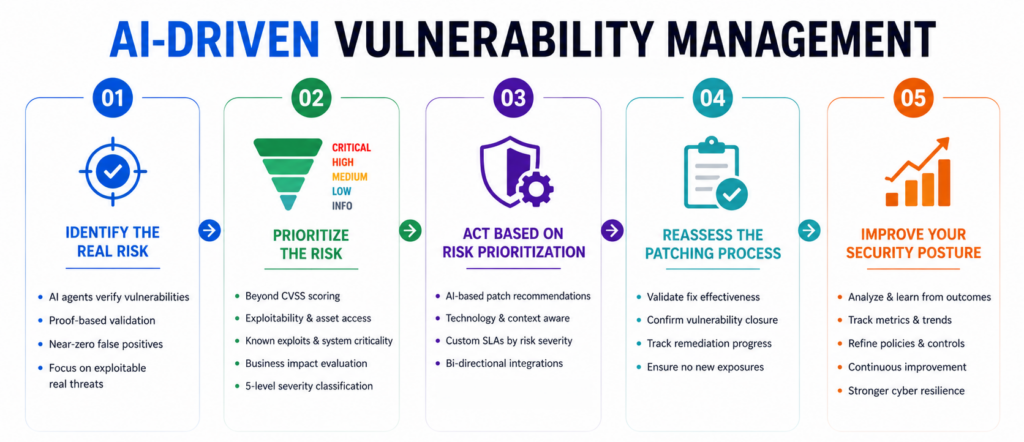
Identify, Prioritize, Act, Reassess, and Improve – the five standard steps of vulnerability management.
AI-Driven Vulnerability Management and How AutoSecT Caters to it All!
Imagine Kratikal’s security experts test one of your asset inventories and discover several vulnerabilities. While identifying security gaps is essential, it is only half the battle. The real objective is to remediate those vulnerabilities before they can be exploited. That’s where vulnerability management begins: identifying and understanding the risks that need immediate attention.
Identify The Real Risk
This is the stage where you evaluate the risks found. Given the growing problem of false positives, AutoSecT verifies the vulnerabilities using AI agents. Further, it generates proof-based validation, ensuring near-zero false-positive results. Instead of overwhelming security teams with unverified findings, the platform focuses on confirming whether a vulnerability is genuinely exploitable and poses a real threat to the organization. Each identified issue is validated with supporting evidence. This approach helps reduce investigation time and eliminates unnecessary effort spent on non-actionable alerts. Moreover, it ensures that security resources are directed toward addressing actual risks that could impact business operations, data security, and overall organizational resilience.
Prioritize The Risk
Not all vulnerabilities pose the same level of threat. In this step, vulnerabilities are ranked based on their severity, ensuring that remediation efforts are focused where they matter most. The prioritization process goes beyond relying solely on the Common Vulnerability Scoring System (CVSS). It also evaluates the likelihood of exploitation, the accessibility of the vulnerable asset, the existence of known exploits, and the criticality of the affected system within the organization’s environment. Additionally, the potential business impact of a successful attack is taken into account. It includes operational disruption, financial loss, regulatory consequences, reputational damage, and data exposure risks.
By combining technical risk indicators with business context, organizations gain a more accurate understanding of which vulnerabilities require immediate attention and which can be addressed later. This risk-based approach helps security teams allocate resources efficiently, reduce remediation backlogs, and improve overall security posture. To simplify decision-making and streamline remediation planning, vulnerabilities are categorized into five: Critical, High, Medium, Low, and Info. This enables the security team of your organization to clearly understand the urgency and impact of each identified risk.

Book Your Free Cybersecurity Consultation Today!
Act Based on Risk Prioritization
This phase involves taking action to reduce the identified risks and ensure vulnerabilities are remediated effectively. AutoSecT provides AI-based patch recommendations tailored to each vulnerability as well as the specific nature, technology stack, and operational requirements of your organization. This enables security and IT teams to implement the most relevant remediation measures without delays or guesswork.
The platform not only recommends corrective actions but also helps ensure that remediation activities are completed accurately and within defined timelines. Thus, to strengthen accountability and track progress, organizations can configure and customize SLAs based on risk severity and business priorities.
Additionally, AutoSecT streamlines the reassessment and remediation workflow through its multi-integration capabilities. Teams can seamlessly collaborate and manage remediation tasks using bi-directional integrations with Jira as well as Google Chat, Microsoft Teams, Slack, and Zoho Cliq.
Reassess The Patching Process
After a fix has been deployed, you must verify that the mitigation was successful and that the vulnerability has been effectively eliminated. Reassessment is critical because an incomplete or incorrect remediation effort can leave assets exposed to the same risk or introduce new security gaps.
AutoSecT, the AI-driven vulnerability management platform, simplifies this process by enabling continuous validation and tracking of remediation activities. Security teams can reassess affected assets and verify that vulnerabilities have been closed without impacting system functionality or business operations. As the platform provides visibility into remediation status, helping stakeholders monitor progress and maintain confidence in the security posture.
This centralized and collaborative approach, along with its multi-integration, improves visibility, accelerates issue resolution, enhances cross-functional coordination, and ensures that high-priority vulnerabilities are validated and closed efficiently, minimizing the risk of recurring security exposures.
Improve Your Security Posture
The final step focuses on continuous improvement, ensuring that vulnerability management becomes an ongoing process rather than a one-time activity. Security teams document lessons learned from previous assessments, analyze remediation outcomes, track key performance metrics over time, and identify recurring security gaps. These insights help organizations refine their security policies, strengthen internal controls, optimize scanning methodologies, and improve remediation workflows, making each subsequent vulnerability management cycle faster, more efficient, and more effective.
AutoSecT supports this process by serving as a live, centralized dashboard that provides complete visibility into the organization’s vulnerability landscape. The platform clearly displays the status of vulnerabilities, remediation progress, risk distribution, SLA compliance, and overall security posture in real time. This enables stakeholders to monitor security performance continuously, maintain accountability across teams, and drive ongoing improvements that strengthen the organization’s cyber resilience over time.
Join our weekly newsletter and stay updated
Not a client yet? No worries. Experience how modern vulnerability management works with AutoSecT before making a commitment. Explore AI-driven validation, intelligent risk prioritization, streamlined remediation, and real-time visibility, all through AutoSecT’s 15-day free trial!
Vulnerability Management FAQs
- What is vulnerability management?
Vulnerability management is the process of identifying, assessing, prioritizing, remediating, and monitoring security vulnerabilities across an organization’s assets to reduce cyber risk and prevent exploitation.
- What are the five steps of vulnerability management?
The five steps of vulnerability management are: Identify vulnerabilities, risk prioritization, remediate vulnerabilities, reassess fixes, and improve security posture.
- Why is vulnerability management important?
It helps organizations prevent cyberattacks, reduce the risk of data breaches, meet compliance requirements, and strengthen overall security by addressing weaknesses before attackers can exploit them.
- What is risk-based vulnerability prioritization?
Risk-based vulnerability prioritization ranks vulnerabilities according to exploitability, business impact, asset criticality, and threat intelligence, ensuring security teams focus on the most dangerous risks first.
- What is the difference between vulnerability scanning and vulnerability management?
Vulnerability scanning identifies security weaknesses, while vulnerability management using AutoSecT includes the entire lifecycle of validating, prioritizing, remediating, verifying, and continuously monitoring vulnerabilities.
- How does AI improve vulnerability management?
AutoSecT’s AI-driven approach improves vulnerability management by validating findings, reducing false positives, prioritizing risks intelligently, and recommending intelligent remediation actions for faster and more efficient security fixes.
- What are false positives in vulnerability management?
False positives are vulnerabilities reported by a scanner that do not actually pose a real security risk. Eliminating false positives helps security teams focus only on verified and actionable threats.
- What should organizations prioritize first during remediation?
Organizations should prioritize actively exploitable vulnerabilities, those that affect critical business assets, have known exploits available, or can cause significant operational, financial, or compliance impact.
- What are the benefits of an AI-driven vulnerability management platform?
AI-driven vulnerability management platforms like AutoSecT provide faster risk validation, intelligent prioritization, AI-driven remediation guidance, improved visibility, and stronger overall cyber resilience.