
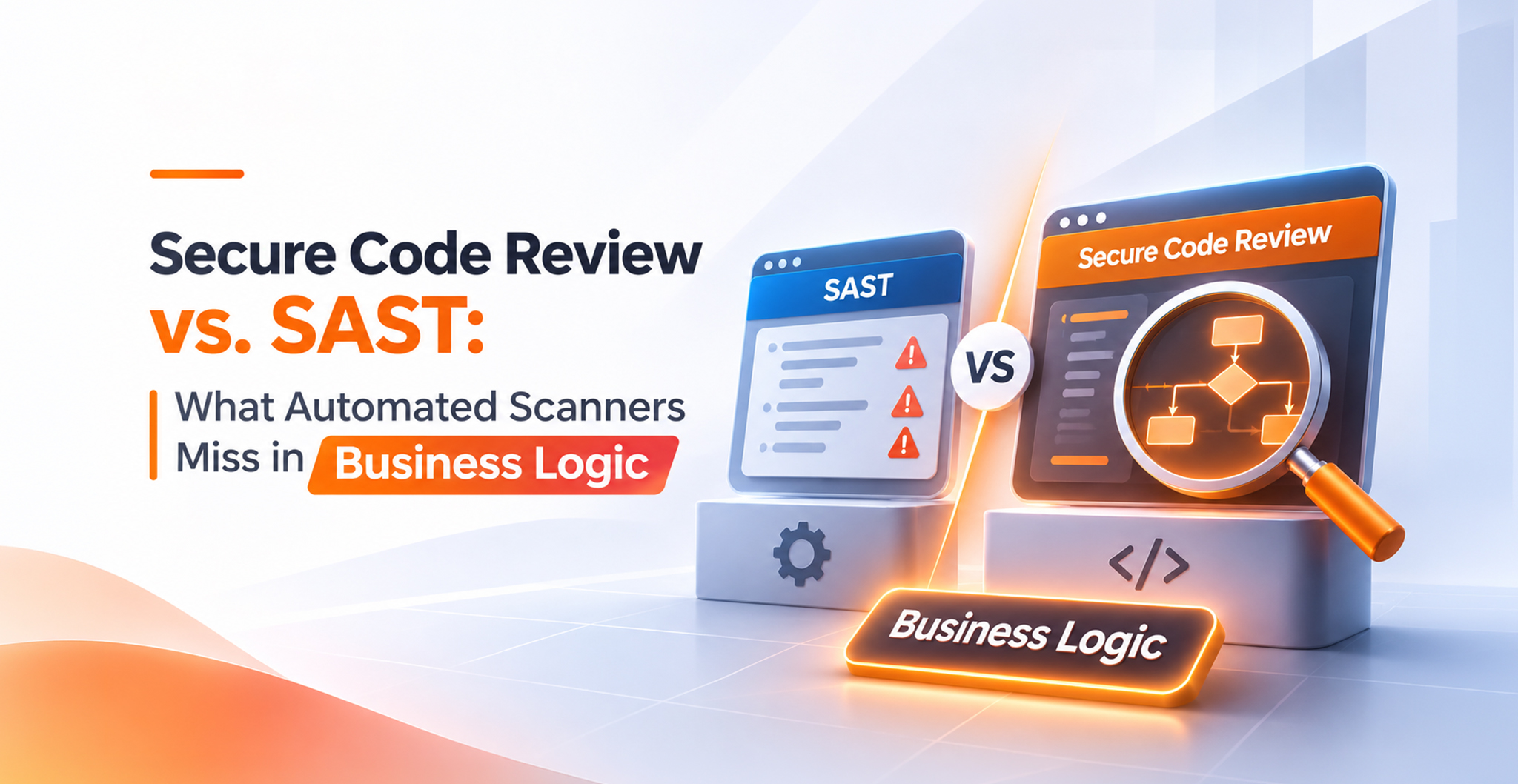
Applications house sensitive information about customers, financial data, and important business data. A single flaw in an application can put this data at risk and enable an attacker to control important business functions. SAST is a form of security testing in which the application’s source code is analyzed without execution to identify potential flaws. Automated scanning tools depend on rules, patterns, and heuristics. This is where a secure code review is important. Secure code review helps in understanding business logic embedded in the application. Integrating both the approaches of SAST and secure code review can enhance a company’s application security.
What is a Secure Code Review?
A secure code review scrutinize an application’s source code to discover vulnerabilities. There are four main areas of focus for secure code reviews, including code implementation, security controls, application workflows, and application business logic.
During secure code review, experts look at:
- Authentication and Authorization – Are users provided with appropriate permissions to access the application?
- Input Validation – Are users’ inputs validated?
- Data Handling – Is sensitive information processed and stored securely?
- Session Management – Are session tokens and controls implemented appropriately?
- Business Logic – Is the workflow of the application enforcing the business rules?
- Error Handling – Does the application expose sensitive information in error messages?
What is SAST (Static Application Security Testing)?
SAST is an automated security testing technique that takes a look at an application’s source code, bytecode, or binaries, and analyzes them without executing the application. SAST identifies potential vulnerabilities through analysis of code and data flow structures, as well as insecure patterns. SAST tools can also be integrated into CI/CD pipelines.
Some common vulnerabilities identified by SAST include:
- SQL injection and cross-site scripting (XSS).
- Hardcoded API keys and passwords.
- Insecure implementations of cryptography.
- Improper input validation and output encoding.
- Unsafe file handling and API implementations.
- Weaknesses in authentication and authorization.
Secure Code Review vs. SAST
The following differences illustrate the types of flaws each approach can find, and the limits of automated scanning.
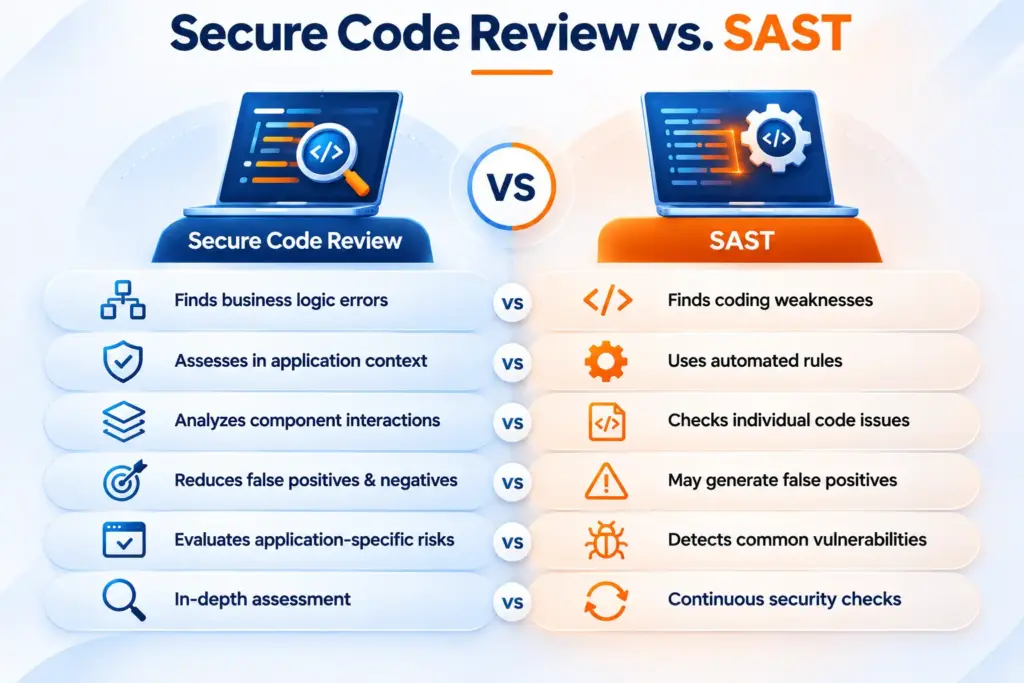
Automated Scanning vs. Manual Code Analysis
Secure Code Review
An approach to reviewing the source code of an application to find weaknesses is to analyze the code to understand the interaction and flow of data. This allows a reviewer to identify weaknesses that would require an understanding of an application’s functionality and how it protects data.
SAST
An approach to testing the source code of an application to find weaknesses is to use automated tools to scan the source code, bytecode, and/or binaries without even running the application. The tools, using pre-defined rules, identify weaknesses like SQL Injection, hardcoded credentials, and insecure cryptography.
Business Logic Vs. Known Coding Patterns
Secure Code Review
A review of application workflows can find weaknesses that allow users to misuse legitimate application functionality. An example of a defect found in an e-commerce application is allowing customers to reuse promotional discounts repeatedly. A reviewer can check the redemption logic to identify the above defect.
Static Application Security Testing (SAST)
SAST understands typical programming patterns and identifies concerns related to them. It will, however, be oblivious to business logic. Therefore, a SAST tool may not discover a coupon function that allows unlimited redemptions if the application code does not feature a well-known vulnerable pattern.
Contextual Security Assessment vs. Rule-based Detection
Secure Code Review
Security professionals perform code review considering application architecture, security, and other relevant requirements. They analyze access control, authorization, session management, and validation. For example, they can discover that an authenticated user is allowed to view or edit another user’s data due to missing access control.
SAST
SAST tools apply rules to identify code that may be vulnerable. SAST rules may detect missing authorization checks but may not be able to identify the application’s complete permission structure.
Complex Attack Scenarios vs. Individual Code Weaknesses
Secure Code Review
Security experts evaluate how different components of the application interact and analyze the overall application functionally to identify combined defects that are exploitable. For example, they can uncover that, by manipulating payments and transactions, an attacker can bypass account verification.
SAST
SAST focuses on identifying individual weaknesses and analyzes code structures and data flows. While sophisticated tools can perform cross-file analysis, tools may not be able to handle more complex attacks affecting multiple business operations.
False Positives and False Negatives
Secure Code Review
Human reviewers assess findings against application requirements and implementation details to determine if a given weakness is exploitable. The accuracy of this approach depends on the expertise of the human reviewers and the extent of the assessment.
SAST
Automated scanners may generate false positives, reporting non-exploitable code as weaknesses. Additionally, scanners may have blind spots and may not report weaknesses outside the scope of their rules and analysis. For instance, a scanner may not identify that the application performs additional security checks and may miss flaws in the application’s business logic.
Application-Specific Risks vs. Common Security Vulnerabilities
Secure Code Review
Different applications have different security requirements. A banking application must secure financial transactions, while a healthcare application must secure patient data. Secure code review helps determine if security controls in the application are implemented properly, such as transaction limits and role-based permissions.
SAST
SAST helps to detect common vulnerabilities, such as:
- SQL injection and cross-site scripting.
- Hard-coded credentials and exposed secrets.
- Insecure cryptographic implementations.
- Unsafe file handling.
- Improper input validation.
- Certain authentication and authorization weaknesses.
However, identification of violations of application-specific business rules requires additional input.
Continuous Security Checks vs. In-Depth Security Assessment
Secure Code Review
Secure code review is useful when an application undergoes a major version release, significant changes to functions or integrations, or changes to sensitive components. It offers a deeper assessment of security controls and business logic, but requires specialized skills and time.
SAST
SAST helps identify vulnerabilities during the development phase by scanning application code during CI/CD. This allows developers to focus on other functional changes.
How Kratikal Can Help Strengthen Application Security
At Kratikal, our goal is to help our clients gain a deep understanding of application security weaknesses through a range of security assessments. These include secure code review, PTaaS, and application security testing. We analyze an application’s architecture, review the mechanisms in place for authentication and authorization, and evaluate how an application handles and protects the sensitive data it manages.
We examine business logic to uncover weaknesses and flaws that may also impact the security of the application. Additionally, by understanding how a given component of an application works, and through analysis of a component’s interactions with other components, we identify misconfigurations and security weaknesses, and provide prioritized recommendations to remediate such issues.
Which Approach Should Businesses Take?
Businesses should take both approaches. SAST helps detect common coding vulnerabilities, while SCR helps detect more complex vulnerabilities that require analysis of application logic and business process flows.
Although SAST provides visibility into some code weaknesses, it can’t validate a given application’s security requirements. To gain an integrated view into security, organizations should invest in a combination of SAST, secure code review, PTaaS, and autonomous application security testing. This layered security approach provides comprehensive coverage and greater assurance.
FAQs
- Can SAST detect business logic vulnerabilities?
SAST can locate certain types of coding patterns related to business logic weaknesses. However, it can not fully understand and analyze the business requirements and determine if the application workflows can be manipulated in various ways to result in unexpected outcomes.
- Which vulnerabilities can secure code review identify?
It can find SQL injection, broken access control, authentication weaknesses, insecure data handling, race conditions, workflow and business logic vulnerabilities, etc., within the scope of the assessment.
- Is secure code review a manual or automated process?
Traditionally, it is a manual process that involves security professionals. However, recent advancements have integrated automated analysis of source code, thereby increasing the coverage and efficiency of the process.
- Does SAST replace manual code review?
No. SAST supports the detection of common coding weaknesses, but manual review of application architecture and business workflows is essential to understand why certain security weaknesses exist.
- When should organizations conduct secure code review?
Organizations should consider it during application development, before major releases, after large code changes, and when new sensitive features (e.g., payment processing, authentication and access control features) are added.
- How does secure code review help prevent business logic attacks?
It determines if an application enforces the business rules by analyzing the application workflows. So, if an application workflow can be manipulated to allow an unauthorized user to access a reward, it would be considered a business logic vulnerability.
- Should businesses use SAST and secure code review together?
Yes. Using both approaches provides improved application security coverage.