
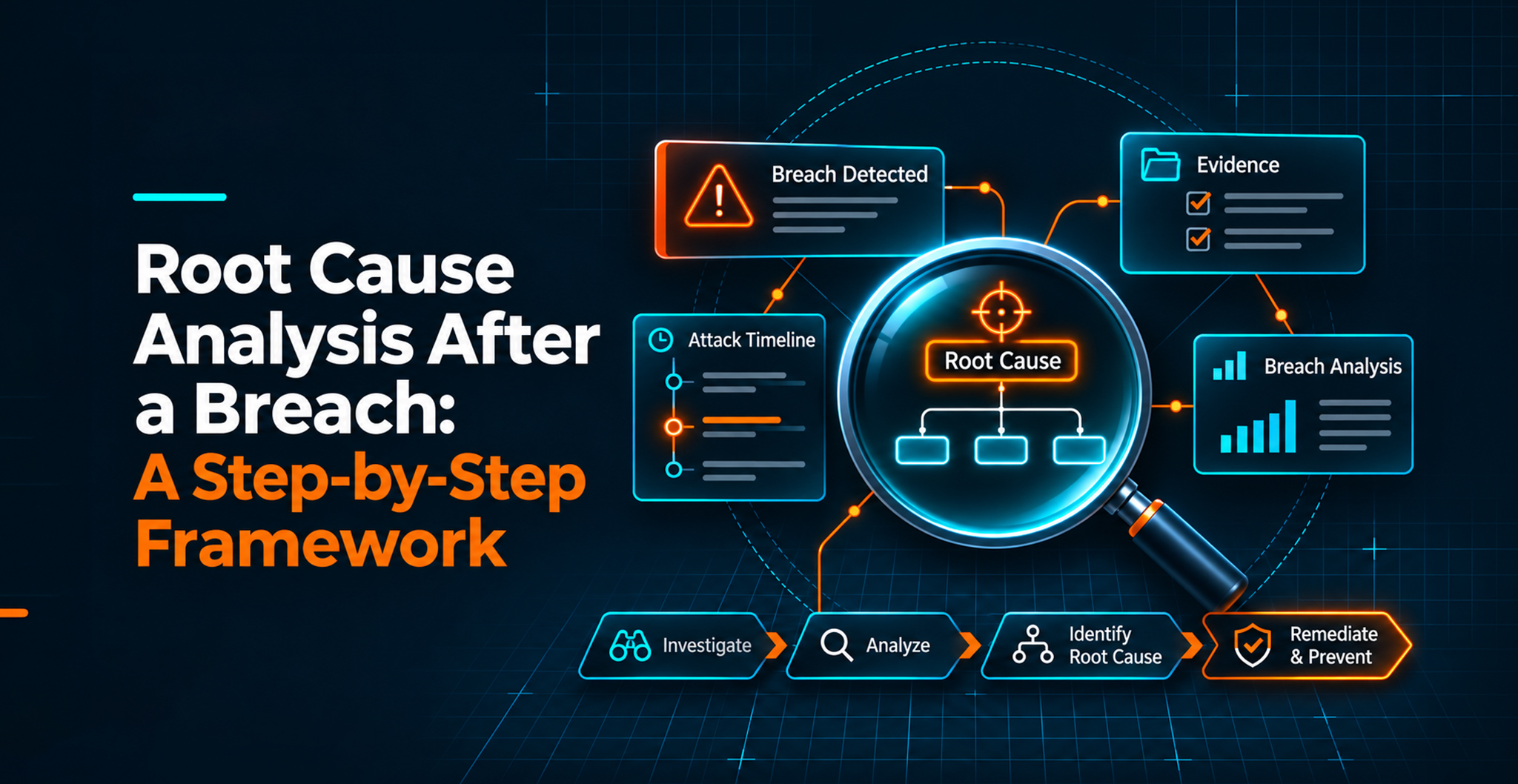
A data breach is more than just a security incident. Often, it is the first incident where attackers successfully exploit gaps and vulnerabilities in an organization’s infrastructure, control, access management, and internal processes. Of course, restoring the normal state of the business and containment are the immediate concerns after an attack. However, it is crucial for an organization to understand the causes that led to the breach. Root cause analysis framework are designed to aid the investigation of security incidents and breaches. These frameworks help identify the initial point of compromise and how attackers moved across the environment. It is important to understand why attackers were successful in breaching security. Fixing just the obvious damage may leave gaps that can lead to repeated attacks on the organization.
In this guide, we will explore a step-by-step root cause analysis framework that helps security teams investigate breaches, identify security gaps, and prevent similar incidents in the future.
What Is Root Cause Analysis After a Cybersecurity Breach?
RCA goes beyond identifying the attack vectors. Let’s take the example of a scenario where attackers gain access through compromised employee credentials. Just resetting the password does not complete the RCA of the incident. The security team must investigate how the credentials got compromised, the processes that attackers used to gain access to the internal systems, and what sensitive information got exposed.
This is where a structured root cause analysis framework is useful for security teams.
This typically involves:
- Collecting and preserving digital evidence.
- Constructing an accurate timeline of events.
- Identifying the initial vector of attack.
- Evaluating and assessing the security controls.
- Investigating the extent of the compromise and impacts.
- Implementing both corrective and preventive controls.
The goal is to analyze what happened, why it happened, and how to prevent it from happening again.

Book Your Free Cybersecurity Consultation Today!
Why Is Root Cause Analysis Important After a Breach?
A data breach can negatively impact customer trust and expose sensitive information. While it is necessary to respond immediately to resolve the breach, failing to analyze the root cause can put the organization at risk of similar breaches.
Root cause analysis provides:
- Attack Recurrence Prevention: Understanding the source of the weakness can allow security teams to fully address and resolve the issue rather than only address the symptoms.
- Attack Path Understanding: Reconstructing the attack can allow teams to understand the attacker’s movement through the system to help answer how attacker privileges were escalated.
- Sensitivity Impacts Analysis: Understanding which sensitive information was impacted.
- Improvement of Security Controls: Findings can lead to strengthening of access and management controls, network and computer system security.
- Compliance: Evidence of investigation can help address requirements for compliance and assurance.
A Step-by-Step Root Cause Analysis Framework After a Breach
A successful investigation requires a systematic approach. The following steps help security teams move from initial incident detection to identifying the root cause and implementing long-term improvements.
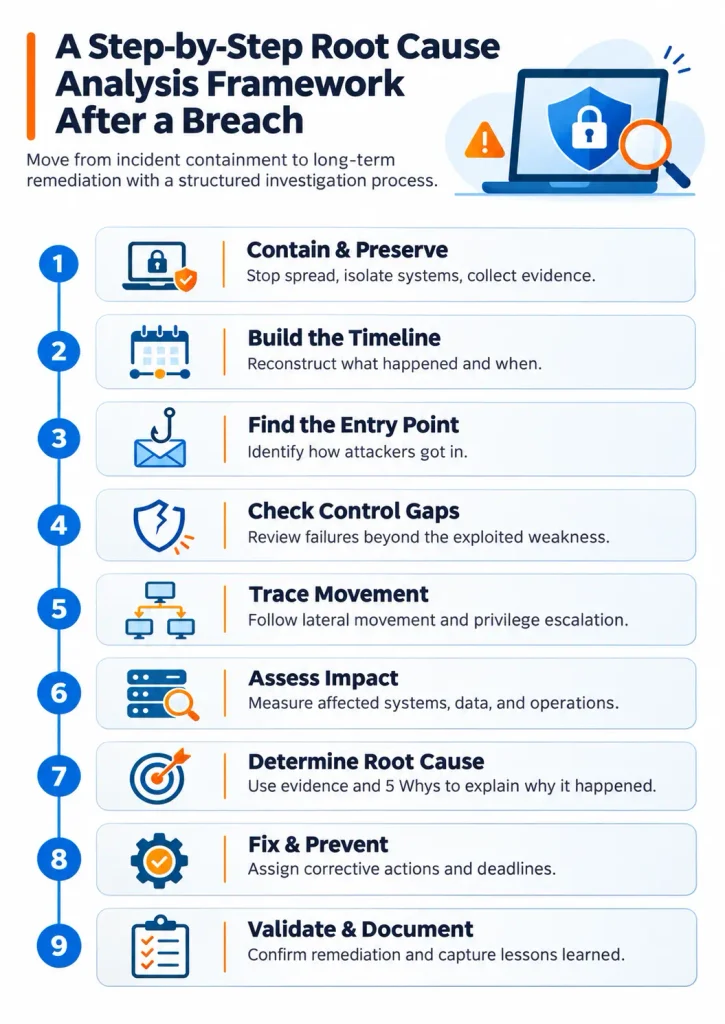
Contain the Incident and Preserve Evidence
The focus is on stopping the attack from spreading. Security teams should isolate the affected systems and block malicious connections. Compromised accounts should be disabled. There is forensic evidence that should be collected before systems are rebuilt.
These include:
- Application, system, and authentication logs.
- Network traffic records and endpoint alerts.
- Suspicious files, processes, and firewall activities.
- Cloud and activity records.
Those working the Incident should maintain evidence integrity by documenting and observing chain of custody procedures.
Establish a Detailed Incident Timeline
Security teams should reconstruct the event sequence to analyze when and how the breach happened.
For example, an attacker may start by phishing for credentials to access an internal application. The attacker may then use that access to escalate privileges to exfiltrate data. Investigators should connect endpoint and authentication logs as well as firewall logs. They should also correlate cloud logs. The aim is to understand the initial compromise, as well as other activities the attacker did later.
Identify the Initial Attack Vector
The next step is determining how attackers gained initial access.
Common entry points include:
- Compromised credentials from a phishing attack.
- Unpatched, vulnerable applications or services.
- Weak or compromised credentials.
- Insufficient or misconfigured cloud storage.
- Vulnerabilities in a third-party application.
- Weak or unsecure remote access.
Investigators should verify the attack vector using forensic evidence. Assumptions shouldn’t be made.
Identify Security Failures Beyond What Was Exploited
Locating the entry point does not always provide the full picture of the security failures. For example, if a server was exploited, there may be failures in the process for patch management or vulnerability assessments.
Things that should be examined include:
- Weak Authentication or Access Management: Leading to excessive permissions
- Unresolved Software Vulnerabilities or Patch Management
- Unrestricted Movement or Network Segmentation
- Insufficient Threat Detection or Endpoint Security
- Security Awareness: Training and awareness
- Configuration Management: Default, unrestricted, or exposed settings, services, etc.
This helps to identify security failures across the entire organization.
Trace Lateral Movement and Privilege Escalation
Attackers will often gain access to a system, move laterally, and raise their level of privileges. Security personnel should investigate logins by unauthorized users, privilege changes, unexpected remote connection activity, abnormal command execution, and access to protected resources. Analyzing movement helps to identify failings of identity security.
Assess the Impact and Scope of the Breach
Organizations must identify which systems and business operations have been impacted.
The investigation must identify:
- Compromised applications and infrastructure.
- Customer, employee, and/or financial data that has been exposed.
- Data that has been encrypted, modified, or deleted.
- Disrupted business services.
- Reporting requirements (i.e., regulations and contracts)
The investigation must also assess if sensitive information was altered or exfiltrated.
Determine the Root Cause and Contributing Factors
Investigators must integrate their findings and explore the root cause of the incident. The 5 Whys can be utilized to explore the root cause of the failure and identify deeper security issues.
For example:
- Why was the server compromised? Because an application on the server was outdated.
- Why was the application outdated? Because the server was not patched.
- Why was the server not patched? Because there was no process to patch the server regularly.
- Why was there not a process? Because it was not clear who was responsible for security.
- Why was it not clear? Because there was no formal vulnerability management policy.
Implement Corrective and Preventive Actions
Security teams should devise a remediation plan after identifying the root cause of an incident.
Some of the key actions may include:
- Enabling and/or enforcing MFA for all users.
- Removing any unnecessary/unwanted user privileges.
- Implementing more effective network segmentation.
- Improving endpoint protection by implementing EDR/MDR.
- Conducting periodic vulnerability assessments.
- Revising the Incident Response procedures and/or plans.
- Raising security awareness for the employees.
Each of the above key actions should be assigned to a person responsible for carrying it out, and a deadline should be specified to accomplish it.
Validate Remediation and Document Lessons Learned
The last step is to validate if the corrective actions implemented address the identified security weaknesses. Teams should conduct follow-on assessments (vulnerability, configuration, and/or pen tests), and review if similar weaknesses exist across the environment. Document and retain information regarding an incident to include the timeline, attack vectors, root causes, evidence, actions taken to address, and the residual risks. This may be of assistance in future security and/or incident response planning.
How Kratikal Can Help You with Root Cause Analysis?
At Kratikal, we help organizations identify the underlying causes of security breaches through a structured root cause analysis framework. Our experts investigate attack vectors, reconstruct incident timelines, analyze exploited vulnerabilities, and uncover gaps in security controls, access management, and processes. By combining evidence-based investigation with VAPT and incident response expertise, we help businesses understand how attackers gained access and what allowed the breach to occur. Our findings guide targeted remediation, strengthen security controls, and reduce the risk of similar incidents. With Kratikal’s support, organizations can move beyond immediate fixes and build a more resilient security posture.
Join our weekly newsletter and stay updated
Conclusion
Treating a breach as an opportunity to improve is more effective than finger-pointing. A root cause analysis framework assists security teams to move beyond containing the immediate impact of a breach. There are plenty of reasons for an organization to be grateful for a breach. Incidents preserve evidence and assist with reconstructing an attack’s timeline. Attack timelines assist with identifying weaknesses and help to validate remediation.
Although attack timelines assist with identifying weaknesses, they should not be relied upon. Weaknesses should be proactively identified and remediated through the continuous improvement and implementation of security controls. The combination of these initiatives and a thorough investigation reduces the likelihood of similar occurrences.
FAQs
- What is root cause analysis in cybersecurity?
In cybersecurity, root cause analysis is the process of finding the primary cause of a security incident and determining the contributing factors and the control failures.
- What are the main steps in a root cause analysis framework?
Steps include incident containment, preservation of evidence, reconstruction of the timeline, identification of the attack vector, investigation of the vulnerability, assessment of impact, identification of the root cause, remediation, and validation.
- How long does root cause analysis take after a breach?
The length of time depends on several factors, including the complexity of the breach, the number of impacted systems, and the availability of forensic evidence. Some straightforward cases can take a few days to complete. Others can take several weeks or longer.
- What tools are used for cybersecurity root cause analysis?
Common tools include Security Information and Event Management (SIEM) tools, Endpoint Detection and Response (EDR) tools, tools and techniques of Digital Forensics and Incident Response (DFIR), network traffic analysis tools, and vulnerability assessment tools.
- How can organizations prevent similar breaches?
Organizations can prevent similar breaches by addressing identified weaknesses, implementing improved access control, strengthening patch management, enhancing segmentation of their network, conducting more regular penetration tests, and continuously monitoring their infrastructure.