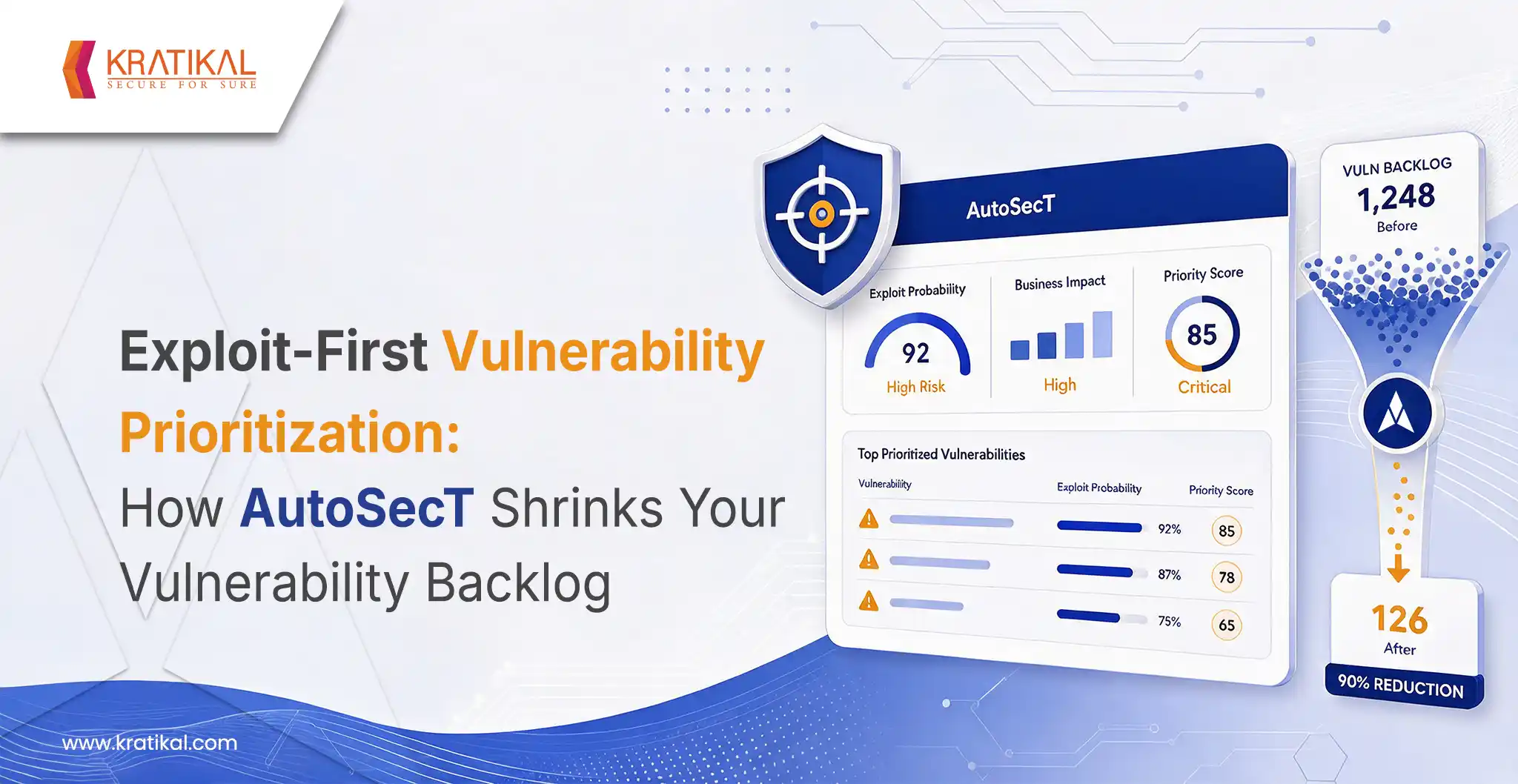
Your vulnerability backlog will never hit zero, and chasing zero is exactly what burns out security teams. What you need is vulnerability prioritization that tells you which handful of issues attackers can really use. That’s the problem AutoSecT, Kratikal’s AI-driven pentest and VM platform, was built to solve.
What is Vulnerability Prioritization?
Vulnerability prioritization is ranking security weaknesses by how likely they are to be exploited and how much damage they could cause, not by severity score alone. Teams weigh exploit availability, exposure, asset value and business impact, then fix the riskiest issues first.
Put simply, you stop asking “How bad does this look?” and start asking “Can someone really use this against us?”
Why Your Vulnerability Backlog Keeps Growing?
According to National Vulnerability Database data and historical CVE lists, 48,185 CVEs were published in 2025, a 20.6% jump over 2024. That’s about 131 new vulnerabilities every day.
Verizon’s 2026 Data Breach Investigations Report shows the problem getting worse. Fixing a critical vulnerability from CISA’s Known Exploited Vulnerabilities catalog now takes a median of 43 days, up from 32 the year before. And only 26% of these vulnerabilities were fully remediated.
You don’t have a scanning problem. You have a focus problem. Traditional vulnerability management finds everything and ranks it poorly, so your team spends weeks on issues that were never going to hurt you.

Book Your Free Cybersecurity Consultation Today!
CVSS vs EPSS
If you’re weighing CVSS vs EPSS, they answer different questions, and you need both.
| Signal | Question it Answers | Gap |
| CVSS | How severe could this be? | Doesn’t show if anyone is attacking it |
| EPSS | How likely is exploitation in the next 30 days? | A probability, not proof |
| CISA KEV | Is it already being exploited? | Lists issues only after attacks begin |
Even all three miss one thing: your environment. A KEV-listed bug on an isolated test server is not the same as a “medium” bug on your public payment portal. Context and proof of exploitability close that gap, and that’s where AutoSecT comes in.
How AutoSecT Turns Noise Into a Short Fix List
AutoSecT maps findings to MITRE ATT&CK and CVSS, so every prioritization decision is easy to defend to auditors and the board. AutoSecT doesn’t hand you a flat list sorted by CVSS. It works exploit-first, in six steps:
1. Onboard and scope
Add web URLs, APK/IPA files, APIs, cloud accounts or network ranges.
2. Discover and scan
Asset-specific scanners cover web, mobile, API, cloud and network, and the Smart Scan Scheduler runs recurring scans automatically.
3. AI-verify
Its agentic AI validates exploits in real time, so only genuine, exploitable vulnerabilities reach your dashboard. This is where most alert fatigue disappears.
4. Prioritize risk
Confirmed findings are ranked critical to low by severity, exploitability and business impact, with exploit intelligence such as known exploited vulnerabilities factored in.
5. Remediate and track
Each finding comes with AI-generated fix guidance, and tickets flow into Jira, Slack, Microsoft Teams, Google Chat and more
6. Report and monitor
Centralized vulnerability management dashboard show risk, remediation SLA progress and compliance tracking, and you get a verifiable VAPT certificate.
Your Backlog Status – Before and After AutoSecT
| Without Exploit-first Prioritization | With AutoSecT |
| Thousands of “critical” findings | A short list of AI-verified exploitable vulnerabilities |
| Analysts chase false alarms | Unverified noise filtered out before it reaches you |
| Manual categorization in spreadsheets | Auto-ranked by severity, exploitability and business impact |
| Fix guidance hunted down by hand | AI remediation steps on every finding |
| Handoffs by email | Integrate with tools your teams already use |
| Hard-to-explain priorities | Centralized Vulnerability Management Dashboard and detailed audit-ready reports available in any format you want |
Key Takeaways
No security team can fix every vulnerability, and the good news is that you don’t need to. Only a small share of vulnerabilities are ever exploited, so the real win comes from strong vulnerability prioritization. That means looking beyond a single score. CVSS tells you how severe a flaw could be, EPSS shows how likely it is to be attacked, and CISA’s KEV catalog confirms what attackers are already using. Add your own context, such as which assets are exposed and which ones run your business, and you get a fix list that reflects real risk instead of theoretical severity.
Join our weekly newsletter and stay updated
The biggest shift, though, is validating exploitability before an alert ever reaches your team. When only confirmed, exploitable vulnerabilities make it to the dashboard, the backlog shrinks and alert fatigue fades. That is exactly what AutoSecT automates. It scans your web apps, mobile apps, APIs, cloud and network, uses AI to verify what can really be exploited, ranks each finding by severity, exploitability and business impact, and tracks fixes through tools like Jira and Slack. Ready to see a shorter backlog in your own environment?
Book a demo a see how AutoSecT’s army of AI Agents work in unison today!
FAQs
- What is vulnerability prioritization?
It’s ranking vulnerabilities by exploit likelihood, exposure and business impact so teams fix the riskiest ones first instead of working down a severity list.
- Is CVSS enough for prioritization?
No. CVSS shows technical severity, not whether attackers are using a flaw or whether the asset is exposed. Pair it with EPSS, KEV and business context.
- What’s the difference between CVSS and EPSS?
CVSS rates how bad a vulnerability could be. EPSS estimates how likely it is to be exploited soon.
- How does AutoSecT prioritize vulnerabilities?
It uses agentic AI to validate exploitability, then ranks confirmed findings by severity, exploitability and business impact, and adds AI-generated remediation guidance.
- Does AutoSecT cover cloud, mobile and APIs?
Yes. It scans web apps, mobile apps (Android and iOS), APIs, cloud environments (AWS, Azure, GCP) and networks from one dashboard.
- Can I try AutoSecT before buying?
Yes. We offer a $1 trial scan with no commitment.