

Most security programs focus on stopping attackers from getting in. Firewalls, endpoint protection, email security, and perimeter monitoring all work to prevent the initial breach. But the bigger question is: Once an attacker gets inside, how far can they go? That is where lateral movement comes into play. Attackers can use stolen credentials, excessive permissions, legitimate administrative tools, and weak network segmentation to move from one system to another and reach critical assets.
Because this activity can look like normal network behavior, attackers may remain undetected for days or weeks. This makes lateral movement one of the most overlooked stages of the attack lifecycle. Organizations need to go beyond perimeter defense and use network VAPT and network penetration testing to test how an attacker could move through the network after gaining a foothold.
What Lateral Movement Actually Looks Like?
Lateral movement is the process attackers use to move from one compromised system, account, or network segment to another after gaining an initial foothold.
For example, an attacker may compromise an employee workstation through phishing. That workstation may not contain sensitive information, but it could provide access to internal applications, credentials, file shares, or administrative services. The attacker can use those opportunities to move toward a more valuable target.
A typical attack path could look like:
Internet → Employee Device → Internal Server → Privileged Account → Domain Controller → Critical Data
The initial compromise may be relatively low-impact. The real damage occurs when the attacker successfully moves through the environment.
This is why network security cannot focus only on preventing unauthorized entry. Organizations also need to understand how easily an attacker can move once inside.
How Lateral Movement Works?
Lateral movement starts when an attacker gets inside a network, often through a stolen password, a vulnerable device, or a low-privilege user account. Instead of immediately attacking important systems, the attacker first looks around. They identify other devices, understand how systems are connected, and search for saved passwords or weak permissions that can help them move from one system to another.
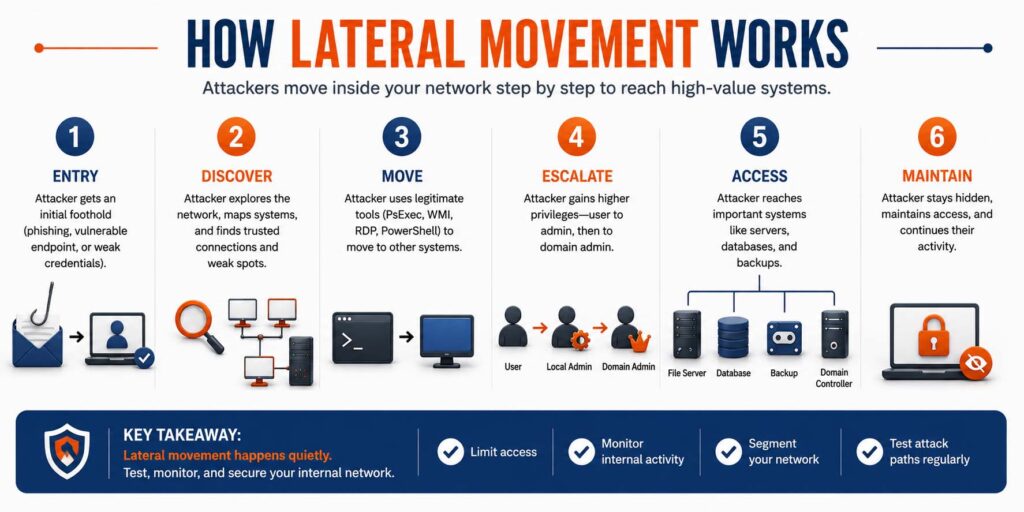
Attackers may use legitimate tools such as PsExec, WMI, RDP, or PowerShell to avoid raising suspicion. They gradually gain more access, moving from a regular user to a local administrator and eventually to a domain administrator. This can give them access to critical systems such as file servers, databases, backups, or domain controllers. Since their actions can look like normal IT activity, attackers may remain hidden for days or even weeks before security teams detect them.
Common Methods Used for Lateral Movement
Attackers use a variety of techniques to move between systems, gain higher privileges, and reach critical resources after gaining an initial foothold.
- Pass-the-Hash (PtH): Attackers use a stolen password hash to authenticate to systems without knowing the actual password. Since Windows environments can accept password hashes for authentication, systems that rely heavily on NTLM can be especially vulnerable.
- Pass-the-Ticket (PtT): Attackers steal Kerberos authentication tickets and use them to access systems as legitimate users without needing their passwords. This can be particularly risky in organizations with large Windows-based environments.
- Kerberoasting and NTLM Relay: With Kerberoasting, attackers request Kerberos service tickets for Active Directory accounts and attempt to crack them offline to recover passwords. NTLM relay attacks intercept authentication attempts and forward them to another system to gain unauthorized access.
- RDP, SMB, and SSH Abuse: Attackers can misuse remote access protocols such as RDP, SMB, and SSH to connect to other systems using compromised accounts or credentials, making their activity appear like normal administrative access.
Book Your Free Cybersecurity Consultation Today!

Why Security Teams Often Miss Lateral Movement?
Traditional security assessments frequently focus on identifying vulnerabilities on individual assets.
A vulnerability scanner might identify:
- An outdated operating system
- An exposed service
- A weak configuration
- Missing security patches
- Weak encryption
- Unnecessary open ports
These findings are important, but they do not necessarily explain how vulnerabilities can be chained together. An attacker does not view the environment as a collection of isolated vulnerabilities. They view it as an interconnected attack path. A low-severity vulnerability on one system might provide credentials that lead to another system. That system might expose a privileged service, which could eventually provide access to a domain administrator account.
Individually, each issue may appear manageable. Together, they can create a high-impact attack chain. This is one reason network pentesting is important alongside automated vulnerability scanning.
Key Strategies to Block Lateral Movement
Stopping lateral movement requires more than securing the network perimeter. Organizations need to limit unnecessary access, protect identities, monitor internal activity, and regularly test how an attacker could move through the environment after gaining a foothold.
- Strengthen Network Segmentation
Divide the network into well-defined segments and restrict communication between them. Critical assets such as databases, domain controllers, and backup systems should not be directly accessible from regular user networks.
- Monitor Internal Network Activity
Security monitoring should not stop at the network perimeter. Track unusual login attempts, unexpected remote connections, privilege changes, abnormal administrative activity, and unusual communication between internal systems. Early detection can help identify attackers before they reach critical assets.
- Regularly Test Internal Attack Paths
Conduct regular network penetration testing and adversary-style assessments to simulate what could happen after an initial compromise. Testing should identify whether attackers can move between systems, escalate privileges, bypass segmentation, or reach sensitive infrastructure.
- Build a Defense-in-Depth Strategy
No single security control can completely prevent lateral movement. Combining network security, strong identity controls, segmentation, continuous monitoring, vulnerability management, and VAPT gives organizations a better chance of detecting and stopping attackers before they reach their most valuable assets.
Join our weekly newsletter and stay updated
Conclusion
Lateral movement is often where a small security breach turns into a major compromise. Once attackers gain a foothold, weak credentials, excessive privileges, poor segmentation, and unmonitored internal activity can help them reach critical systems. Organizations need to look beyond perimeter defense and regularly assess how an attacker could move through their environment. Combining strong network security, least-privilege access, continuous monitoring, and regular network VAPT and network penetration testing can help identify and close these attack paths before attackers exploit them.
FAQs
- How can network segmentation reduce lateral movement?
Proper segmentation limits communication between systems and reduces the number of resources an attacker can reach after compromising one device.
- What role does least privilege play in preventing lateral movement?
Least privilege limits user and service-account permissions, making it harder for attackers to use a compromised account to access additional systems.
- Can lateral movement happen without exploiting a vulnerability?
Yes. Attackers can use legitimate credentials, excessive permissions, misconfigured systems, and trusted network relationships to move through an environment without exploiting a software vulnerability.
- What are common signs of lateral movement?
Unusual login patterns, unexpected remote connections, access from unfamiliar systems, sudden privilege changes, and abnormal internal traffic can indicate lateral movement.
- What role does Active Directory play in lateral movement?
Weak permissions, excessive privileges, compromised accounts, and poorly configured trust relationships in Active Directory can create pathways for attackers to access additional systems.