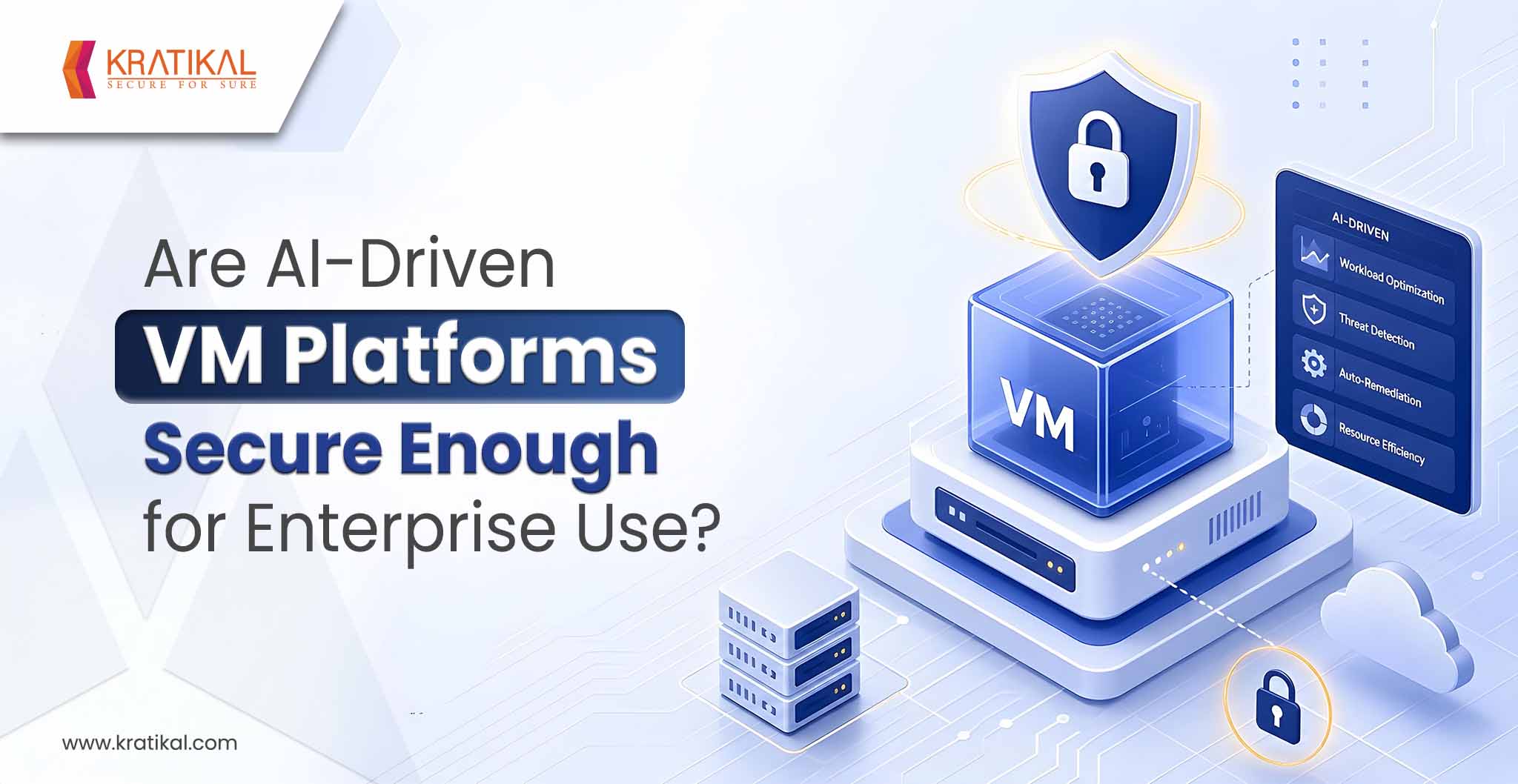
We know VM platforms are a must for ensuring continuous monitoring and security. With every development in security comes a series of ‘buts’ and ‘ifs’ that, if left unaddressed, could become a gateway to major cyberattacks. One such question is: ‘Are AI-Driven VM Platforms Secure Enough for Enterprise Use?’ The answer is both ‘Yes’ and ‘No’ based on the VM platforms you use. Coming to ‘Enterprise Use’, evaluating the security of a VM platform has become a necessity, given its interconnectedness among the inventory stack, where one broken door in an asset is enough to shut down a complete organization. And, with the platform being completely driven by AI, the ‘trust’ factor among organizations is a bit positive-deficient.
That is why this blog is for: to discuss how secure an AI-driven VM platform is for you, given its array of extraordinary features to curb cyberattack risks. Let’s start with what the world has to say –
Does the Evidence Say in Favour of AI-Driven VM Platforms?
The strongest validated data point is IBM’s Cost of a Data Breach Report 2026 (Ponemon Institute, 602 breached organisations across 16 countries, incidents from March 2025 to February 2026). Organisations using security AI and automation extensively averaged USD 4.00 million per breach versus USD 5.93 million for those using none, a saving of USD 1.93 million and contained breaches 65 days faster. Only 36% use these AI-driven VM platforms extensively, up modestly from 32%.

Book Your Free Cybersecurity Consultation Today!
AI-Driven VM Platforms Security – Where the Real Risk Sits?
The attack surface is the plumbing, not the VM Platform:
IBM found prompt injection incidents averaged $5.89 million and model inversion attacks $6.07 million, and that these were rarely caused by weaknesses in the platforms themselves, but traced back to compromised APIs, connected applications, plug-ins, and cloud misconfigurations. Cloud misconfigurations and compromise of connected apps, APIs or plug-ins were the two most-reported incident types, at 27% each.
The Systemic Gap is Access Control:
92% of organisations that suffered an AI-related breach lacked proper AI access controls. Only 40% applied access controls to AI models and data at all, and 68% of breached organisations had no AI governance policy.
Immature Agentic Integrations:
Prompt injection remains OWASP’s #1 LLM risk precisely because LLMs process instructions and data in the same channel without clear separation, so a model can’t distinguish attacker-crafted input from legitimate content.
If your VM platform ingests untrusted content like scan output, ticket text, code comments, third-party advisories, that’s an injection vector. The MCP layer many platforms now use for tool access is worse: Censys counted 12,520 internet-accessible MCP services, most unauthenticated, and a separate study found roughly 40% of remote servers expose tools with no authentication at all.
Is AutoSecT AI-Driven VM Platform Safe for Enterprise Use?
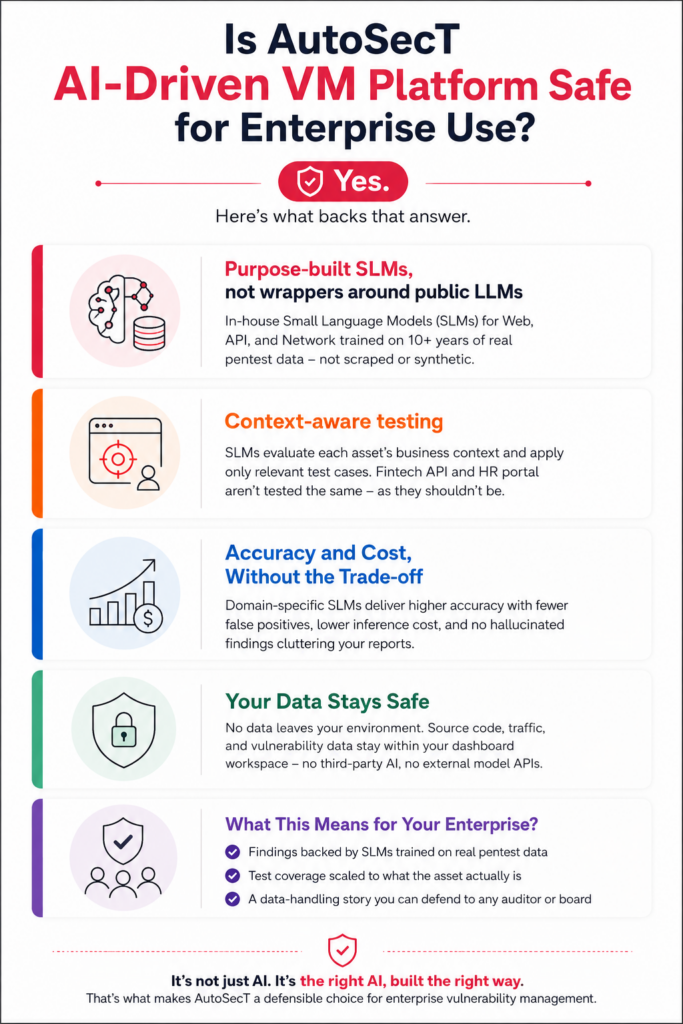
Yes, AutoSecT delivers enterprise-grade security, and the reasoning behind that assurance matters more than the answer itself. For a CISO evaluating any AI-driven VM platform, “safe” is a question about data handling, platform origin, and whether the AI is making decisions you can actually trust. Here’s what backs up that “yes.”
1. Purpose-built SLMs instead of using a wrapper around a public LLM
A lot of “AI-powered” security platform on the market today are really just prompt engineering layered on top of a general-purpose LLM like GPT or Claude. A general-purpose model wasn’t trained to think like a penetration tester, so it has to be coached into the task every time, and its judgment is only as good as the prompt.
AutoSecT takes a different architectural approach. Kratikal has built in-house Small Language Models (SLMs) dedicated to specific scanning domains – Web, API, and Network. Each SLM is trained on thousands of datasets built from over a decade of real audit and penetration testing findings produced by Kratikal’s own security engineers, instead of scraped or synthetic data.
That distinction matters because AutoSecT has effectively absorbed the pattern-recognition instincts of thousands of real-world engagements which vulnerability classes actually show up in which contexts, which findings are true positives versus noise, and how a live application actually behaves under test versus how it looks on paper.
2. Context-Aware Testing Unlike The Conventional
AutoSecT’s SLMs work differently than traditional VM platforms. When a new application is onboarded, the relevant model evaluates the asset’s business context like its functionality, data flows, and use case, and determines which test cases are actually applicable, rather than firing a generic scanner template at everything. A customer-facing fintech API and an internal HR portal don’t carry the same risk profile, and they shouldn’t be tested identically. This is where the “hundreds of thousands of findings” training base pays off. The SLMs has seen enough real-world variation to make that judgment call reliably, rather than guessing.
3. Accuracy and Cost, Without the Trade-off
Off-the-shelf LLMs are expensive to run at scale precisely because they’re generalists. You’re paying for a model that also knows how to write poetry and summarize contracts, none of which helps it find an IDOR vulnerability. A domain-specific SLM, trained narrowly on security findings, does the one job it needs to do with fewer parameters, lower inference cost, and critically, fewer hallucinated or irrelevant findings cluttering your risk report.
4. Your Data Stays Safe
This is the part enterprise security teams care about most. Because AutoSecT doesn’t outsource scanning logic to third-party AI providers or send your application data to an external model API, your source code, traffic patterns, and vulnerability data never leave the platform’s controlled environment – Your dashboard workspace. It’s worth being precise here! No scanning platform can promise zero risk, that’s true of any enterprise software, but keeping the entire AI pipeline in-house is a materially stronger security posture than routing your data through an external model provider.
What This Means for Your Enterprise
Put together, AutoSecT AI-Driven VM platform gives enterprise security teams three things they can defend to an auditor or board:
- Findings backed by a small language model trained on real pentest data rather than internet text
- Test coverage that scales to what the asset actually is instead of a one-size-fits-all memo.
- A data-handling story that doesn’t require trusting a fourth-party AI vendor with your crown jewels.
That combination and not the “AI” label itself is what makes AutoSecT a defensible choice for your enterprise’s vulnerability management.
Join our weekly newsletter and stay updated
FAQs
- Are AI-driven VM platforms secure enough for enterprise use?
Yes, AI-driven VM platforms can be secure for enterprise use when they provide strong access controls, protected data handling, domain-specific AI, continuous monitoring, and transparent vulnerability validation.
- What makes an AI-driven vulnerability management platform secure?
A secure AI-driven VM platform uses controlled data environments, strong access management, domain-specific models, accurate testing, continuous monitoring, and safeguards against prompt injection and unauthorized access.
- What are the main security risks of AI-driven VM platforms?
Key risks include compromised APIs, cloud misconfigurations, weak AI access controls, insecure integrations, prompt injection, exposed agentic tools, and unauthorized access to sensitive vulnerability or application data.
- How does AI improve vulnerability management for enterprises?
AI improves vulnerability management by prioritizing risks, identifying relevant attack paths, reducing irrelevant findings, analyzing asset context, and accelerating detection and remediation across large enterprise environments.
- Can AI-driven VM platforms protect sensitive enterprise data?
They can, provided the platform keeps source code, vulnerability data, traffic patterns, and testing information within a controlled environment instead of sending them to external AI providers.
- What is the role of Small Language Models in vulnerability management?
Small Language Models can improve vulnerability management by using security-specific training data to deliver context-aware testing, lower inference costs, and fewer irrelevant or hallucinated findings than general-purpose models.
- How should enterprises evaluate an AI-driven VM platform?
Enterprises should evaluate AI architecture, data handling, access controls, model security, integration risks, testing accuracy, governance, vulnerability validation, and whether the platform supports their specific business and technical context.
- Is AutoSecT safe for enterprise vulnerability management?
AutoSecT is designed for enterprise vulnerability management using purpose-built SLMs, context-aware testing, and a controlled AI pipeline that keeps scanning logic and customer security data within the platform environment.