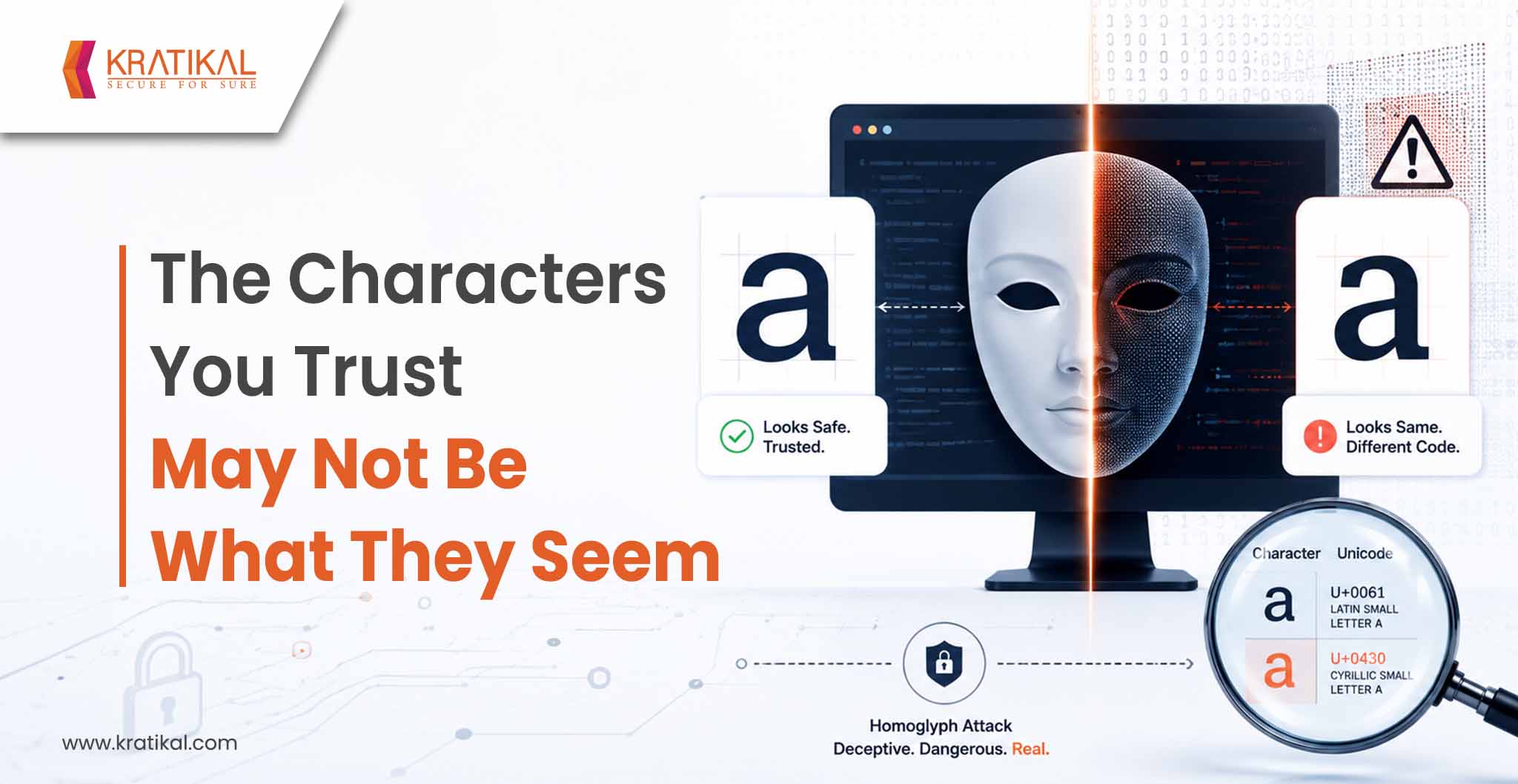
At first glance, two characters can look identical. Yet, beneath their visual appearance, they may have completely different digital identities. This simple mismatch between what users see and what computers interpret creates an opportunity for attackers to exploit human perception. Homoglyph Attacks take advantage of visually similar characters from different alphabets or character sets to create deceptive domains, usernames, file names, and identifiers. To the human eye, the difference may be almost impossible to notice. To a computer, however, these characters are distinct.
As organisations increasingly depend on digital identities, web applications, cloud platforms, and internationalised domain names, understanding the technical reality behind Homoglyph Attacks has become critical.
A Brief of Homoglyph Attacks
Homoglyph Attacks occur when threat actors register domains, craft email addresses, or design phishing pages using characters from different alphabets or scripts that visually resemble legitimate ones. The Cyrillic “а” (U+0430) looks nearly indistinguishable from the Latin “a” (U+0061) in most fonts, but to a computer, they are entirely different code points pointing to entirely different resources.
This means an attacker can register “аmazon.com” using a Cyrillic “а” instead of the Latin one, and to the naked eye, it’s a perfect match for the real Amazon domain, while technically being a completely separate, attacker-controlled destination.
The Technical Mechanics Behind the Deception
The deception works because computers process characters based on their underlying Unicode values, while humans often rely on how those characters visually appear.
1) Unicode: A Blessing and a Vulnerability
The root cause of homoglyph attacks lies in Unicode, the character encoding standard that allows the internet to support over 150 scripts and 140,000+ characters across global languages. While Unicode enables true internationalization of the web, it also introduced a side effect: many characters across different scripts share near-identical or completely identical glyphs.
- Cyrillic and Latin overlap: Characters like а, е, о, р, and с exist in both scripts but map to different Unicode code points.
- Greek script confusables: Letters such as α (alpha) or ο (omicron) can substitute for Latin “a” and “o.”
- Full-width and mathematical variants: Unicode also includes stylistic variants of standard characters (used in typography) that render visually identical to their ASCII counterparts.
2) Internationalized Domain Names (IDNs) and Punycode
Homoglyph attacks became significantly more risky with the rollout of Internationalized Domain Names (IDNs), which allow non-ASCII characters in domain names. Since DNS infrastructure only understands ASCII, browsers convert these Unicode domains into an ASCII-compatible encoding called Punycode, prefixed with “xn--“.
So while a user sees “аpple.com”, the actual underlying domain resolves to something like “xn--pple-43d.com”, a completely different, attacker-registered domain that most browsers will render using the deceptive Unicode glyphs rather than the revealing Punycode string.
This gap between what’s displayed and what’s actually resolved is the technical crux of the IDN homograph attack, a specific and widely-used subtype of homoglyph attacks.
3) Beyond Domains: Email and UI-Level Spoofing
Homoglyph techniques aren’t limited to browser address bars. Attackers use the same principle to:
- Spoof sender display names and email addresses in phishing campaigns that bypass basic string-matching filters.
- Forge file names, application names, or UI labels in social engineering attacks targeting internal systems.
- Bypass brand-monitoring and typosquatting detection tools that rely on exact ASCII string comparisons rather than visual or Unicode-normalized analysis.
As Homoglyph Attacks exploit the gap between what users see and what systems interpret, Kratikal helps organisations uncover such hidden security risks through proactive cybersecurity testing and assessment.
How Are Homoglyph Attacks Constructed?
Attackers typically begin by identifying a legitimate name or identifier that users already trust. They then replace one or more characters with visually similar Unicode characters.
Step 1: Target Selection
The attacker identifies a high-value target, a brand, financial institution, internal company portal, or executive, that people trust and interact with frequently. They study exactly how that target’s name, domain, email format, or UI elements normally appear.
Step 2: Finding Confusable Characters
Using Unicode’s vast character set (150+ scripts, 140,000+ characters), the attacker identifies homoglyphs, characters from different scripts that are visually identical or nearly identical to the target’s legitimate characters:
- Latin “a” vs. Cyrillic “а”
- Latin “o” vs. Greek “ο” (omicron)
- Latin “l” (lowercase L) vs. “I” (uppercase i) vs. “1” (digit one) — even within ASCII, font rendering can make these confusable
- Full-width or mathematical Unicode variants that render identically to standard characters
Step 3: Crafting the Deceptive Asset
Depending on the attack surface, this takes different forms:
- Domains: Registering a look-alike domain using substituted characters (e.g., microsоft.com with a Cyrillic о)
- Email addresses: Spoofing a sender’s display name or address using homoglyph characters to bypass exact-match filters
- File and application names: Naming a malicious file or app to visually mimic a trusted one in a file explorer or app store listing
- UI elements: Replicating login buttons, form labels, or system prompts with subtly altered text to slip past automated content scanners
Step 4: Infrastructure Setup
The attacker builds supporting infrastructure to make the deception convincing: a cloned website, a valid SSL/TLS certificate (easy to obtain since CAs verify ownership, not brand similarity), and often a working backend to proxy stolen credentials to the real service in real time so victims don’t notice anything wrong.
Step 5: Exploitation
Once the victim interacts, clicks the link, enters credentials, downloads the file, or approves a spoofed prompt, the attacker harvests credentials, session tokens, payment details, or deploys malware, depending on the campaign’s goal.
The Bigger Security Picture
Homoglyph Attacks demonstrate an important principle in cybersecurity: what users see is not always what systems process.
The attack does not necessarily require exploiting a software vulnerability. Instead, it exploits the difference between visual interpretation and technical representation.
As organisations adopt internationalised applications, cloud services, global identities, and Unicode-compatible systems, this risk becomes increasingly relevant.
Security teams should therefore treat identity validation as a technical security problem rather than only a user-awareness issue.
The most effective defence combines:
- Unicode-aware application design
- Mixed-script detection
- Identifier validation
- Domain monitoring
- Threat intelligence
- Security awareness
- Continuous security testing
Conclusion
Homoglyph Attacks are a reminder that not every threat announces itself through broken code, malformed payloads, or obvious red flags. Sometimes, the most effective attacks exploit the simplest thing of all, the trust we place in what we see on screen. As Unicode adoption and internationalized infrastructure continue to expand, the attack surface for homoglyph-based deception will only grow, making proactive detection, employee awareness, and rigorous domain monitoring non-negotiable parts of any mature security posture.
As digital environments become more interconnected and Unicode becomes increasingly common, security controls must evolve beyond simple string matching. Detecting the difference between what something looks like and what it actually is can be the key to preventing identity confusion and protecting critical digital.
FAQs
- Why are Homoglyph Attacks difficult to detect?
Homoglyph Attacks are difficult to detect because humans tend to rely on visual appearance. A malicious identifier may look almost identical to a trusted one, while security systems and computers interpret the characters as completely different.
- What is the role of Unicode in Homoglyph Attacks?
Unicode allows computers to represent characters from multiple writing systems. Attackers can abuse this capability by using characters from different scripts that visually resemble Latin letters or other commonly used characters.
- Can Homoglyph Attacks target domain names?
Yes. Attackers can create internationalised domain names using visually similar Unicode characters. These domains may appear similar to legitimate websites, creating opportunities for identity deception and other security risks.
- What is Punycode, and how is it related to Homoglyph Attacks?
Punycode is an encoding system used to represent Unicode characters in domain names using ASCII-compatible characters. It plays an important role in internationalised domain names, which can sometimes be abused to create visually deceptive domain names.
- Can Homoglyph Attacks affect applications and source code?
Yes. Visually similar characters can potentially be used in usernames, variable names, function names, configuration files, and other identifiers. This can create confusion for developers, reviewers, and security teams.