


Every NBFC works under strict rules. These rules protect customer data, financial systems, and the overall market. But meeting every compliance requirement is not easy. New regulations come frequently, and cyber threats keep growing, but still, many teams depend on traditional processes and limited resources. This creates gaps that often go unnoticed until a regulator or attacker finds them. Weak access, poor log monitoring, or an outdated risk analysis can create compliance failures. It can also expose your business to cyber attacks. These gaps also increase the chance of service downtime, fraud, and data leaks. Even a small issue today can create a major business risk tomorrow.
For CISOs and security leaders, the challenge is to reduce risk while meeting the RBI guidelines and audit requirements. This is not always easy because many systems do not work well together. In many cases, teams review security only when an audit is near, and this leaves important compliance gaps unnoticed. The way is to find these gaps early and fix them before they turn into bigger business and regulatory risks. This is where a CICRA audit comes in. It helps NBFCs identify compliance gaps, improve security controls, and prepare for regulatory audits. It helps organizations find and reduce risks and stay compliant with changing regulatory requirements.
Table of Contents
Why NBFCs Face Higher Regulatory Risks?
NBFCs handle sensitive customer and financial data daily. This includes loan records, PAN and Aadhaar details, banking information, KYC documents, payment transaction data, credit history, mobile app user data, and more.
At the same time, many NBFCs now depend heavily on cloud infrastructure, APIs, mobile lending apps, third-party vendors, remote work systems, and digital onboarding platforms. Every connected system increases the attack surface. If security controls are weak, attackers can enter systems easily. This is where a CICRA audit becomes critical. It helps NBFCs identify gaps in infrastructure, compliance processes, access controls, and data protection measures.
Book Your Free Cybersecurity Consultation Today!

What is a CICRA Audit?
A CICRA audit refers to a compliance audit, or an audit to verify that banks, non-bank financial corporations (NBFCs) and other authorized entities comply with both the provisions of the Credit Information Companies (Regulation ) Act, 2005 (CICRA) and the associated guidelines as laid down by the Reserve Bank of India.
The audit cross-examines the customer credit information of an organization. It audits the gathering, retention, utilization, and distribution of credit information in a secure and privacy-compliant manner. It also analyses the security controls, including access controls, data protection, logging, and monitoring, to safeguard customer information.
A CICRA audit assists NBFCs in:
- Identify compliance gaps.
- Secure customer credit information.
- Improve security controls.
- Be ready for regulatory checks.
- Reduce the risk of penalties, data breaches, and reputational damage.
Major Compliance Gaps That Put NBFCs at Risk
Many NBFCs believe compliance only means documentation. In fact, regulators now focus on technical security controls, monitoring systems, and incident response readiness. Below are some of the compliance gaps that create regulatory risks:
Weak Access Control Management
Many organizations don’t limit access to employees, vendors, or third-party users. Also, weak passwords and poor access management create serious security risks. If attackers access one account, they can move quickly across systems. The common issues include –
- Shared user accounts
- Weak password policies
- No MFA implementation
- Excessive admin privileges
- Poor identity monitoring
A proper CICRA audit helps identify risky access permissions and weak authentication controls.
Poor Vulnerability Management
Many NBFCs fail to patch vulnerabilities on time. Old systems, unpatched servers, and outdated applications remain exposed for months. Cyber attackers actively scan financial institutions for such weaknesses.
NBFCs should regularly perform:
- Vulnerability assessments
- Penetration testing
- Patch management reviews
- Cloud security checks
- API security testing
This is why businesses conduct regular CICRA audit assessments to reduce compliance exposure.
Insecure APIs and Digital Platforms
Most NBFCs now depend on APIs for mobile apps, payment gateways, loan processing, KYC verification, and third-party integrations. But insecure APIs create major risks. Attackers can exploit weak APIs to steal customer data, bypass authentication, manipulate transactions, access backend systems, etc.
OWASP reports API attacks are rising globally due to poor authentication and weak security testing. A detailed CICRA audit helps businesses identify insecure API configurations and access flaws.
Weak Cloud Security Controls
NBFCs are rapidly moving to cloud platforms. But cloud misconfiguration remains a major security issue. Common cloud risks include open storage buckets, poor IAM settings, exposed databases, weak monitoring systems, and unsecured backup environments, among others.
One small configuration mistake can expose sensitive financial records. According to Gartner, cloud misconfigurations are one of the leading causes of cloud security incidents. A strong CICRA audit helps identify cloud security gaps before they create regulatory trouble.
Lack of Incident Response Planning
Many NBFCs still lack a proper cyber incident response plan. When attacks happen, teams struggle with threat containment, regulatory reporting, customer communication, recovery planning, and evidence collection
This delay increases financial and compliance risks. RBI and CERT-In now expect organizations to report incidents within defined timelines. Some of the key response gaps include no incident response drills, poor threat visibility, weak forensic readiness, delayed escalation process.
A proper CICRA audit evaluates incident preparedness and response maturity.
Third-Party and Vendor Risks
NBFCs work with many external vendors for KYC services, payment systems, cloud hosting, collection platforms, and CRM solutions. If vendors have weak security, attackers can enter through third-party systems.
Supply chain attacks are now increasing across financial sectors globally. Third-party involvement continues to play a role in many breach incidents. This makes vendor risk assessment a major part of every CICRA audit.
Weak Employee Security Awareness
Employees are also one of the biggest cybersecurity risks. Without awareness training, employees may unknowingly expose sensitive systems. To reduce this risk, organizations should conduct regular security and compliance training. Kratikal’s compliance team provides awareness sessions to help employees understand regulatory requirements, recognize cyber threats, and follow security best practices. This helps build a stronger security culture and supports ongoing compliance.
Important controls include security awareness programs, insider threat monitoring, and access control reviews. Many organizations include employee security reviews during a CICRA audit process.
Compliance Documentation Gaps
Some NBFCs implement security controls but fail to maintain proper compliance records. Missing documentation can create problems during audits and investigations. This may include missing policy documents, no risk assessment reports, weak audit trails, incomplete access logs, poor incident records, etc.
Regulators expect proper documentation for every security process. A structured CICRA audit helps maintain compliance evidence and audit readiness.
Business Impact of Compliance Failures
Compliance gaps can affect more than cybersecurity, and they directly impact business operations and growth. A major security incident can lead to financial penalties, regulatory action, customer trust loss, legal complications, business disruption, reputation damage, and operational downtime.
For NBFCs, even short service disruptions can affect thousands of customers. This is why businesses now treat CICRA audit assessments as part of long-term risk management.
CICRA Audit – Kratikal’s Approach
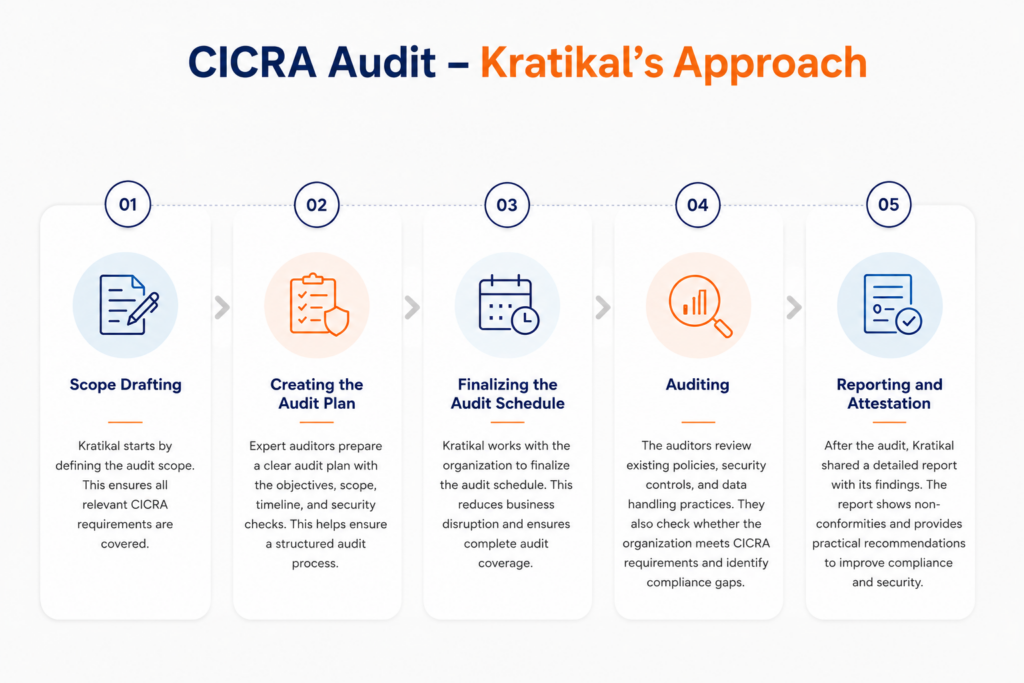
Here’s how Kratikal’s compliance team proceeds with the internal audit for your organization:
- Scope Drafting: Kratikal starts by defining the audit scope. This ensures all relevant CICRA requirements are covered.
- Creating the Audit Plan: Expert auditors prepare a clear audit plan with the objectives, scope, timeline, and security checks. This helps ensure a structured audit process.
- Finalizing the Audit Schedule: Kratikal works with the organization to finalize the audit schedule. This reduces business disruption and ensures complete audit coverage.
- Auditing: The auditors review existing policies, security controls, and data handling practices. They also check whether the organization meets CICRA requirements and identify compliance gaps.
- Reporting and Attestation: After the audit, Kratikal shared a detailed report with its findings. The report shows non-conformities and provides practical recommendations to improve compliance and security.
Get in!
Join our weekly newsletter and stay updated
Conclusion
NBFCs are facing growing pressure from regulators, customers, and cyber threats. Small compliance gaps can now create major financial and operational risks. Weak APIs, poor cloud security, vendor exposure, and weak monitoring systems continue to increase attack surfaces across the BFSI sector, along with many other hidden risks. This is why every NBFC should conduct regular CICRA audit assessments. It helps identify hidden security gaps, improve compliance readiness, and enhance cybersecurity.
FAQs
- What are the most common compliance gaps in NBFCs?
The most common compliance weaknesses involve late regulatory filings, ineffective KYC and AML business practices, lack of proper risk management, poor documentation, and inability to keep pace with reformative RBI regulations. These problems can subject NBFCs to financial fines, derailment of operations, and a decline unless they are effectively mitigated on a timely basis.
- Why is regulatory compliance important for NBFCs?
Regulatory compliance also assists NBFCs in working within the jurisdiction of the law adopted by the RBI and other regulators. It shields consumers, decreases business and operational risk, fosters investor trust, and guarantees long-term business expansion, as well as limiting the chances of penalties or government intervention.
- How can NBFCs reduce compliance risks?
NBFCs can mitigate risks of compliance through regular internal audits, employee training on regulatory changes, ensuring proper documentation, and having an effective governance structure. Preemptive checks and balances will detect malicious acts and address them at an early stage before they turn into regulatory breaches.
- How should NBFCs review their compliance framework?
Risk assessments, periodic audits, and updating of policies are useful in ensuring that there is compliance and organisations are able to adapt to the changing expectations of various regulations quickly.
- What is the importance of KYC and AML compliance for NBFCs?
KYC and AML compliance assist NBFCs in achieving verification of customers’ identities, suspicious transactions, and the elimination of financial crimes like money laundering and fraud. Effective KYC and AML policies also show regulatory accountability and contribute to customer confidence and institutional credibility.
- Can compliance consulting help NBFCs stay compliant?
Yes. Compliance consulting helps NBFCs understand regulatory requirements. It identifies compliance gaps through detailed assessments. Kratikal’s expert auditors help implement the necessary controls and prepare organizations for the final audits. They further guide NBFCs in reducing risks and keeping up with changing regulations.




Leave a comment
Your email address will not be published. Required fields are marked *