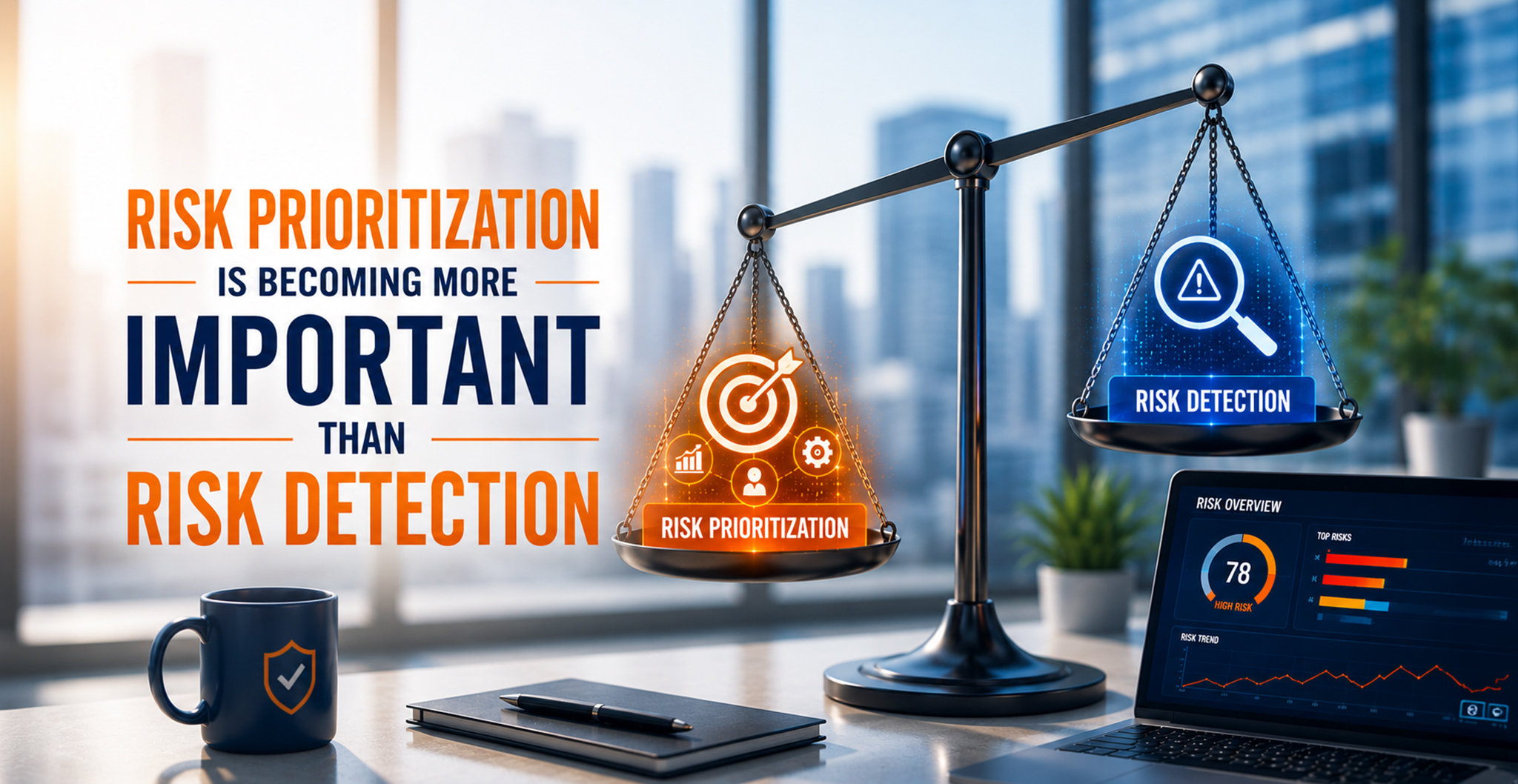
For years, cybersecurity teams have been working on technologies to improve threat detection. Enterprise environments are now significantly more visible with the advent of Endpoint Detection and Response (EDR) tools, attack surface management solutions, cloud security scanners, and vulnerability assessment tools. However, there are still organizations that are suffering from breaches. IBM’s 2025 cost of a data breach report found the average global breach cost was USD 4.44 million. The answer is quite simple: it’s not the hardest part of cybersecurity to find risks. The tough part is determining which risks should be addressed right away.
Organizations nowadays make thousands of vulnerability findings, alerts, and security events per week. Security teams do not always have the resources they need, the breadth of attack surfaces to contend with and the number of remediation tasks to keep up with, among other problems. Thus, many organizations face difficulties in identifying the most likely vulnerabilities that are to be exploited and the ones that might have the greatest impact on business. As a result of this change, the importance of risk prioritization is increasing. Advanced security programs are not just about detecting threats, but identifying, prioritizing and mitigating those threats that pose the greatest threat.
Why Are Security Teams Drowning In Findings?
Security teams have greater security data available to them than ever before. For the first time, vulnerability exploitation overtook stolen credentials as the leading initial access vector, accounting for 31% of all breaches.
Modern environments include:
- Cloud infrastructure
- APIs
- SaaS applications
- Containers
- Remote endpoints
- Third-party integrations
- AI-powered systems
Each asset can include a degree of potential vulnerabilities, misconfigurations, and security alerts. Most traditional security software is known for its ability to discover every vulnerability. This method provides visibility but can also lead to a heavy data burden on security teams.
You can find thousands of problems when you have a vulnerability scan performed. Cloud security solutions provide ongoing alerts. New attack methods are being discovered daily on threat intelligence platforms. The result is a growing volume of findings that exceed most teams’ remediation capacity.

Book Your Free Cybersecurity Consultation Today!
The Problem With Detection-First Security
The number of vulnerabilities exposed or alerts generated was used as a metric for cybersecurity success for years. This detection-first mindset made sense when organizations lacked visibility into their environments. However, today’s challenge is different. Security teams can find vulnerabilities more quickly than they can fix them.
A detection-first approach can lead to the creation of:
- Alert fatigue
- Vulnerability backlogs
- Security team burnout
- Delayed remediation timelines
- Inefficient resource allocation
Not all vulnerabilities are of equal concern. For example, a medium-severity vulnerability in an internet-facing customer portal might carry a major business risk compared to a critical vulnerability in an isolated development environment.
What Risk Prioritization Actually Means
Risk Prioritization involves prioritizing vulnerabilities and security findings based on their potential for business impact and likelihood of attack. Organizations do not consider all findings equally, but also take into account additional context, like:
- Asset criticality
- Threat intelligence
- Internet exposure
- Exploit availability
- Business impact
- Compliance requirements
- Existing security controls
This method will allow security professionals to concentrate on the weaknesses that are likely to impact the organization. Assume two vulnerabilities having the same CVSS score.
One affects a publicly accessible payment application. The other affects a restricted internal asset. The potential damage of each vulnerability might be equivalent, but the business risk is far from alike. Risk prioritization can be useful to identify these differences and prioritize resources accordingly. 48% of all breaches in 2026 highlight the fact that attackers continue to prioritize high-impact targets.
The intention is not to solve all the problems right away. The goal is to reduce the greatest amount of risk as quickly as possible.
Why CVSS Scores are No Longer Enough
CVSS scores have been used extensively for years to guide remediation decisions. CVSS is still useful in measuring technical severity, but does not consider several important factors:
- Whether exploit code is publicly available
- Whether attackers are actively exploiting the vulnerability
- Whether the affected system is internet-facing
- Whether the asset supports critical business operations
- Whether the vulnerability creates a realistic attack path
This is a huge challenge. A vulnerability with a CVSS score of 9.8 may never be exploited. At the same time, a less critical vulnerability could be used as an attack point if it crops up in broadly distributed software, or if it is desired by attackers. These days, AI-driven vulnerability management platform add the following to CVSS:
- Threat intelligence
- Exploit prediction models
- Exposure analysis
- Business context
- Attack path analysis
This will give a better understanding of the risk of the organization.
The Rise of Exposure Management
The cybersecurity industry is shifting away from vulnerability management to exposure management. Traditional vulnerability management focuses on identifying weaknesses. Exposure management is about knowing how those weaknesses can really be exploited.
This includes evaluating:
- Attack paths
- Misconfigurations
- Excessive permissions
- Identity risks
- Vulnerabilities
- Cloud exposures
- Third-party risks
Vulnerability does not automatically create meaningful risk. Risk becomes an issue when there are vulnerabilities that combine with other weaknesses to form attack paths.
By using exposure management, an organization can find these paths and prioritize remediation work for the highest risk reduction. This is a significant shift from counting vulnerabilities to understanding exposure.
Why Risk Prioritization Requires More Than Vulnerability Scanning
Several organizations already conduct regular vulnerability checks and security audits. But, identification of vulnerabilities is only one part of the process. The more difficult part is figuring out which findings create the highest business risk.
An application vulnerability that has a significant customer impact might have to be fixed right away, and a vulnerability of a system that has minimal internal impact but is high severity might be much less of a risk.
If there’s no context to go by, security teams might have to dedicate much time and effort to resolving security issues that offer little benefit in reducing their exposure. This is where risk-based security assessments are becoming all the more critical.
Companies are turning to a mix of vulnerability data, threat intelligence, asset criticality, attack path analysis and business impact assessments. This helps security teams to concentrate their remediation activities on the vulnerabilities that are most likely to be exploited, and the vulnerabilities that have the potential for creating the greatest operational disruption.
How AutoSecT Prioritizes Risk?
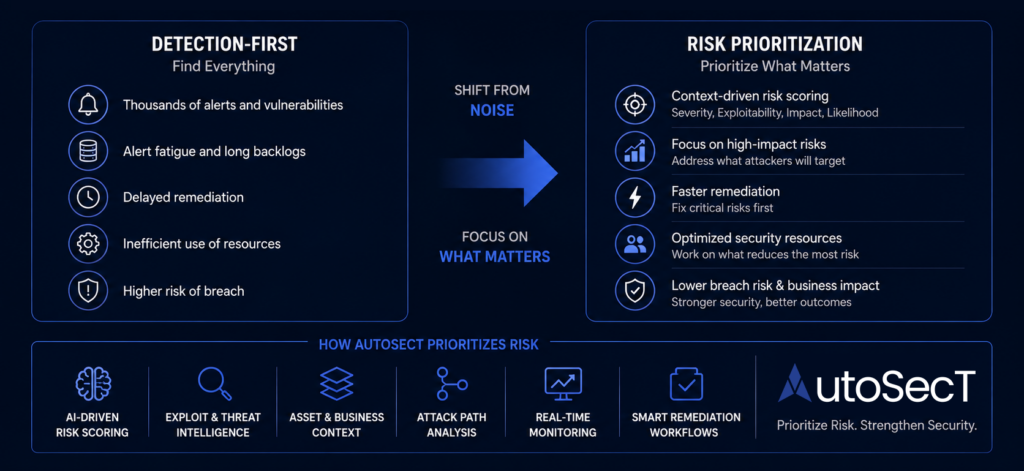
AutoSecT simplifies vulnerability management by helping security teams focus on the risks that matter most. Instead of overwhelming organizations with thousands of alerts and vulnerabilities, AutoSecT uses AI-driven risk prioritization to identify and rank security issues based on factors such as severity, exploitability, business impact, and the likelihood of an attack. This enables organizations to address critical threats first and reduce their overall cyber risk exposure.
The platform goes beyond traditional vulnerability scoring by providing contextual analysis and AI-powered patching recommendations. AutoSecT continuously evaluates vulnerabilities across networks, cloud environments, web applications, mobile applications, and APIs, ensuring that security teams gain complete visibility into their attack surface. Through real-time monitoring, CVSS-based risk assessment, and automated prioritization, organizations can make informed remediation decisions faster.
Additionally, AutoSecT integrates with tools such as JIRA, Slack, Microsoft Teams, and Google Chat, allowing vulnerabilities to be assigned to the right teams instantly and tracked through the remediation lifecycle. By reducing false positives, streamlining workflows, and delivering actionable insights, AutoSecT helps businesses optimize resources, shorten remediation timelines, and strengthen their security posture against evolving cyber threats.
Join our weekly newsletter and stay updated
Conclusion
Cybersecurity has entered a new era where visibility alone is no longer enough. The organizations that succeed are not those that find the most vulnerabilities, but those that understand which ones pose the greatest risk. As attack surfaces expand, risk-based decision-making has become essential for a mature cybersecurity strategy. Detection shows what exists, but risk prioritization reveals what truly matters.
AutoSecT helps organizations focus on critical threats by using AI-driven risk prioritization to identify vulnerabilities based on severity, exploitability, asset criticality, and business impact. This enables security teams to remediate high-risk vulnerabilities faster, optimize resources, and reduce the likelihood of a breach. In today’s threat landscape, prioritizing risk is what turns visibility into effective security.
FAQs
- What is risk prioritization in cybersecurity?
Risk prioritization is the process of ranking vulnerabilities and security findings based on their exploitability, exposure, and the impact an exploit may have on the business.
- Why is risk prioritization becoming more important?
There are more vulnerabilities that any organization can fix at any one time, and prioritization is needed to effectively bring down risk.
- How does risk prioritization differ from risk detection?
Detection identifies vulnerabilities and threats, whereas prioritization acts as a priority indicator to know what results should be acted on.
- Why are CVSS scores insufficient?
CVSS is a technical severity measure and does not take into consideration exploitability, business context, or threat activity.
- What is exposure management?
Exposure management analyzes vulnerabilities, identities and attack paths to understand the actual risk to the organization.
- How does threat intelligence support prioritization?
Organizations benefit from threat intelligence by being able to discover vulnerabilities actively attacked by attackers.
- What role does asset criticality play?
The determination of the most important systems to business operations can be done using the concept of asset criticality.
- How can a VM tool help improve risk prioritization?
AutoSecT improves risk prioritization by using AI-driven analysis to rank vulnerabilities based on severity, exploitability, asset criticality, and business impact. This helps security teams focus on the most critical threats first, enabling faster remediation, efficient resource allocation, and stronger cybersecurity outcomes.