Data breaches cost a lot. Sometimes the cost goes far beyond a ransom payment or a fine. As a result, your business may lose money, time, customers, and trust. In 2026, a data breach can impact every business, regardless of its domain or size. To avoid this, many teams now use automated pentesting to find weaknesses before attackers do. It helps security teams test systems more often and fix problems faster.
Why Are Data Breaches Getting More Expensive?
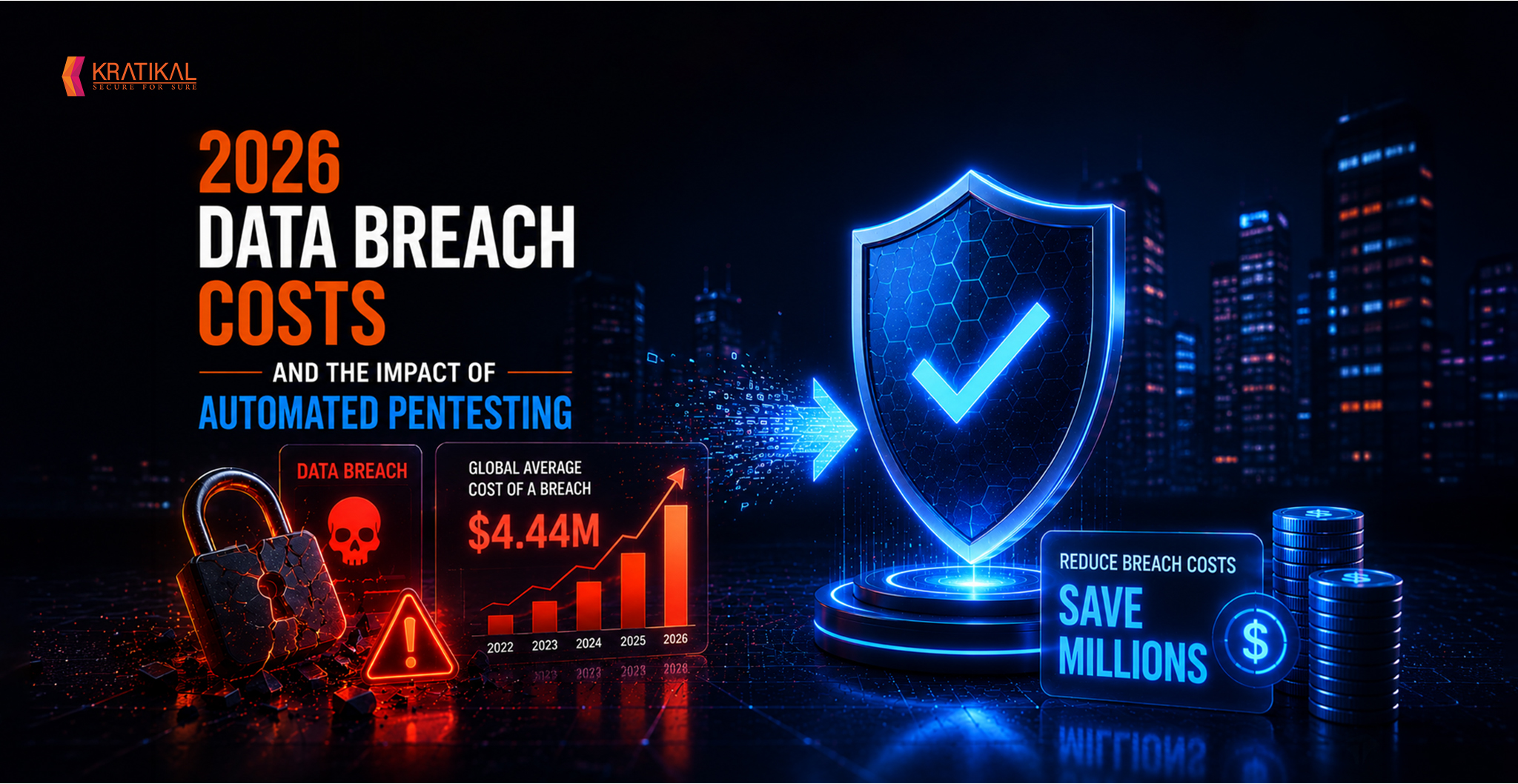
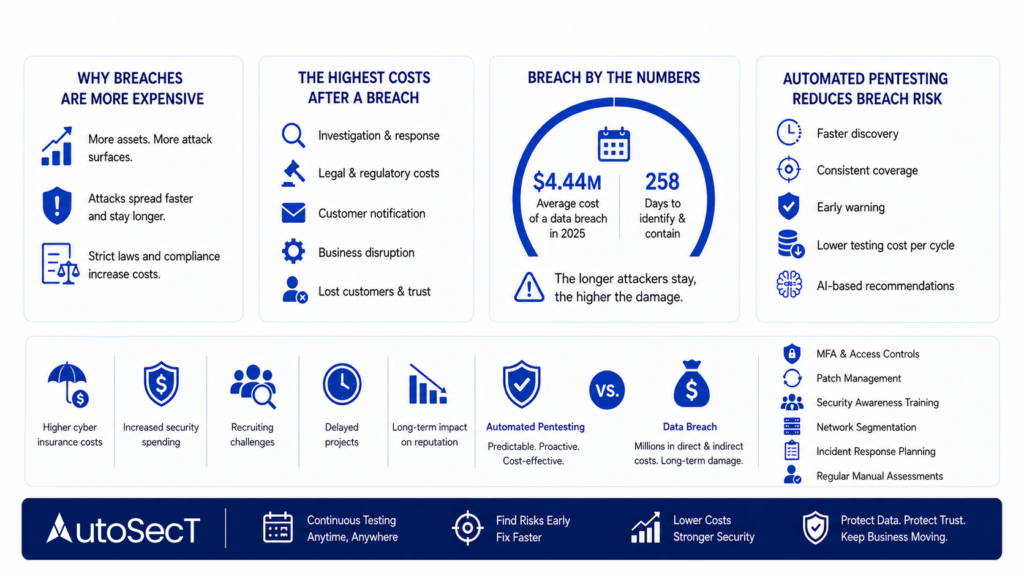
The global average data breach cost reached $4.44 million in 2025. Companies use different tools and technologies such as cloud apps, APIs, and AI tools. Every new asset you implement opens a new door for attackers to target your IT.
Also, modern attacks spread fast. A stolen password can cause serious trouble. It may give attackers access to email, cloud storage, and company infrastructure. Once they get in, they can move around and take important data.
Data privacy laws have become complex over the years. As a result, businesses need to report security incidents. They must also notify affected customers and explain how they worked to keep data safe. All of that adds cost.

Book Your Free Cybersecurity Consultation Today!
The Highest Costs After A Breach
- Investigation and response: Security teams need to find out what happened. They often hire forensic experts. This work can take weeks or months.
- Legal and regulatory costs: Many breaches trigger legal reviews. Regulators may investigate. Companies may face fines or settlements.
- Customer notification: Organizations often must notify affected people. They may provide credit monitoring or identity protection services.
- Business disruption: Systems may go offline. Employees may lose access to tools. Sales and operations can slow down.
- Lost customers: Trust is not easy to maintain and rebuild. Some customers leave after a breach. Future deals can become harder to close.
The Hidden Costs Companies Miss
Many leaders focus on the headline number, but hidden costs often stay longer.
- Higher cyber insurance costs: Insurers may increase rates after a major incident.
- More security spending: Many companies buy new random security tools after a breach.
- Recruiting challenges: A damaged reputation can make your hiring more complex.
- Delayed projects: Most of the time, teams stop product launches for some time while they recover. These costs may seem a little initially, but they impact your business for years.
How Long Does A Breach Take To Contain?
The average time to identify and contain a breach was 258 days. The answer is very surprising. Breaches often stay hidden for months. Indeed, if the attackers stay longer inside your network, the more damage they can do to your system. They can steal and harm your company’s data, create backdoors, and open your system for others. That is one reason many security teams focus on continuous testing instead of yearly audits.
Automated Pentesting – How Does It Reduce Breach Risk?
It checks apps, APIs, networks and other assets for security issues. It helps teams find problems before hackers find them. It can run on a schedule and repeat tests often. A traditional penetration test usually involves human experts who test systems over a limited period. Automation adds continuous coverage between those engagements.
1. Faster discovery
Human-led tests may occur once or twice a year. Whereas automated penetration tools can run daily, weekly, or after every major change.
2. Consistent coverage
Teams do not rely on memory or checklists alone. The tool runs the same core tests every time.
3. Early warning
A new vulnerability can appear after a software update. Automated scans can detect it sooner.
4. Lower testing cost per cycle
Running another scan is usually cheaper than scheduling another full human-led engagement.
5. AI-based recommendations
Teams can apply the right fixes for a given flaw instead of a generic solution. With each fixed vulnerability ensures that security gets stronger.
Can Automated Pentesting Prevent Every Breach?
Attackers use different techniques to damage or harm your data. Some attacks target people instead of technology. Automated penetration testing identifies technical loopholes, tests them repeatedly, and helps in effective proactive security. The following, along with an automated pentesting tool can prevent your organization from a data breach:
- Multi-factor authentication
- Patch management
- Security awareness training
- Network segmentation
- Incident response planning
- Regular human-led security assessments
What Does A Breach Cost Compared With Automated Penetration Testing?
Consider a simplified example.
An automated pentesting platform helps organizations maintain a predictable security budget by identifying and addressing vulnerabilities before they can be exploited. In contrast, a single major data breach can result in millions of dollars in direct and indirect costs, including incident response, legal expenses, regulatory penalties, and recovery efforts. Beyond financial losses, businesses may also suffer a significant loss of customer trust, which is often difficult to quantify and can have long-lasting effects on brand reputation and customer retention. Additionally, security incidents can lead to business downtime, disrupting critical operations, reducing productivity, and negatively impacting revenue. Investing in proactive security measures is therefore far more cost-effective than dealing with the consequences of a successful cyberattack.
The cost can be different for every company. But, it is more cost-effective to stop a breach than to deal with it.
Why Are Organizations Moving Toward Automated Pentesting?
A yearly security review cannot keep up with that pace. Automated penetration testing helps security teams see changes sooner and act faster. Other reasons include –
- Modern environments change constantly.
- New cloud resources appear every week.
- Developers release code frequently.
- Third-party integrations expand the attack surface.
- Remote work adds more devices and connections.
What Should Companies Look For In An Automated Pentesting Tool?
Organizations using AI and automation in security saw average savings of about $2.22 million per breach.
Things to consider:
- Coverage for web apps, mobile apps, APIs, cloud, and other infrastructure.
- Clear risk prioritization.
- Insights into which issues attackers can actually use.
- Helps teams track and fix issues without switching between tools.
- Support for compliance reporting.
- Options for human validation when needed.
What to avoid
- Tools that produce thousands of unranked alerts.
- Platforms with poor remediation guidance.
- Solutions that cannot fit into existing workflows.
What Is The Real Value Of Automated Penetration Testing In 2026?
The biggest value is not the scan itself. It is the shorter window of exposure. If a vulnerability appears today and you find it next month, attackers have weeks to exploit it. If you find it tomorrow, the risk drops. Automated pentesting helps organizations:
- Discover weaknesses sooner.
- Reduce the time vulnerabilities remain open.
- Validate security fixes with AI-driven recommendations
- Support compliance efforts.
- Build a stronger security posture over time based on scan results.
Why Should Businesses Use AutoSecT To Reduce Data Breach Costs?
Finding security issues early can save a business a lot of money, and AutoSecT helps you here. With AutoSecT, businesses can test their security regularly. AutoSecT helps security teams find and fix vulnerabilities before attacks through its real-time risk detection feature. It supports continuous testing across web apps, APIs, cloud environments, mobile apps, and networks from one platform.
Key features include:
- Easy Project Management
- AI-Driven Real-Time Vulnerability Analysis
- AI-Verified Vulnerabilities
- Automated Vulnerability Scanning
- Risk Prioritization
- Vendor Vulnerability Management Hub
- Easily Verifiable Online VAPT Certificate
- Password Protected Reports
- Centralized Vulnerability Management Dashboard – CISO and Analytics
- Multi – Integration System
- Real-Time Threat Detection with Agentic AI
- Smart Scan Scheduler
- Vulnerability Lifecycle Management
- Scalable & Customizable
- AI-based Patch Recommendations
Join our weekly newsletter and stay updated
Conclusion
A data breach can be more expensive. The median ransom payment is about $200,000. It can also harm a company’s reputation and make customers lose trust in you. With tools like AutoSecT, security teams can find risks early. This gives them more time to fix issues before attackers take advantage of them. Undoubtedly, finding security gaps faster increases the chances of staying safe.
FAQs
- How much can a data breach cost?
The cost of data breach depends on the size of the company and the type of data breached. Some of the costs may include investigation costs, legal fees, downtime etc.
- Why are data breaches becoming more expensive?
Businesses now use more cloud services and applications. Also, regulations and growing customer expectations have made data breaches more expensive.
- How does automated pentesting help reduce breach costs?
It helps teams find and fix security loopholes early. So, addressing vulnerabilities before an attack can reduce breach cost.
- Can automated pentesting replace human-led penetration testing?
Automated penetration testing helps security teams test faster. But human experts are still required to identify complex risks and perform deeper security assessments.
- How frequent should a business perform automated pentesting?
Businesses should test their inventory regularly. Because continuous testing helps you identify new risks as they occur.
- What should businesses look for in an automated pentesting tool?
A good pentesting tool should help teams find security issues early. It should show which risks need attention first and suggest ways to fix them. It should also work across web apps, APIs, cloud environments, and networks.