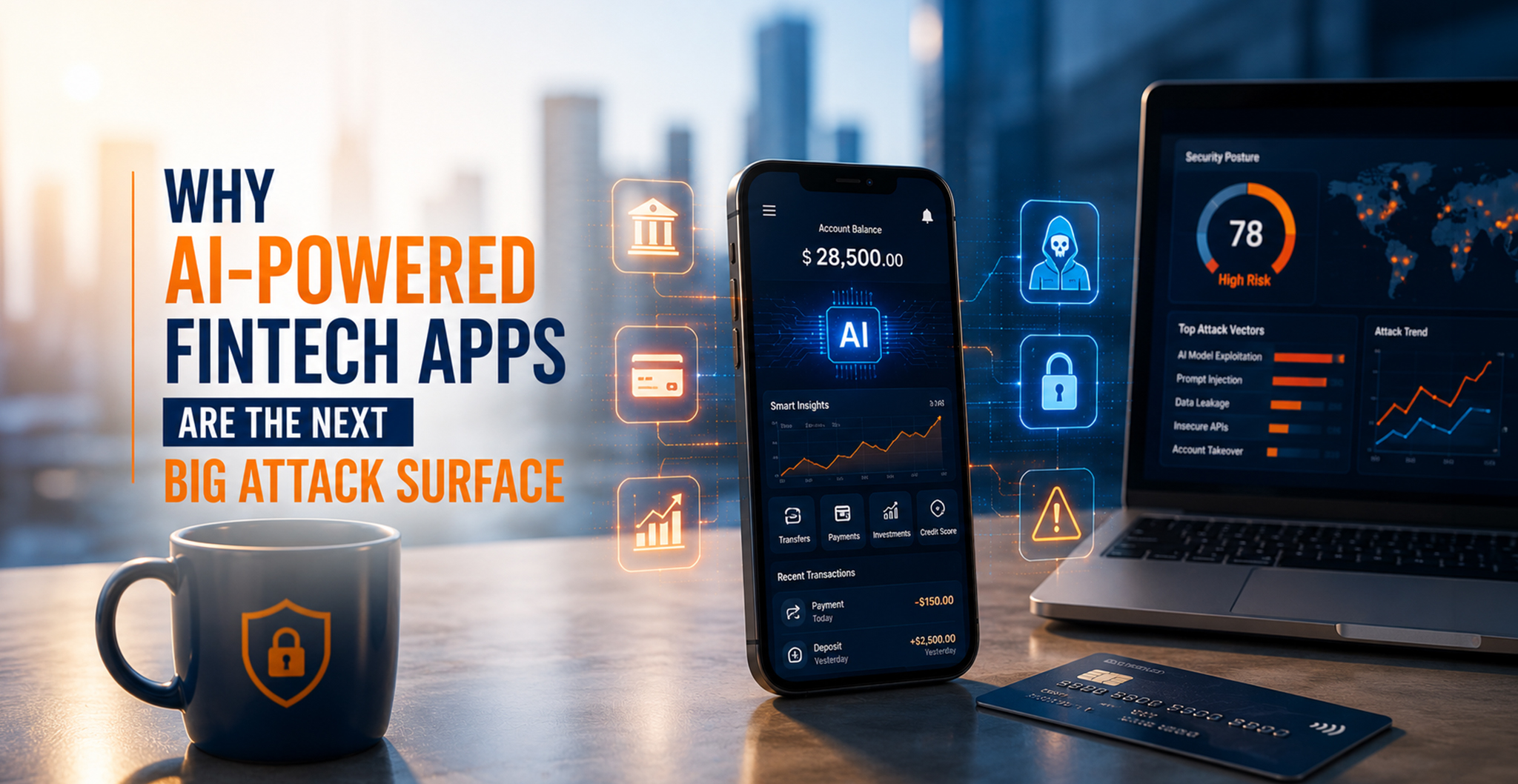
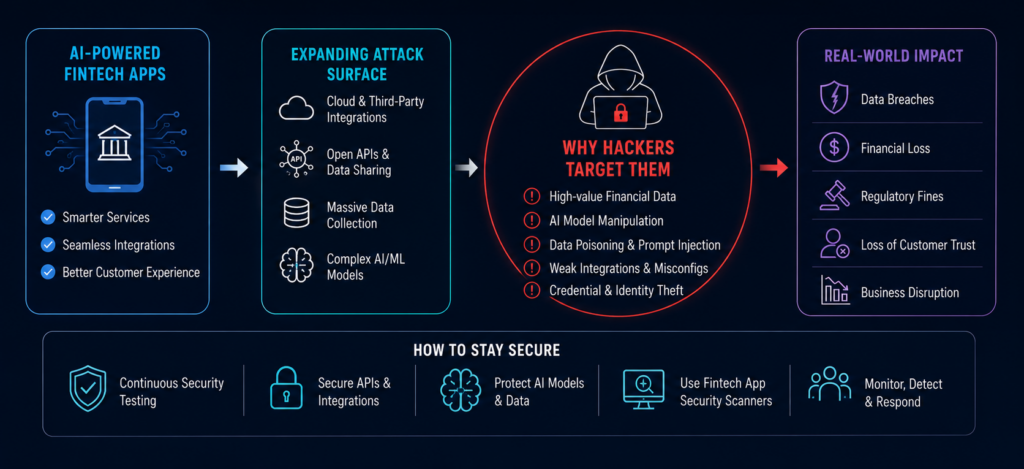
AI-powered fintech applications are helping organizations deliver faster, smarter, and more personalized financial services. These technologies improve customer experiences but also expand the attack surface. AI-enabled fintech platforms process large volumes of sensitive information, including banking data, personal details, transaction histories, and behavioral signals. As fintech ecosystems become more interconnected, the number of potential entry points for attackers increases. Organizations increasingly rely on a fintech app security scanner to identify vulnerabilities before attackers can exploit them.
Why AI Expands the Attack Surface
1. More APIs and Integrations
Modern fintech apps frequently connect with payment gateways, banking networks, identity providers, fraud-detection services, and other third-party platforms. Each API introduces additional authentication, authorization, and monitoring requirements. Weak API security can expose customer data, payment flows, or account functionality. A modern fintech app security scanner helps assess API security weaknesses across interconnected fintech ecosystems.
2. Increased Cloud Dependency
AI workloads often rely on cloud infrastructure for model training, data processing, and scalable compute resources. Misconfigured storage buckets, overly permissive IAM policies, and exposed services remain common sources of security incidents. As cloud environments grow more complex, maintaining consistent security controls becomes more challenging. Using a fintech app security scanner enables security teams to detect risks arising from cloud misconfigurations and exposed services.
3. Data Concentration
AI systems require substantial amounts of data to operate effectively. Fintech applications may aggregate financial records, identity information, transaction data, device telemetry, and user behavior signals in centralized repositories. These repositories become attractive targets because a single compromise can expose multiple categories of sensitive information.
4. Third-Party and Supply-Chain Risk
AI-powered fintech apps often depend on external SDKs, open-source libraries, cloud services, and machine-learning frameworks. Vulnerabilities or compromises within any component of this supply chain can affect the security of the entire application.

Book Your Free Cybersecurity Consultation Today!
AI-Specific Security Risks
1. Data Poisoning
Attackers may attempt to introduce malicious or misleading data into training or feedback pipelines, causing the model to make inaccurate predictions or develop security blind spots.
2. Model Theft and Reverse Engineering
Exposed APIs can sometimes allow attackers to infer model behavior, extract proprietary logic, or reconstruct aspects of a machine-learning model through repeated queries.
3. Prompt Injection in Generative AI Features
For fintech applications that incorporate generative AI or LLM-based assistants, prompt injection attacks are becoming an important concern. Malicious inputs may attempt to manipulate the model’s behavior, bypass safety controls, or influence downstream actions.
4. Automated Abuse at Scale
AI can be used defensively, but it can also be used by attackers to automate credential attacks, generate phishing content, discover vulnerabilities, or rapidly test attack paths.
Examples of How Risk Manifests
1. Exposed API Credentials
A mobile application accidentally ships with hard-coded API keys that allow unauthorized access to backend services.
2. Insecure Cloud Storage
A publicly accessible cloud bucket exposes transaction logs or customer documents.
3. Vulnerable Third-Party SDK
A payment or analytics SDK contains a vulnerability that enables data leakage or remote code execution.
Why One-Time Testing Is Not Enough
AI-powered fintech environments change rapidly. New features, model updates, API integrations, cloud configurations, and mobile releases can introduce fresh security weaknesses. A vulnerability assessment performed once a year provides only a snapshot in time. Continuous testing through a fintech app security scanner provides greater visibility than periodic assessments.
Modern security programs increasingly adopt:
- Continuous vulnerability scanning
- Security testing integrated into CI/CD pipelines
- Regular cloud security reviews
- API security monitoring
- Post-release validation after major updates
A Layered Security Approach
Fintech companies should implement a layered security strategy to reduce risk exposure.
Key practices include:
- Strong API authentication and authorization
- Least-privilege access controls in cloud environments
- Encryption of data at rest and in transit
- Continuous vulnerability management
- Security testing for mobile applications
- Monitoring for anomalous AI model behavior
- Supply-chain security reviews for third-party components
Organizations should complement API and cloud security controls with a dedicated mobile app scanner to secure customer-facing applications.
How AutoSecT Can Help
AutoSecT supports continuous security testing for web, mobile, cloud, API, and AI-driven fintech environments. The platform combines automated scanning with AI-assisted validation to help reduce false positives and prioritize remediation efforts. Capabilities include:
Web Application Scanning
Identify vulnerabilities such as injection flaws, authentication weaknesses, and misconfigurations.
Mobile App Security Scanning
AutoSecT’s mobile app scanner helps identify vulnerabilities in Android and iOS applications, detect insecure data storage practices, evaluate authentication mechanisms, and prioritize remediation efforts.
Cloud Security Assessment
Detect misconfigurations and excessive permissions across cloud environments.
API Security Testing
Evaluate authentication, authorization, and exposure risks across fintech APIs.
As a comprehensive fintech app security scanner, AutoSecT helps organizations continuously assess and strengthen the security of their fintech applications.
Join our weekly newsletter and stay updated
Conclusion
AI-powered fintech applications are not inherently insecure, but they do introduce additional complexity, data concentration, integrations, and AI-specific risks that can expand the attack surface. Organizations that combine strong architecture, continuous security testing, cloud governance, API protection, and AI risk management are better positioned to secure modern fintech platforms.
As attack surfaces continue to expand, deploying a robust fintech app security scanner is becoming essential for modern fintech organizations. Continuous monitoring using a mobile app scanner helps fintech companies address vulnerabilities introduced through frequent application updates. As fintech systems continue to evolve, security must evolve with them, from a periodic assessment activity to an ongoing operational capability.
FAQs
- Why are AI-powered fintech apps becoming major targets for hackers?
Using AI to prepare fintech deals involving lots of personal and financial data. They place a lot of reliance on APIs, cloud resources, and AI models which expose the attackers to many access points.
- What are the biggest security risks facing fintech applications today?
The most prevalent ones are API vulnerabilities, account takeover, misconfigurations, chain of supply chain attacks, AI model manipulation and phishing campaigns.
- How does AI increase the attack surface in fintech applications?
AI apps demand a large amount of data collection, third-party integrations, and complex algorithms. These elements add on more security issues that conventional applications might not encounter.
- What is a fintech app security scanner?
A fintech app security scanner is a security tool that will automatically identify software bugs, malpractices, unprotected API or unprotected API malfunctions, and compliance violations and more in fintech applications automatically before being compromised.
- How often should fintech businesses perform security assessments?
Ongoing security tests throughout the software development life cycle should be undertaken. With the frequent testing, vulnerabilities will be identified early enough and reduce the risk of incurring expensive breach.
- Are APIs a major cybersecurity concern for fintech companies?
Yes. The APIs are essential during the payment processing, open banking, customer verification, and the data sharing. The inadequately secured APIs have become one of the most prevalent attack vectors in the modern fintech settings.
- What role does cloud security play in fintech app protection?
Cloud security is important since the majority of fintech applications are based on cloud infrastructure. Appropriate access controls, encryption, monitoring, and configuration controls assist in avoiding unauthorized access and exposure of data.
- How can fintech businesses improve the security of AI-powered applications?
Under the ongoing category of their cybersecurity efforts, businesses can safeguard their security with multi-factor authentication, data protection, monitoring AI, analysis of the third parties, and a fintech app security scanner.