

Web applications rely on multiple layers of infrastructure to process user requests efficiently. Load balancers, reverse proxies, caching servers, and application servers all work together to improve performance and availability. However, when these systems interpret incoming requests differently, attackers can exploit the gap to manipulate traffic and compromise applications. This is where HTTP Request Smuggling becomes a serious cybersecurity concern.
Although many organizations focus on vulnerabilities such as SQL injection, cross-site scripting, or insecure APIs, request smuggling attacks often remain unnoticed. The hidden nature of these attacks makes them particularly risky because malicious traffic can bypass traditional security controls while remaining undetected for long periods.
Gist on HTTP Request Smuggling
HTTP Request Smuggling occurs when two systems involved in processing HTTP requests disagree on where one request ends and another begins. This usually happens because different servers interpret HTTP headers in different ways. Attackers exploit this mismatch to “smuggle” malicious requests through front-end systems into backend servers.
Most modern web environments use a front-end server, such as a proxy or load balancer, and a backend application server. If these components process request boundaries inconsistently, attackers can manipulate the communication channel and inject unauthorized requests.
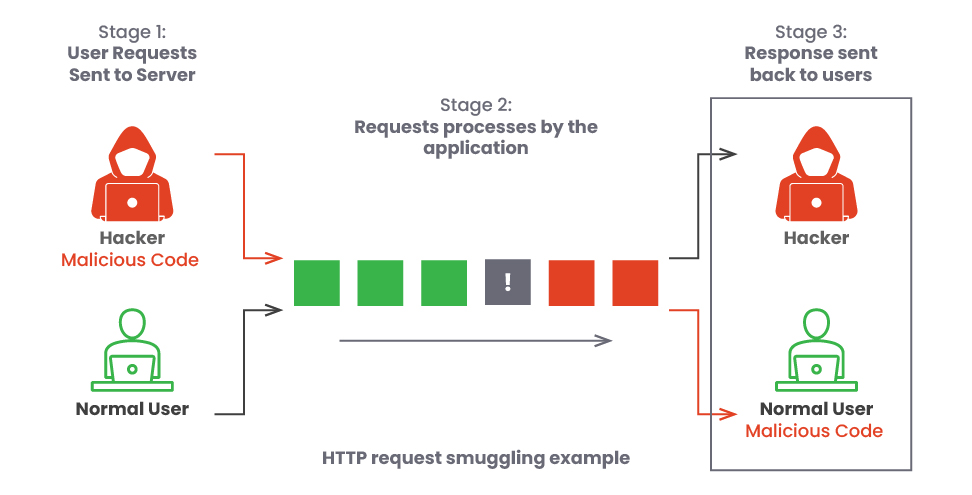
For example, one server may rely on the Content-Length header while another prioritizes the Transfer-Encoding header. By crafting specially designed requests, attackers can trick backend systems into processing hidden commands that were never intended by the application. Because these attacks target the communication between servers rather than the application itself, they are often difficult to detect through standard security testing.
The Silent Risks Behind HTTP Request Smuggling
Miscommunication between web servers and applications can create serious security risks that attackers use to evade detection and compromise systems.
1) Bypassing Security Controls
One of the most serious hidden risks of HTTP Request Smuggling is security control bypass. Modern architectures rely on front-end layers, WAFs, authentication gateways, and reverse proxies to filter malicious traffic before it reaches the application. But when a smuggled request reaches the back-end, it has already passed through the front-end unscrutinized.
An attacker can use smuggling to access restricted internal endpoints, bypass IP allowlisting, or circumvent authentication middleware that only lives on the front-end layer. The back-end, unaware that the request arrived through an abnormal path, processes it as trusted.
2) Session Hijacking and Request Capture
Perhaps the most alarming abuse of HTTP Request Smuggling involves Session Hijacking through the capture of other users’ requests. By smuggling a partial request that instructs the back-end to treat the next incoming connection’s data as the body of an attacker-controlled endpoint, an attacker can literally read the raw HTTP requests of other users, including their Cookie headers, Authorization tokens, session IDs, and POST body contents.
This transforms a protocol-level parsing bug into a full credential-theft mechanism. Victims need to take no action whatsoever; simply browsing the web application at the wrong moment is enough to expose their session to the attacker.
3) Cache Poisoning at Scale
Content Delivery Networks and shared caches are the backbone of performance-optimized web infrastructure. HTTP Request Smuggling can weaponize these systems through cache poisoning by injecting malicious responses that get stored and served to many subsequent users.
An attacker smuggles a request that causes the back-end to return a poisoned response, perhaps a redirect to a phishing page, a JavaScript injection payload, or a crafted error page. When the cache stores that response under a popular URL, every user who requests that resource receives the malicious content. A single successful attack becomes a persistent, scalable infection.
4) Internal Service Exploitation
In microservice architectures, back-end services frequently trust traffic that arrives from internal networks or load balancers. They skip authentication checks, expose administrative APIs, or make assumptions about request origin that would never be made for external traffic.
HTTP Request Smuggling can be used to reach these internal services directly. By crafting a smuggled request that targets an internal hostname or path, attackers can trigger server-side request forgery (SSRF), access internal admin panels, invoke privileged API operations, or extract metadata from cloud provider endpoints like AWS IMDSv1.
What if hidden server communication flaws are silently exposing your applications? Kratikal helps detect and stop advanced web attacks before they escalate.

Book Your Free Cybersecurity Consultation Today!
Best Practices to Prevent HTTP Request Smuggling Attacks
To reduce the risk of such attacks, organizations should adopt proactive security measures across their web infrastructure and application environments.
- Ensure Consistent HTTP Request Processing
Organizations should ensure that all front-end and backend systems interpret HTTP requests in the same way. Standardizing request parsing rules and removing conflicting configurations can help eliminate inconsistencies that attackers may exploit.
- Keep Servers and Proxies Updated
Regularly updating web servers, reverse proxies, and load balancers is essential. Vendors often release security patches to fix parsing issues and protocol-related vulnerabilities that could otherwise expose systems to attacks.
- Conduct Regular Penetration Testing
Routine penetration testing helps identify hidden weaknesses in web infrastructure. Security assessments should include manual testing for request parsing anomalies, especially in environments using multiple proxies, gateways, or caching systems.
- Implement Strong Monitoring and Logging
Organizations should deploy robust monitoring and logging mechanisms to detect unusual traffic behavior. Correlating logs across different infrastructure components can help security teams identify suspicious or malformed requests more effectively.
The Growing Importance of Proactive Security
As organizations continue adopting cloud services, APIs, and distributed application architectures, the risk landscape surrounding HTTP Request Smuggling continues to evolve. Attackers actively search for hidden inconsistencies in server communication because these vulnerabilities often provide stealthy and highly effective attack paths.
Cybersecurity strategies must therefore go beyond traditional vulnerability scanning. Businesses need deeper visibility into how applications, proxies, and backend systems interact. Security testing should focus not only on application logic but also on the protocols and infrastructure supporting those applications. Organizations that proactively identify request parsing inconsistencies can significantly reduce the risk of exploitation. Continuous monitoring, secure configuration management, and regular security assessments are essential for defending against modern web-based threats.
Join our weekly newsletter and stay updated
Conclusion
HTTP Request Smuggling is far more than a technical protocol issue. It is a hidden but powerful attack technique capable of bypassing security controls, compromising sessions, poisoning caches, and exposing sensitive systems. Because these attacks exploit communication gaps between servers, they often remain invisible to traditional security tools.
As digital ecosystems become increasingly complex, organizations must prioritize secure HTTP handling, infrastructure consistency, and proactive security testing. Businesses that fail to address these hidden risks may leave critical applications vulnerable to sophisticated attackers.
By understanding how request smuggling works and implementing strong defensive measures, organizations can strengthen their web security posture and reduce the likelihood of silent yet damaging attacks.
FAQs
- Why is HTTP Request Smuggling risky?
It can bypass security controls, hijack user sessions, poison web caches, and expose sensitive backend systems.
- Which systems are commonly affected by this attack?
Applications using reverse proxies, load balancers, caching servers, or multiple backend servers are more vulnerable.
- Can a Web Application Firewall prevent HTTP Request Smuggling?
A WAF can reduce the risk, but proper server configuration and consistent request handling are also necessary.
- How can organizations prevent HTTP Request Smuggling?
Organizations should standardize request parsing, update servers regularly, and conduct routine security testing.