Every second a vulnerability sits unpatched in your environment, the clock is ticking, not for you, but for the attacker on the other side. Security teams have long fought an unwinnable race: discover vulnerabilities, triage them, assign them, track them, and patch them. A never-ending cycle. The traditional vulnerability management cycle was never designed for the speed of modern attacks, modern infrastructure, or modern development. It was designed for an era when threats evolved over months, and attack surfaces were predictable.
That era is over.
Today, 78% of cyber attacks target vulnerabilities that already have patches available. Let that sink in. The exploits causing the most damage are not sophisticated zero-days. They are known vulnerabilities that organizations simply have not gotten around to patching because their VM process is too slow, too noisy, and too fragmented to keep up. The answer is not more scanners. It is smarter vulnerability management, powered by AI. And right now, the most compelling embodiment of that answer is VAPT Tool AutoSecT.
Why Speed Is the Real Metric in Vulnerability Management (VM)?
When security leaders talk about VM, the conversation typically centers on detection, how many vulnerabilities were found, what their CVSS scores are, what percentage have been remediated. But these metrics miss the point entirely.
The metric that matters is time to risk reduction: how quickly can your organization move from identifying a threat to neutralizing it?
Traditional approaches fail this metric at every stage. Static scanners run on fixed schedules, leaving multi-day or multi-week windows of blindness between scans. Sorting and prioritizing is done manually, with analysts wading through thousands of alerts to find the handful that genuinely require action.

Book Your Free Cybersecurity Consultation Today!
AI-Driven Vulnerability Management For Faster Risk Reduction
AI-driven vulnerability management eliminates each of these bottlenecks. It replaces scheduled scans with continuous monitoring, replaces manual triage with intelligent prioritization, and replaces fragmented handoffs with automated workflows, compressing the entire risk reduction cycle from weeks to hours. AutoSecT was purpose-built around this principle.
Intelligent Prioritization: Stop Chasing the Wrong Vulnerabilities
Speed without direction is useless. Patching 500 low-risk vulnerabilities while a critical, actively-exploited flaw goes unaddressed is not risk reduction; it is risk theater. This is exactly what happens when security teams work from raw scanner output without intelligent context.
AutoSecT changes this equation fundamentally. Rather than presenting a flat list sorted by CVSS score, AutoSecT prioritizes vulnerabilities based on a multi-dimensional risk model that accounts for exploitability in your specific environment, real-world threat intelligence, business impact, likelihood of attack, and compliance exposure.
The result: Your security team always knows exactly which vulnerability to fix first, second, and third, without spending hours in manual sorting and prioritizing. AutoSecT also supports MITRE ATT&CK and CVSS benchmark mapping, giving teams richer context for every finding and making prioritization decisions defensible to auditors and stakeholders.
Near-Zero False Positives: Reclaim Your Team’s Time
False positives are not a minor inconvenience. In security operations, they are a productivity crisis. When analysts must investigate five false alarms before finding one genuine threat, 80% of their effort generates zero risk reduction.
AutoSecT addresses this with a 90% reduction in false positives compared to traditional tools. As one of the world’s advanced AI-agentic vulnerability scanner, AutoSecT does not simply flag suspicious patterns, it validates them. Its AI engine attempts to exploit each detected vulnerability using custom exploit code and intelligent reasoning before surfacing it to the security team. Only confirmed threats get escalated. Only real problems reach your dashboard.
This is not just a technical improvement. It fundamentally changes how security teams operate. When every alert on your dashboard represents a real, verified risk, your team stops firefighting noise and starts making meaningful progress on risk reduction.
The Workflow That Closes the Loop
Faster detection and smarter prioritization only translate to risk reduction if remediation actually happens. This is where many vulnerability management programs stall; the gap between the security team identifying a risk and the developer or DevOps engineer actually patching it.
AutoSecT eliminates this gap through seamless bi-directional integrations with the tools teams already use: JIRA, Slack, Microsoft Teams, Google Chat, Zoho Cliq and CI/CD pipelines including Jenkins. When AutoSecT validates a vulnerability, the teams can create a ticket. Then they can assign it to the responsible team member, and track its remediation status in real time. All in a single dashboard. No manual handoffs, no follow-up emails and no issues falling through the cracks.
AutoSecT’s Smart Scan Scheduler further automates the operational cadence, allowing teams to configure recurring scans across all asset types, web, mobile, cloud, API, and network, on their own timeline. Security coverage runs 24/7 in the background, without manual intervention.
Kratikal AutoSecT: The AI-Driven VAPT Tool As VMaaS Solution
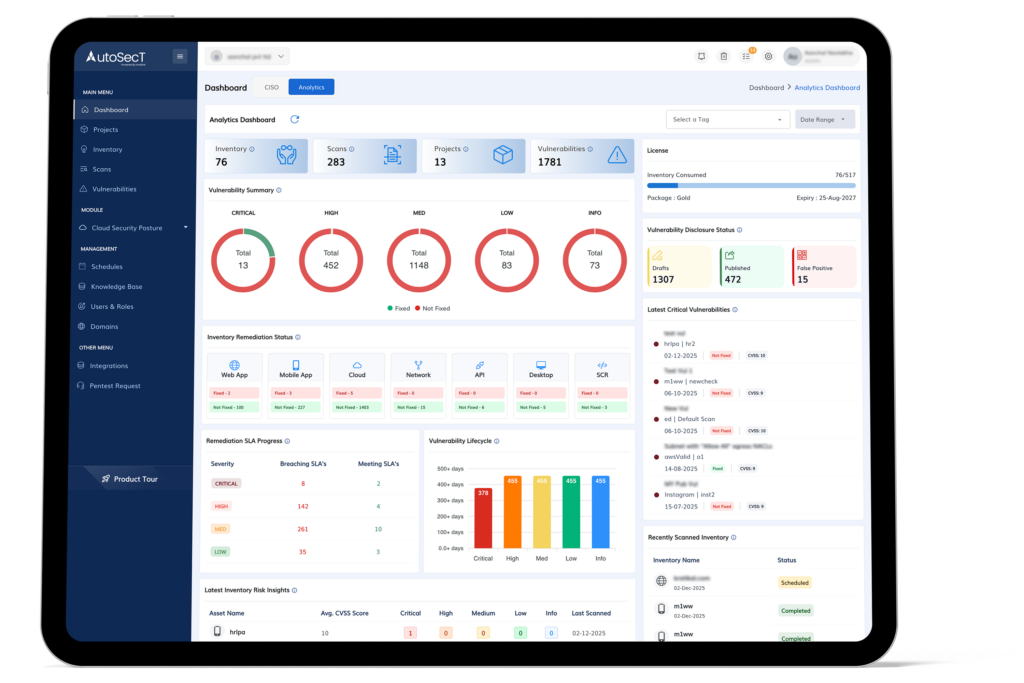
The foundation of faster risk reduction is visibility, and visibility cannot have blind spots. AutoSecT delivers AI-driven remediation suggestions on each vulnerability detected across an organization’s entire attack surface: web applications, mobile apps (Android and iOS), cloud environments on AWS, Azure, and Google Cloud, APIs, and network infrastructure. All information flows into a single, unified dashboard.
Unlike traditional scanners that react to known vulnerability signatures, AutoSecT’s AI engine anticipates. It continuously analyzes both historical and real-time data to detect emerging threats and respond to potential risks before they can be weaponized. When a new CVE is published, AutoSecT’s AI can write custom exploit code and incorporate it into the scanner within 2 hours of the vulnerability being reported; a pace that traditional scanners cannot come close to matching.
Organizations leveraging AutoSecT have achieved 50% faster risk mitigation through AI-driven prioritization and remediation guidance.
The Numbers That Tell the Story
AutoSecT’s impact is not theoretical. The platform’s track record speaks directly:
- 50% faster risk mitigation through AI-driven prioritization
- 90% reduction in false positives, so teams focus only on real threats
- 80× faster vulnerability detection versus manual pentesting
- New CVE exploit code incorporated within 2 hours of public disclosure
- 1.2 million+ vulnerabilities identified per year across customer environments
- Over 1,150 web apps, 750+ mobile apps, 2,200+ cloud assets, and 6,000+ APIs secured
These are not benchmark numbers. They represent real organizations that have moved from chaotic, reactive vulnerability management to a disciplined, AI-driven risk reduction program with AutoSecT at its core.
The Window Is Closing
The uncomfortable truth about vulnerability management is that your exposure is not defined by what you have not found. It is defined by the gap between finding a vulnerability and fixing it. Every day that gap exists, your organization is at risk. AI-driven vulnerability management with AutoSecT does not just find vulnerabilities faster. It closes that gap, through intelligent prioritization that tells your team exactly what to fix, automated workflows that ensure fixes happen, and continuous monitoring that makes sure nothing new is missed.
Join our weekly newsletter and stay updated
Book a demo with AutoSecT today and see how fast risk reduction is supposed to feel.
Vulnerability Management FAQs
- How does AI-driven vulnerability management reduce risk faster than traditional methods?
Traditional VM relies on scheduled scans, static CVSS scores, and manual triage, a process that is too slow for the pace of modern threats. AI-driven vulnerability management, as implemented in AutoSecT, accelerates every stage of the risk reduction cycle. Continuous scanning replaces periodic assessments, eliminating days-long blindness windows. AI-powered risk prioritization instantly surfaces the vulnerabilities most likely to be exploited, eliminating hours of manual work.
- What makes AutoSecT’s AI-driven VAPT tool different from standard vulnerability scanners?
Rather than matching signatures against a static database, AutoSecT’s AI agents actively reason about threats, validate findings by attempting controlled exploits, and adapt to emerging attack techniques in near-real time. Critically, it can write its own exploit code and update its scanner within 2 hours of a new vulnerability being publicly disclosed far faster than traditional scanners.
- How does AutoSecT support both security and development teams in the remediation process?
AutoSecT streamlines vulnerability remediation with role-based dashboards, compliance-driven insights, and seamless integrations with JIRA, Slack, Microsoft Teams, Google Chat, Cliq and Jenkins. It automatically creates and assigns tickets, provides developer-focused remediation guidance with file names and fix recommendations, and integrates security directly into CI/CD pipelines for continuous DevSecOps-driven protection.