


Enterprises today are experiencing a major change in how networking and security work. With more employees working remotely, increased use of cloud services, and the growth of edge computing, traditional network setups and firewalls are no longer enough. Secure Access Service Edge (SASE) solves this challenge by bringing networking and security together in a single, cloud-based model. It combines SD-WAN with essential security tools such as firewalls, secure web gateways, CASB, and zero-trust access to provide fast and secure access from anywhere.
This shift is happening rapidly. Gartner reports that nearly 72% of companies now follow a hybrid work model, and IDC predicts that about 85% of workloads will be in the cloud by 2025. In this new environment, SASE is no longer optional—it has become a critical requirement for modern IT teams.
Table of Contents
Core Components of Secure Access Service Edge
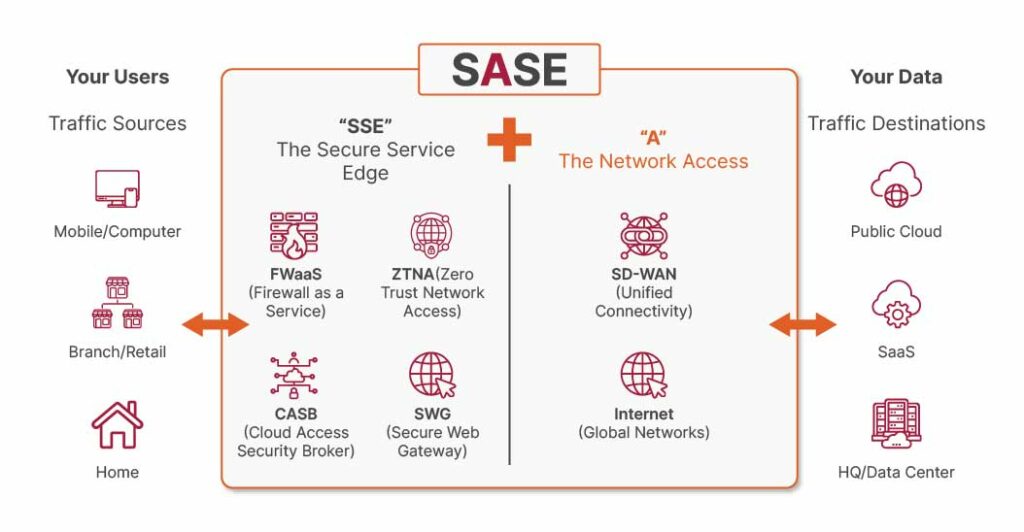
SASE is defined by its core components, which blend connectivity and security. At the heart of SASE is SD‑WAN – a software-defined WAN overlay that manages how traffic flows across multiple links (broadband, LTE, etc.) with centralized intelligence. SD‑WAN ensures resilient, high-performance connectivity between branches, data centers, and cloud sites by dynamically choosing the best paths. Layered on SD‑WAN are key cloud-native security functions, delivered from distributed points-of-presence (PoPs):
- Secure Web Gateway (SWG): Filters and inspects web and Internet-bound traffic to block malware and enforce content policies.
- Cloud Access Security Broker (CASB): Monitors and secures access to cloud services and SaaS apps, enforcing data and compliance policies in real time.
- Firewall-as-a-Service (FWaaS): A cloud-based firewall that protects all traffic at the edge. In a SASE model, FWaaS is integrated with SD‑WAN so that branch traffic is inspected in the cloud without on-site hardware.
- Zero Trust Network Access (ZTNA): Often replacing traditional VPNs, ZTNA enforces least-privilege access. Every user and device must authenticate and be authorized before gaining access to applications, minimizing lateral movement and unauthorized access.
In sum, SASE delivers “all-in-one” SD‑WAN plus a security stack from the cloud. By integrating these functions into a single architecture, SASE eliminates the need for multiple siloed appliances and point products at each location.
Drivers of Secure Access Service Edge
Several major business and technical trends are driving rapid SASE adoption:
Cloud Migration & SaaS:
With most applications moving off-premises, legacy backhaul architectures are inefficient. Rather than routing all traffic through a central data center, SASE pushes security controls into the cloud, closer to users and apps. Gartner observes that as data and workloads leave the LAN, the WAN and security must shift to the edge to avoid latency and performance issues. SASE’s cloud-native model offers the elasticity and global reach needed for modern multi-cloud deployments.
Security Complexity:
Traditional architectures required chains of appliances (firewall, VPN, SWG, etc.) for each branch or remote user. Managing these silos is costly and error-prone. SASE simplifies the stack – Gartner explains that SASE “reduces complexity” by consolidating functions in the cloud and using a single-pass inspection model. Rather than multiple point solutions, SASE enforces one coherent policy set. This consolidation also lowers capital and operational costs. For example, moving from legacy MPLS to SASE-based internet links can dramatically cut network spend and deployment time.
Evolving Threats and Compliance:
The threat landscape demands tighter controls. SASE is built on Zero Trust principles, continuously authenticating users and devices before granting any access. This approach limits breaches and lateral spread of malware. Enterprises also face strict regulations (HIPAA, PCI, etc.) and require granular visibility. SASE’s centralized governance means new threat defenses or compliance policies are applied network-wide at once. In one analyst’s words, when a threat is detected at one SASE node, “the adaptation can be available to all the edges” immediately.
Get in!
Join our weekly newsletter and stay updated
Benefits of Secure Access Service Edge
Adopting Secure Access Service Edge (SASE) delivers strong business and IT advantages by simplifying networks, strengthening security, and improving performance across the enterprise.
Better Application Performance
With SASE, user traffic is sent to the nearest cloud point of presence instead of being routed through a central data center. This reduces delays and improves speed. As a result, applications run faster, video meetings are smoother, and SaaS platforms perform better. Many organizations report major improvements in user experience after moving to SASE, including significant drops in latency and major gains in application performance.
Fast Scalability and On-Demand Growth
SASE is built on a cloud-native architecture, which means it scales instantly with business needs. New branches, users, or bandwidth can be added within hours instead of weeks. During periods of high traffic or rapid expansion, SASE platforms automatically adjust to handle the load. Centralized management also allows IT teams to roll out policy changes globally in real time, making deployments faster and far more flexible than traditional WAN environments.
Reduced IT Complexity
SASE combines networking and security into a single platform, replacing multiple devices and management tools. Instead of managing separate firewalls, VPNs, web gateways, and WAN appliances, teams work from one unified dashboard. This removes tool sprawl, simplifies operations, and reduces dependence on multiple vendors. With fewer systems to manage, IT teams can support more users and locations with the same resources.
Stronger Security With Zero Trust
Security is built into SASE by design. Every user and device is verified before access is granted, and trust is continuously evaluated. Policies are applied uniformly at the cloud edge, ensuring consistent protection no matter where users connect from. When a new threat emerges or policies change, updates are instantly enforced across the entire network. Organizations adopting Zero Trust SASE models often experience a sharp decline in security incidents and data breaches.
Lower Infrastructure and Operational Cost
By moving away from on-premise hardware to a subscription-based cloud model, enterprises significantly reduce capital expenses. Branch offices no longer require expensive firewalls, VPN appliances, or specialized networking gear. Maintenance, power, and upgrade costs are also transferred to the SASE provider. Over time, this results in a much lower total cost of ownership and improved IT efficiency.
Book Your Free Cybersecurity Consultation Today!

Conclusion
Secure Access Service Edge is no longer “bleeding edge” – it has become a practical imperative. As enterprises continue shifting to cloud and hybrid environments, SASE’s converged, cloud-native model offers exactly what is needed: one architecture that improves performance, scales globally, and enforces strong security consistently. By unifying SD‑WAN and key security services in the cloud, SASE eliminates many complexities of the old perimeter-based model. For IT leaders and CISOs, the message is clear: adopting SASE can future-proof connectivity and protection for today’s distributed workforce and applications, while simplifying management and reducing costs.
FAQs
- What does Secure Access Service Edge do?
Secure Access Service Edge (SASE) is a cloud-based architecture that combines networking and security services into a single unified platform. It integrates SD-WAN with essential cloud-native security capabilities such as secure web gateways, cloud access security brokers, firewall-as-a-service, and zero-trust network access.
- What is the difference between Secure Service Edge and Secure Access Service Edge?
The key difference between SASE and SSE is that SASE brings together both networking and security into one cloud-based architecture, while SSE is focused only on delivering cloud-based security services.





Leave a comment
Your email address will not be published. Required fields are marked *