



Over the last few years, cloud computing has been growing at a rapid rate. It has completely revolutionized the business world, enabling organizations to keep up with today’s increasingly digitized landscape. According to Grand View Research, the global cloud computing market reached $752.44 billion in 2024 and is projected to hit $2.39 trillion by 2030 at a 20.4% CAGR. Organizations globally use cloud services for cloud-native development, data analytics, machine learning, and application migration, among many other things. While data storage and management have never been easier, cloud vulnerabilities have become a huge threat to data security.
Table of Contents
Top 7 Cloud Vulnerabilities in 2026:
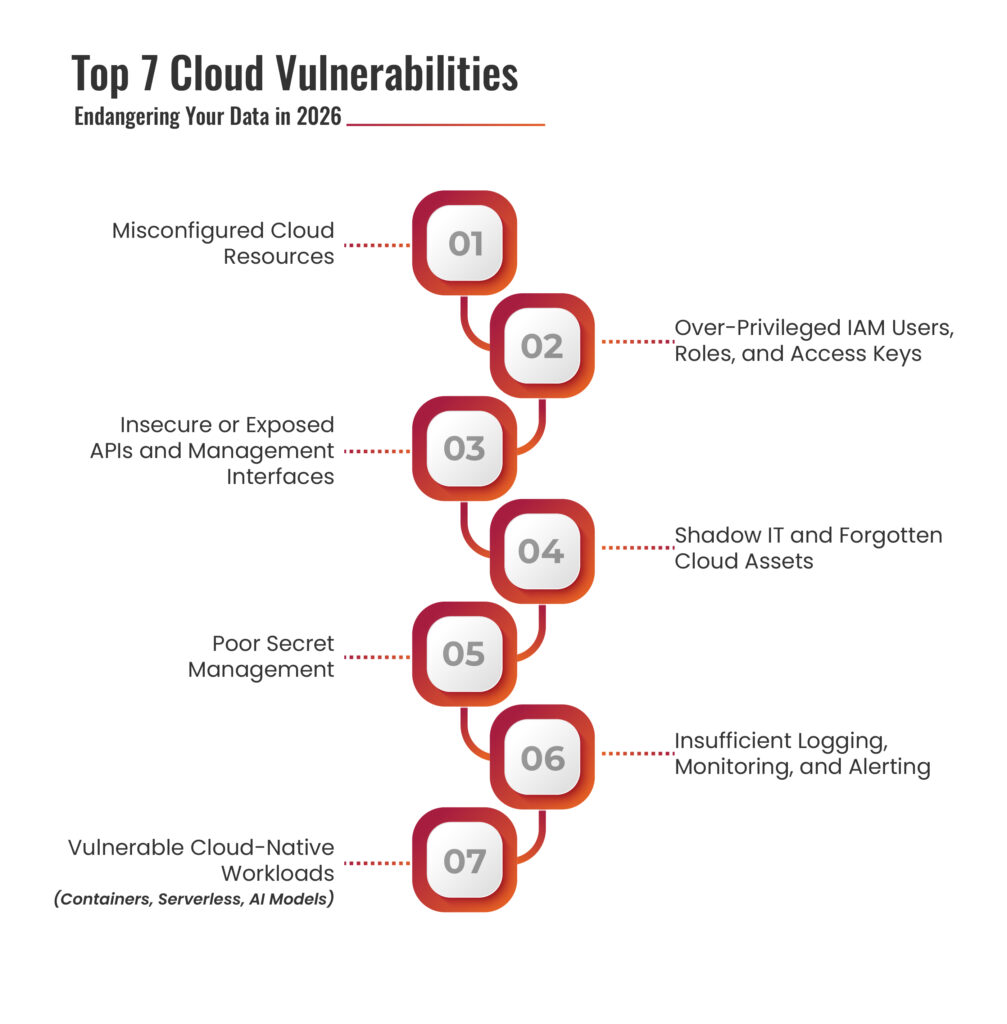
Kratikal has conducted cloud security audits for numerous organizations around the globe. Here is a list of the top 7 critical cloud vulnerabilities we found.
#1 Misconfigured Cloud Resources
Misconfiguration is the single most common cause of cloud data breaches. In most cases, something meant to be private is accidentally left open. Storage buckets, databases, virtual machines, or backup snapshots are often exposed to the internet because of incorrect permissions or rushed setup. When this happens, hackers don’t need sophisticated techniques; they simply discover what’s already accessible and walk in. One misconfigured resource can lead to massive data loss or unauthorized access.
#2 Over-Privileged IAM Users, Roles, and Access Keys
Identity and Access Management (IAM) controls who has access to what. During audits, we repeatedly find users and services with far more privileges than necessary. Accounts belonging to former employees may remain active, and access keys often go unrotated for months or years. When permissions are too broad, a single stolen credential can give attackers complete control over a cloud environment. Poor privilege management turns minor breaches into major compromises.
#3 Insecure or Exposed APIs and Management Interfaces
Cloud systems rely heavily on APIs. If these APIs are exposed without proper authentication or access controls, they become easy targets. Cloud penetration testing often uncovers unused endpoints, poorly protected login pages, or development APIs accidentally left open. These exposed interfaces act like unlocked control panels. Hackers use them to exfiltrate data, manipulate resources, or gain deeper access into the cloud computing environment.
#4 Shadow IT and Forgotten Cloud Assets
Teams frequently spin up cloud resources for testing or short-term development and forget to shut them down. These “orphaned” assets are rarely monitored or maintained. They often run outdated software, have weak configurations, or contain sensitive data no one remembers. Hackers actively search for these neglected assets because they are easier to compromise. A forgotten virtual machine or database can become the weakest point in the entire cloud setup.
#5 Poor Secret Management
Passwords, API keys, and access tokens are often found stored in unsafe locations. Audits reveal secrets hard-coded into source code, buried in configuration files, or exposed in logs. In many cases, organizations fail to use dedicated secret-management tools like vaults or key management systems. If hackers obtain these credentials, they can log in directly, no hacking required. Compromised secrets are one of the fastest paths to unauthorized access.
#6 Insufficient Logging, Monitoring, and Alerting
Many organizations believe their cloud provider automatically monitors everything. In reality, key logging and monitoring tools must be manually configured, and cloud VAPT shows they often aren’t. Without proper logs or alerts, suspicious activity goes unnoticed. If malicious actors get inside, they can operate quietly for weeks. Lack of monitoring means you won’t detect unauthorized access, privilege misuse, or data exfiltration until it’s too late.
Book Your Free Cybersecurity Consultation Today!

#7 Vulnerable Cloud-Native Workloads (Containers, Serverless, AI Models)
Modern cloud environments rely heavily on containers, Kubernetes clusters, serverless functions, and AI workloads. These technologies move quickly, and security practices often fail to keep up. Cloud pentesting or Cloud Security Audit uncovers outdated base images, overly permissive container privileges, and third-party package vulnerabilities. Because everything is interconnected, a single vulnerable container image or dependency can compromise multiple applications. Cloud-native architectures increase speed and with it, the need for tighter security controls.
Why Risk from Cloud Vulnerabilities Is Escalating in 2026
- Cloud usage is exploding: according to recent industry data, many organizations now have dozens to hundreds of cloud assets and nearly a third of those remain “neglected,” unmanaged, or insecure.
- As per OWASP, the complexity of cloud-native deployments (microservices, containers, AI-driven modules, dynamic workloads) dramatically increases the number of potential weak points, making traditional perimeter-based security largely ineffective.
- Human error remains a major factor: misconfigurations and credential mishandling are frequent, and once access is gained (via phishing, stolen credentials, exploited APIs), lateral movement and data exfiltration become trivial.
What This Means for Your Organization
You will likely have more vulnerable cloud assets than you think. Especially if your environment is dynamic (frequent provisioning, multiple services, rapid deployments). If you don’t have strict governance and ongoing cloud security audits, you are probably exposed.
Protecting cloud data requires more than perimeter/infrastructure hardening. Traditional firewalls or network-layer protections are insufficient when threats come via misconfigurations, APIs, insider access, or forgotten assets.
Security must be baked into architecture, not tacked on. Cloud security cannot be an afterthought. IAM policies, least-privilege access, secure provisioning, continuous monitoring, and effective asset/account lifecycle management are mandatory.
Get in!
Join our weekly newsletter and stay updated
What You Should Do – The Top 7 Remedies
Get in touch with CERT-In Empanelled security auditors, like Kratikal, as the severity of vulnerabilities varies from organization to organization. Meanwhile, you can do the following to ensure your cloud security:
- Audit all cloud assets like storage buckets, compute, containers, AI workloads, third-party components, and inventory them. Flag and remediate anything unused or unmanaged.
- Implement strict IAM policies like enforcing least privilege, using role-based or just-in-time access, removing excessive privileges, and regularly reviewing.
- Review and test all APIs/interfaces. Enforce strong authentication, rate-limiting, proper permission scopes, and treat APIs as high-risk surfaces.
- Use automation and continuous monitoring. AutoSecT can help you with cloud security posture management, threat detection, and many more, to identify misconfigurations, vulnerable packages, or anomalous behavior.
- Limit human error and insider risk by enforcing credential hygiene, MFA everywhere, minimizing hard-coded secrets, rotating credentials frequently, and educating personnel/trusted accounts.
- If using containers/AI/third-party libraries, track supply-chain risks, patch vulnerabilities early, and treat dependencies as first-class risks.
- Embed security into every phase of cloud adoption, starting from architecture design, deployment, maintenance, and decommissioning.
Takeaway
Cloud computing has transformed how businesses operate, but it has also created a much larger and faster-moving attack surface. Most vulnerabilities discovered during cloud security audits aren’t rare; they stem from everyday issues like misconfigured resources, excessive privileges, exposed APIs, and forgotten cloud assets. As cloud computing expands across AI workloads, multi-cloud setups, and rapid development cycles, these weaknesses become even easier for attackers to exploit. Securing cloud environments now requires continuous governance, strict IAM controls, proactive monitoring, and regular audits, not one-time fixes. If your organization depends on cloud computing, strengthen your cloud security posture now and protect your data and maintain operational resilience.
FAQs
- What are the most common cloud vulnerabilities that lead to data breaches?
The most common cloud vulnerabilities include misconfigured resources, over-privileged IAM roles, exposed APIs, poor secret management, and forgotten cloud assets.
- How do misconfigurations impact cloud computing security?
Misconfigurations expose private cloud computing resources like storage buckets, databases, or VMs to the public internet. This allows hackers to access sensitive data without hacking, making misconfiguration the leading cause of cloud breaches.
- How can organizations protect themselves from cloud vulnerabilities?
Organizations can reduce cloud vulnerabilities by enforcing least-privilege IAM policies, securing APIs, rotating credentials, monitoring cloud activity, fixing misconfigurations quickly, and conducting regular cloud security audits.






Leave a comment
Your email address will not be published. Required fields are marked *