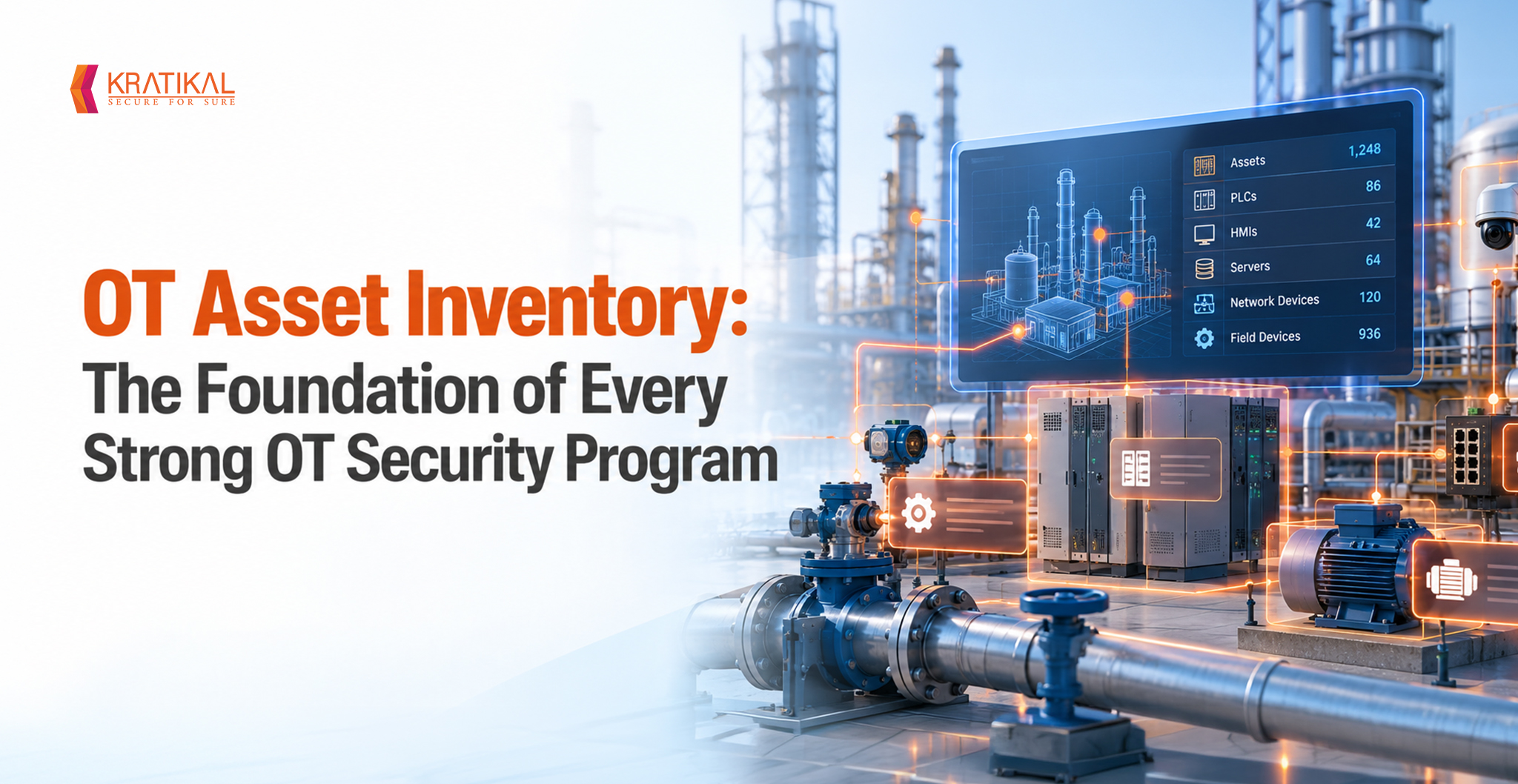
Industrial systems connect to various corporate and other external networks and use cloud and other remote services. As a result, risks to the OT environment increase in number and complexity. An OT Asset Inventory is a critical component of any Cyber Security program for industrial and related enterprises. It helps to track and maintain visibility of field equipment, software and control systems in an OT environment. The inventory helps security teams identify equipment that is inefficient, obsolete, incompatible, unsupported and/or unauthorized; and, more generally, latent risks that could lead to failure. An accurate asset inventory helps Security teams understand their attack surface area and prioritize efforts to protect at-risk assets. A lack of asset knowledge creates an increased attack surface area, increases the risk of failure and creates operational disruptions. Maintaining an accurate inventory of OT assets is the foundation of an effective OT cybersecurity program.
Let’s find out more about it in this blog.
What Is an OT Asset Inventory?
A record of the hardware, software, and control systems used in an industrial operation. It includes configurations, functions, and network interconnections. An OT(Operational Technology) Asset Inventory accounts for long equipment lifecycles, high availability (or “uptime”) requirements, legacy systems, and specialized industrial communications protocols.
A comprehensive inventory may include:
The inventory should also record relevant asset details, such as device identifiers, firmware versions, network addresses, locations, business owners, and communication relationships.
- Programmable Logic Controllers (PLCs): Devices that control industrial machines and processes.
- Supervisory Control and Data Acquisition (SCADA) systems: Platforms used to monitor and control industrial operations.
- Human-Machine Interfaces (HMIs): Interfaces that allow operators to interact with industrial equipment.
- Industrial Control Systems (ICS): Systems that manage and automate industrial processes.
- Remote Terminal Units (RTUs): Devices that collect field data and communicate with control systems.
- Industrial network devices: Switches, routers, firewalls, and gateways connecting OT assets.
- Engineering workstations and servers: Systems used to configure, manage, and monitor industrial equipment.
- Industrial Internet of Things (IIoT) devices: Sensors, smart meters, and connected monitoring equipment.
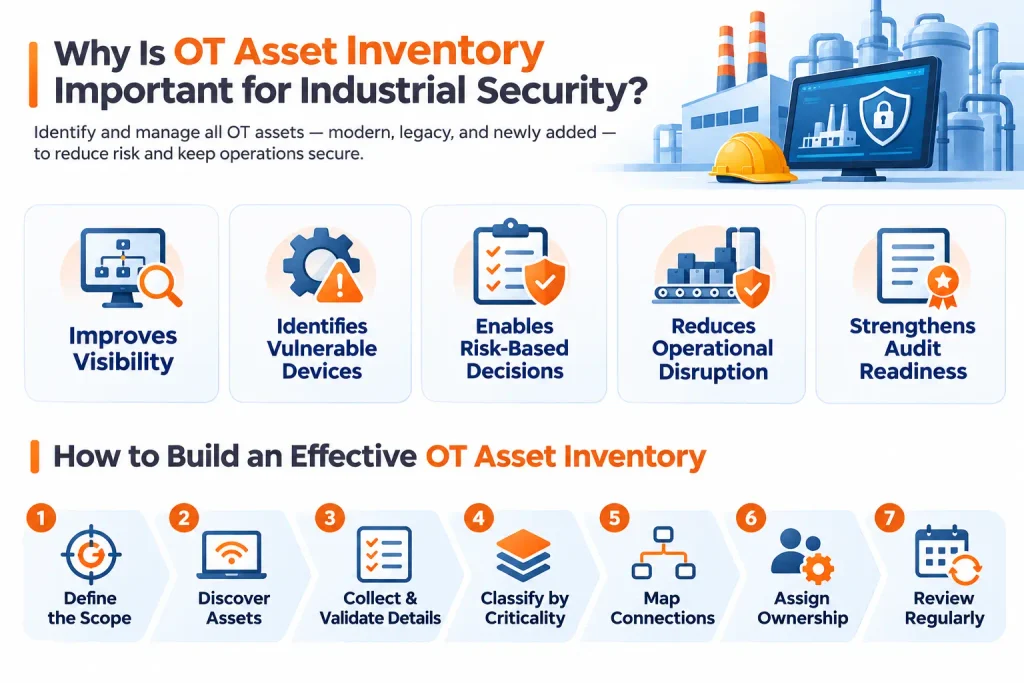
Why Is OT Asset Inventory Important for Industrial Security?
Industrial environments may contain both modern and legacy equipment. Some devices may be connected for long periods of time and may not be up-to-date with the latest software versions. Still other equipment may be added to a system during a maintenance window and not logged. From an information security perspective, these situations pose environmental risks. An asset inventory helps identify these situations before they impact operational processes.
1. Improves Visibility Across OT Environments
In the absence of an asset inventory, a security team will be unaware of assets that are connected to the network and controlled by employees. An asset inventory helps security teams reduce and, if possible, eliminate blind spots in OT environments.
2. Helps Identify Vulnerable and Outdated Devices
An asset inventory often includes the firmware and/or software versions of devices. If a known vulnerability exists for a firmware or software version, a security team can easily identify affected devices.
3. Supports Risk-Based Security Decisions
Some assets may carry more risk than others. A controller for a critical production process may require a greater level of protection than a nonessential monitoring device. Teams may use an inventory to evaluate assets based on their criticality, exposure, and impact to business operations. Security decisions may then be aligned to the requirements of the business.
4. Reduces the Risk of Operational Disruption
Unexpected changes in an industrial system may disrupt a production process or affect equipment safety. Understanding which devices are involved in a critical production process may help support the safe management of equipment during maintenance, updates, and incident responses.
5. Strengthens Regulatory and Audit Readiness
Industrial organizations may need to demonstrate the management of their organization’s technology assets. An up-to-date inventory may serve as evidence for security reviews, internal audits, and help fulfill requirements as mandated by the organization. Furthermore, an up-to-date inventory may help organizations’ security practices align to the requirements of the IEC 62443 and NIST Cybersecurity Framework.

Book Your Free Cybersecurity Consultation Today!
How to Build an Effective OT Asset Inventory
Building an effective OT Asset Inventory requires a structured process that ensures accurate records without disrupting industrial operations.
Step 1: Define the Scope
Identify the facilities, production lines, control systems, and networks to include. Document IT-OT boundaries and third-party connections.
Step 2: Discover Assets
Use network diagrams, equipment registers, maintenance records, and engineering documents. Passive monitoring can identify devices while minimizing operational risks. Assess active discovery carefully before deployment.
Step 3: Collect and Validate Details
Fill in asset details like name, manufacturer, model, firmware, function and connection types. Compare findings to existing records and investigate unknown/undocumented assets.
Step 4: Classify Assets by Criticality
Assess each asset’s impact on safety, production, and business continuity. Prioritize critical systems for stronger protection and monitoring.
Determine the impact of the asset on the safety of personnel, production and the continuous running of the business. Take note to better protect and/or monitor critical business systems.
Step 5: Map Connections
Record the paths of communication between various controllers, HMIs and SCADA servers and/or connected IT systems. Take note of these paths and look for attack paths to better segment the network.
Step 6: Assign Ownership
Assign responsibility to an individual for each asset and integrate updates to the asset inventory into change control.
Step 7: Review Regularly
Look at the asset inventory after connecting or replacing an asset. Make regular reviews to determine the accuracy of the asset inventory and to capture any unknown devices.
Common OT Asset Inventory Challenges
Certain challenges organizations face with regard to maintaining an accurate OT Asset Inventory include:
- Legacy equipment: Older equipment may not be discoverable via modern means, or may not be sufficiently documented.
- Limited network visibility: Equipment may be located on segmented networks, isolated systems, or remote facilities.
- Operational safety: Discovery methods may affect sensitive equipment.
- Unauthorized equipment: Contractors or plant personnel may introduce equipment or connections not sanctioned by the organization.
- Frequent changes: Equipment may be replaced, connected or disconnected, or maintained.
Maintaining an accurate Asset Inventory requires collaboration by cybersecurity, plant engineers, and operations personnel. Regular reviews and change management help ensure asset records are accurate and up to date.
How OT Asset Inventory Supports a Stronger Security Program
Review the asset inventory after connecting or replacing an asset. Make regular reviews to determine the accuracy of the asset inventory and capture any unknown devices. Here’s how having an accurate OT asset inventory helps enhance your security program.
- Vulnerability management: Having an inventory allows your team to find affected devices and help evaluate exposure and prioritize remediation.
- Network segmentation: Asset relationships and communications help determine how system communications should be restricted.
- Threat detection: It is much easier to investigate unusual communications or behavior when you know which devices on your network should be communicating.
- Incident response: Asset inventories provide information that helps responders identify which devices on your network are most critical and why.
- Patch management: From an asset inventory, you can determine which devices should be maintained and help prioritize remediation activities.
- Business continuity: Asset inventories help you determine how your network and devices should be communicating.
A centralized asset inventory helps bridge the communication gap between IT security and Industrial Operations. Each team has a more accurate and complete picture of the controlled environment. For organizations using or transitioning to the NIST Cybersecurity Framework, asset inventory helps with the Identify function and helps strengthen the Protect, Detect, Respond and Recover Functions. Having an asset inventory doesn’t stop attacks, but using the information from the asset inventory to make security decisions helps strengthen your overall security program.
Best Practices for Maintaining an Accurate OT Asset Inventory
Organizations can improve inventory quality by following a few practical principles and having an OT Security checklist.
- Use passive discovery to identify devices while minimizing operational disruption.
- Maintain a centralized inventory to avoid duplicate or conflicting records.
- Prioritize critical assets based on safety and operational impact.
- Update records whenever equipment or network configurations change.
- Restrict access to sensitive inventory data.
- Validate automated findings with plant engineers and system owners.
- Investigate unknown devices and document approved exceptions.
- Test discovery methods safely before deploying them in production environments.
Test procedures without disrupting operations. Validate discovery and response methods in suitable environments before broader deployment. These practices help transform the inventory from a static list into a reliable source of security intelligence.
How Kratikal Helps Strengthen OT Asset Inventory and Security
Kratikal helps organizations strengthen OT security through Vulnerability Assessment and Penetration Testing (VAPT), OT risk and architecture assessments. These services help identify unknown assets, security gaps, vulnerable systems, and network misconfigurations that could expose industrial operations to cyber risks. By improving asset visibility and evaluating risks based on operational criticality, Kratikal helps manufacturing, energy, gas, oil, and other OT enterprises prioritize remediation, strengthen security controls, and protect critical operations while minimizing disruption.
Conclusion
A strong OT security program begins with understanding every asset, its function, and its connections. A well-maintained OT Asset Inventory helps identify vulnerabilities, improve threat detection, strengthen network segmentation, and support incident response. Organizations should document critical assets, validate connections, and assign clear ownership. Regular updates and continuous monitoring help maintain accurate records, reduce operational risks, and support safer, more informed security decisions.
Join our weekly newsletter and stay updated
FAQs
- What is an OT Asset Inventory?
It is a compilation of the devices, software and control systems in the industrial environment, including their functions, configurations and interconnections.
- Why is OT asset inventory important for cybersecurity?
It helps in identifying unknown/unmanaged/unaccounted devices, firmware and software, and unmanaged connections. With these, existing vulnerabilities in the systems can be managed, and risks can be better identified and documented.
- What assets should be included in an OT Asset Inventory?
These should include PLCs, SCADA systems, HMIs, RTUs, industrial networking devices, servers, engineering workstations and IIoT devices.
- How often should an Operational Technology asset inventory be updated?
It should be updated whenever the asset or configuration changes. Monitor newly connected or unidentified devices and review regularly.
- What is the difference between IT and OT asset inventory?
IT asset inventories include all technology across the enterprise. OT inventories include assets like industrial control systems, legacy equipment, and specialized and/or unsafe protocols.
- What tools are used for OT asset discovery?
Various tools, such as passive network monitoring, OT security platforms, and configuration management and/or asset discovery tools, are used.
- How does OT asset inventory help with compliance?
It captures the asset, ownership, and configuration, thus helping with security audits and assessments against the aforementioned security frameworks.
- Does Operational Technology asset inventory help other areas?
Yes, it helps determine affected devices and criticality and prioritize remediation of vulnerabilities.