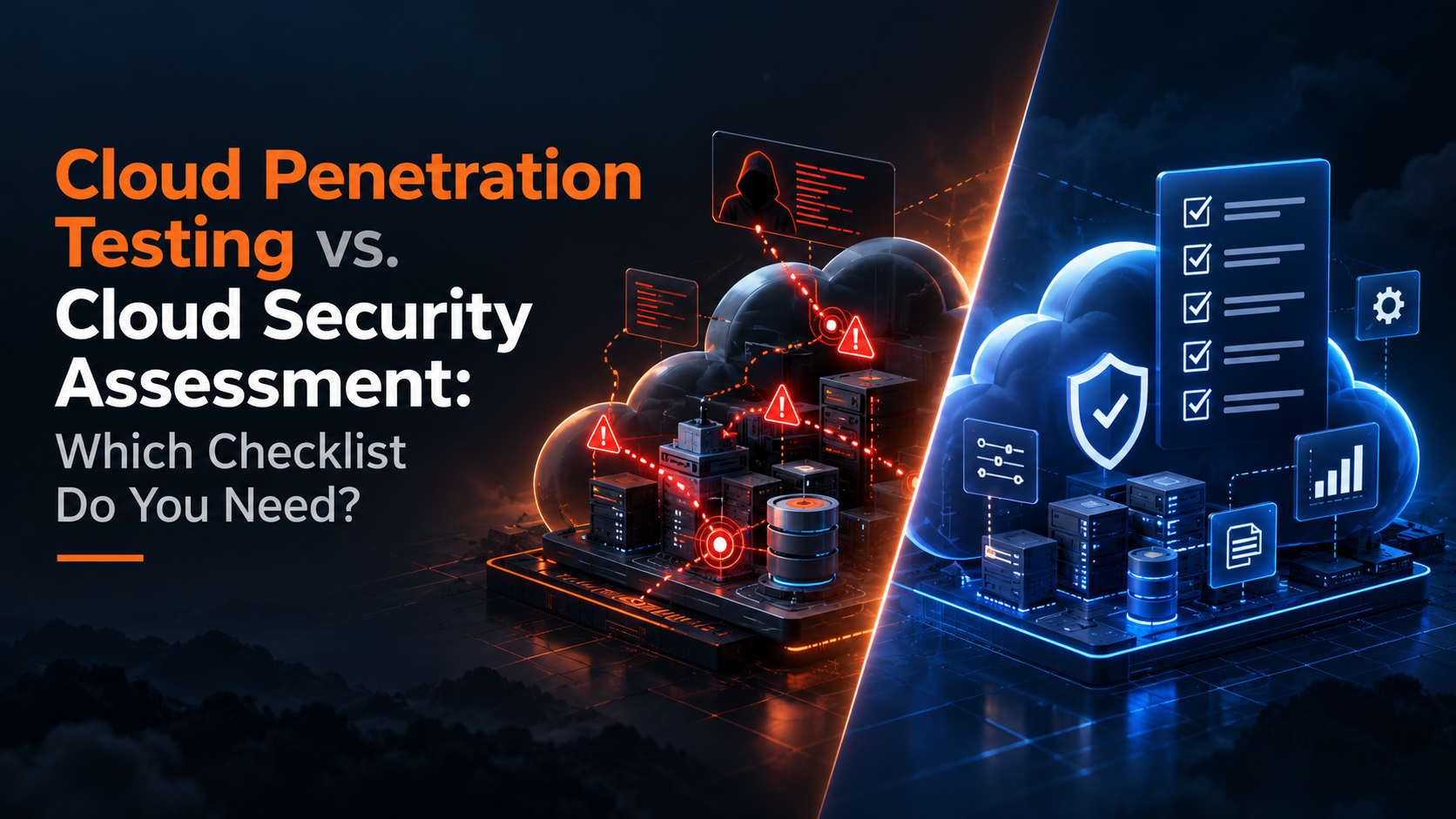
Cloud environments ease application and data storage and help support distributed teams. Public storage buckets, broad identity permissions, and exposed services can all be openings for an attack. There are two ways to review these risks: cloud penetration testing and a cloud security assessment. While they have the same goal, they don’t always have the same means. A cloud security assessment, for example, is typically done to review the cloud environment and determine security gaps and misconfigurations. On the other hand, penetration testing looks to see if there are ways to exploit the vulnerabilities in the cloud. Which approach is better depends on the organization’s cloud configuration and security maturity. The best cloud security framework is the one that is most relevant to an organization’s business. It should give sufficient guidance to ensure progress is being made toward the organization’s goals and objectives.
Cloud Penetration Testing Checklist
Pentesting for cloud emulates real-world attacks to see how an attacker can reach secured data. Cloud security testing evaluates vulnerabilities in the cloud and identifies attack paths in the following areas:
Cloud Assets and Attack Surface
- Identify all cloud assets (i.e. VMs, storage, databases, APIs, functions, etc.)
- Identify services exposed to the internet, and determine if they are unnecessary.
- Identify software and service versions, and see if they are out of date.
- Identify vulnerable services and open ports.
- Review DNS records, subdomains, and external endpoints.
- Verify that unused resources are removed.
Identity and Access
- Determine if weak or compromised credentials can provide access.
- Check if multi-factor authentication (MFA) can be bypassed.
- Determine if access control lists (ACLs) can be modified.
- Evaluate if there are other privileged user accounts.
- Check for any users, roles or service accounts with excessive permissions.
- Examine multi-factor authentication to protect privileged accounts.
- Look for exposed access keys and tokens.
- Examine cross-account access risks and trust relationships.
Cloud Configuration Vulnerabilities
- Examine storage buckets for configuration errors.
- Check management consoles and interfaces for unauthorized access.
- Assess security groups, firewall rules, and other access controls.
- Look for defaults and weak configurations.
- Assess configuration weaknesses for unauthorized access.
- Examine cloud metadata for unauthorized access.
Network Security Testing
- Check segmentation between public, private, and restricted networks.
- Examine access between workloads and sensitive resources.
- Check inter-service communications.
- Assess virtual network and subnet communication.
Application and API Testing
- Examine authorization and authentication mechanisms for cloud applications.
- Test for injection flaws and broken access controls.
- Look for insecure API endpoints.
- Check for exposed credentials and sensitive information.
- Test whether users can access data owned by other users.
- Examine serverless functions for permissions and input validation.
- Check for attack paths in integrated applications.
Data Security
- Examine data to determine if unauthorized users can access it.
- Test encryption to determine if it is adequate.
- Assess how compromised identities can access or move confidential data.
- Review whether data access logs capture suspicious activities.
- Identify paths that could be used to steal data via misconfigured services.
Attack Emulation and Validation
- Emulate attacks along paths approved by management.
- Evaluate if the identified weaknesses can be combined to gain greater access.
- Validate the potential impacts of an attack.
- Review whether security control monitoring tools capture and act on suspicious activities.
- Verify vulnerabilities, provide supporting evidence, and assess potential impact on business.
- Retest and verify if critical issues are resolved.
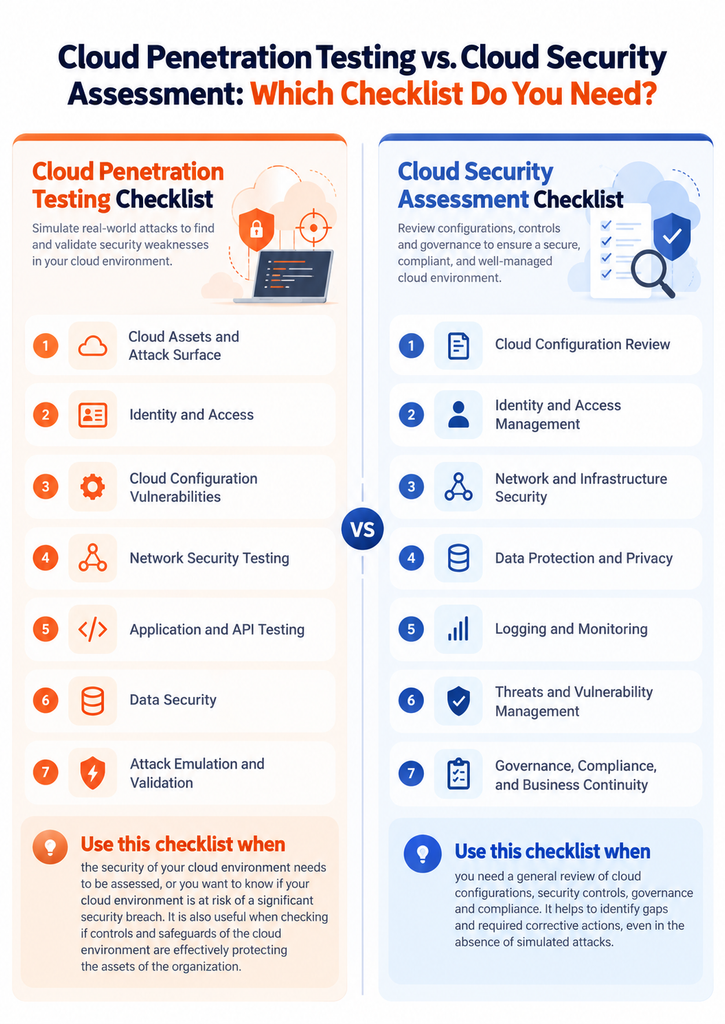
Use this checklist when the security of your cloud environment needs to be assessed, or you want to know if your cloud environment is at risk of a significant security breach. It is also useful when checking if controls and safeguards of the cloud environment are effectively protecting the assets of the organization.
Cloud Security Assessment Checklist
This checklist helps assess the security of a cloud environment by covering configurations and access, governance, monitoring, and compliance.
Cloud Configuration Review
- Review configurations of all cloud accounts, subscriptions, and projects.
- Check for public storage and services.
- Confirm if security baselines are enforced.
- Find unneeded resources and permissions.
- Check for configuration drift and policy violations.
- Check if security configuration meets business needs.
Identity and Access Management
- Review user accounts, access, groups, and service identities.
- Implement the principle of least privilege across cloud resources.
- Verify MFA enforcement for privileged and sensitive accounts.
- Identify inactive accounts and unused or excessive permissions.
- Review procedures for managing and approving requests for privileged access.
- Access controls for third-party users and external integrations.
- Confirm that access is removed upon role changes and when employees leave.
Network and Infrastructure Security
- Review configuration of virtual networks, subnets, routing and firewalls.
- Verify that access controls are set on public-facing services.
- Review segmentation of networks between production, development and testing.
- VPNs, private connectivity and remote administration.
- Containers, virtual machines and serverless.
- Verify that infrastructure configurations follow approved security standards.
Data Protection and Privacy
- Classify business-critical and sensitive data.
- Verify encryption at rest and in transit.
- Review key management for encryption.
- Verify data retention, deletion, and backup policies.
- Data residency, privacy, and protection requirements.
- Verify sensitive data is not shared unnecessarily with other users.
- Review controls for preventing unauthorized data transfer.
Logging and Monitoring
- Verify that audit logging is configured for critical services.
- Review monitoring for identity, network, and data activities.
- Verify that security alerts are configured for suspicious activities.
- Verify log retention is in accordance with organizational policies.
- Review processes for incident response for the cloud.
- Review the incident response plans.
Threats and Vulnerability Management
- Review the coverage of vulnerability scans for cloud workloads.
- Recognize outdated operating systems and software.
- Verify if critical and high-risk vulnerabilities have timelines for patching.
- Look at the remediation processes and the open security findings.
- Make sure vulnerabilities are prioritized based on risk and exposure.
Governance, Compliance, and Business Continuity
- Examine cloud security policies, standards and assigned responsibilities.
- Find out if there is compliance with relevant frameworks, like ISO 27001, where applicable.
- Find out where the responsibilities of the cloud provider and the organization meet.
- Make sure third-party access is controlled and Vendor security is met.
- Review critical cloud security services’ business continuity plans.
- Retain evidence of security reviews, exceptions and remediation.
Use this checklist when you need a general review of cloud configurations, security controls, governance and compliance. It helps to identify gaps and required corrective actions, even in the absence of simulated attacks.
When to use this checklist: Choose a cloud security assessment checklist to evaluate a broader aspect of cloud configurations, security controls, assurance, and compliance readiness. It helps pinpoint gaps that require corrective actions, regardless of whether an active attack is simulated.
Cloud Penetration Testing vs. Cloud Security Assessment: Which Checklist Do You Need?
Start with your most important question. Cloud penetration testing is the better way to validate whether a given attack vector can be successfully exploited. Cloud security assessment, on the other hand, is a better way to validate whether configuration and controls are adequately set across several cloud resources.
The maturity of your security framework also plays a role. Security assessments may be a better way to establish a security control framework for teams with minimal security controls. In comparison, penetration testing may be a better way to assess high-risk attack paths and frameworks for a team with security controls.
Timing is also a factor. Cloud security assessments may be scheduled routinely and after significant configuration changes. Cloud penetration testing should be performed before a major release, after architecture changes, and when risk justifies the testing.
A balance is also needed between cost and scope. It may be more valuable to perform a narrow penetration test on a critical application, compared to a broader assessment with no clear rationale. Likewise, a broad assessment may be justified only if there is time and will within the team to remediate findings.
Conclusion
Cloud penetration testing and cloud security assessments serve different but complementary purposes. While assessments identify security gaps and configuration issues, penetration testing validates how these weaknesses could be exploited. Organizations should begin with a cloud security assessment to understand their risks and prioritize critical systems for testing.
AutoSecT by Kratikal simplifies cloud security across AWS, GCP, and Azure through Cloud Security Posture Management (CSPM), automated scanning, continuous configuration audits, and real-time analysis. It also supports remediation and vulnerability compliance mapping. With scheduled automated scanning, AutoSecT helps organizations strengthen cloud security, address vulnerabilities, and maintain a proactive approach to risk management.
FAQs
- Cloud penetration testing and cloud security assessments: what are the differences?
Cloud penetration testing focuses on attacking and validating attacks on the systems. Cloud security assessments are audits that review the configurations and other control environments.
- When to perform cloud penetration tests?
Cloud security penetration tests should be performed prior to major releases. Tests should also be performed after major changes are made to the systems. Lastly, validating key controls requires penetration testing.
- Are cloud security assessments and penetration testing performed together?
No, but assessments may include evaluation of configuration controls.
- Is cloud pentesting redundant with regular vulnerability scans?
Not exactly. Vulnerability scans discover known vulnerabilities. Cloud pentesting uncover potential pathways through the system, also known as attack paths, and assess if the vulnerabilities scanned can be exploited.
- What should be included in an AWS pentesting checklist?
AWS penetration testing checklists should include exposed resources, IAM permission boundaries, access control lists, network ACLs, application endpoints, credential exposure, and privilege escalation. During testing, pentesters should adhere to the AWS policies and the constraints outlined in the test plan.
- How often should pentests be conducted to ensure the security of an organization’s cloud environment?
This is mainly determined by the rate of change of the organization’s infrastructure. It is also influenced by the requirements of external controls. Pentesting should be scheduled, and additional ad hoc testing should be performed following infrastructure or security control changes.
- Can cloud security assessments uncover gaps in compliance?
Yes, cloud security assessments review cloud control environments and may uncover gaps in alignment and compliance as well as configuration issues.
- When should an organization use each of the checklists?
An organization should use both checklists to get the best level of control and confidence. A cloud security assessment can uncover weaknesses, and a cloud pentest can verify if previously assessed weaknesses can be exploited.