
Manufacturing and Energy Plants utilise Operational Technology (OT) to help manage and operate their business. These technologies include programmable logic controllers (PLCs), supervisory control and data acquisition (SCADA) systems, and human-machine interfaces (HMIs). Integrating these technologies introduces risks to plant operations and service. Security breaches to plant control systems may lead to physical damage to plant equipment, disruption of production or supply of service, and a possible threat to employees’ safety and health.
OT Security Checklist for Manufacturing & Energy Plants
A recent report published by the European Union Agency for Cybersecurity (ENISA) outlined the 2025 threat landscape and noted that manufacturing accounted for 13.26% of all cybersecurity incidents. Here’s the OT Security checklist you need:
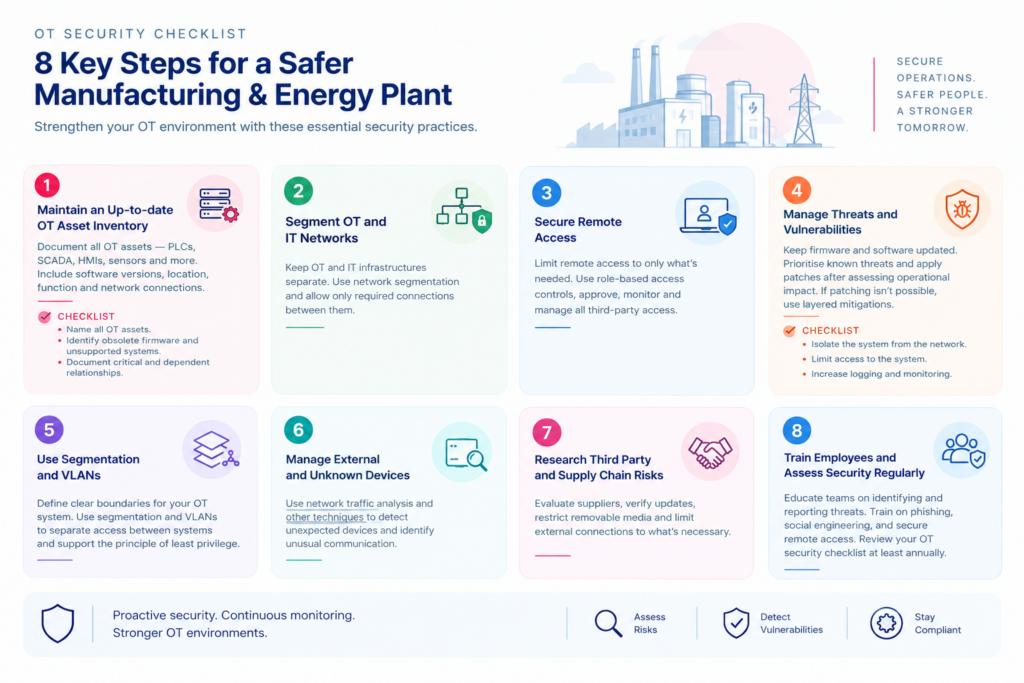
Maintain an up-to-date OT Asset Inventory
Develop and maintain an inventory of all OT assets. An inventory may include PLCs, SCADA and engineering workstations, HMIs, sensors, and other control and/or automation systems, network and/or communications equipment, and remote access equipment.
For each item documented on the inventory, list the equipment’s software version, location, function, and how it communicates with other equipment (if any). It is good practice to review the inventory when any changes occur on the OT security system to ensure unsupported equipment is identified.
CHECKLIST
- Name all OT assets.
- Identify equipment with obsolete firmware and unsupported systems.
- Identify and document all critical and dependent relationships.
Segment OT and IT Networks
OT and IT infrastructures have different requirements. Connecting them increases the attack surface area. For example, an attack on an IT network computer may spread to a critical control system of a plant.
Network segmentation can help reduce these risks. Organizations must logically separate corporate, production, and control system networks and establish only the necessary connections between them.
In manufacturing environments, network segmentation can limit communication between different production units. In energy plants, it can restrict communication between control systems and business systems.

Book Your Free Cybersecurity Consultation Today!
Secure Remote Access
Using the internet to access control systems from a remote location provides convenience to plant personnel and service providers. Remote access increases the attack surface area for a control system if remote access is not configured and controlled appropriately.
Bound the remote access to the minimum required by implementing role-based access control. Approve, monitor, and control remote access provided to service providers.
Manage Threats and Vulnerabilities
Control systems become vulnerable to known security threats when organizations fail to update their firmware or software. Organizations should control changes to these systems to prevent unexpected behaviour.
Organizations should prioritize publicly known threats and establish vulnerability management processes to address the most relevant risks. Before installing patches, they should assess their potential impact on plant and system operations.
Organizations should integrate engineering and operational processes into vulnerability management. If they cannot patch a critical system, they should apply the following mitigation measures together and document their decisions.
CHECKLIST
- Isolate the system from the network
- Limit access to the system
- Increase logging and monitoring of the system
Use Segmentation and VLANs
Carefully consider the boundaries of your OT system. Consider using segmentation and VLANs to help you separate access between different OT systems and support the principle of least privilege.
Segmenting and VLANs also help secure engineering workstations and operator consoles. These systems may provide access to control OT processes.
Manage External and Unknown Devices
A consolidated OT network makes it easier to identify unknown devices. Use network traffic analysis and other techniques to detect unexpected devices and help answer the question, “Why is this device communicating to that device?”
Research Third Party and Supply Chain Risks
Evaluate suppliers to determine if there are sufficient controls to mitigate vendor security risks before providing access to the supplier’s systems. Establish policies regarding the reporting of security incidents, and the control and updating of the software. Limit connections to suppliers to what is necessary.
When possible, verify software updates. Restrict removable media to authorised personnel. Limit removal of media to what is necessary, and verify that media does not contain unauthorised software.
Train Employees and Assess Security Regularly
Employees should be engaged in protecting industrial systems. Training should be provided to operators, engineers, maintenance personnel and contractors on how to identify and report suspicious activities.
Train personnel on phishing and other social engineering attacks, and the proper handling of media and incident reporting. Provide training on secure use of remote access and ensure that personnel are aware of security controls implemented to protect industrial systems. Review the OT Security Checklist at least annually.
How Kratikal Helps With OT Security?
Kratikal helps organizations strengthen OT security through Vulnerability Assessment and Penetration Testing (VAPT), OT risk assessments, and architecture assessments. These services help identify security gaps in industrial control systems, evaluate network architecture and segmentation, and assess potential risks to critical operations. By aligning assessments with the plant’s operational requirements and applicable security frameworks, Kratikal helps manufacturing and energy organizations prioritize remediation, improve security controls, and strengthen operational resilience while minimizing disruption to plant operations.
Conclusion
The checklist requires that security owners and deadlines be assigned to close identified security gaps. Policies and procedures should be reviewed after security incidents and/or infrastructure changes.
Therefore, a robust OT security program relies on an integration of various systems, processes, and services and not on a single product. This OT Security Checklist helps address some of these requirements in the context of manufacturing and power plants. It is important for safety and business reasons to evaluate the checklist, customize it to address specific requirements, and utilize it for continuity of operations.
Join our weekly newsletter and stay updated
FAQs
- What is an OT security checklist for manufacturing and energy plants?
An OT security checklist helps manufacturing and energy plants protect PLCs, SCADA systems, HMIs, and industrial networks from cyber threats. It covers asset inventory, network segmentation, remote access, vulnerability management, third-party risks, and employee training.
- Why is OT security important for manufacturing and energy plants?
OT security protects industrial operations from cyberattacks that can disrupt production, damage equipment, interrupt energy supply, and endanger employee safety.
- What are the key steps in an OT security checklist?
Key steps include maintaining an OT asset inventory, segmenting IT and OT networks, securing remote access, managing vulnerabilities, detecting unknown devices, assessing supplier risks, and training employees.
- How can manufacturing plants secure their OT networks?
Manufacturing plants can secure OT networks by separating corporate IT and production systems, using VLANs and firewalls, restricting unnecessary communication, monitoring network traffic, and applying least-privilege access controls.
- How can energy plants protect SCADA, PLC, and HMI systems?
Energy plants should maintain asset inventories, restrict remote access, monitor communications, apply tested security patches, segment critical control systems, and establish incident response procedures to protect SCADA, PLC, and HMI systems.
- How should organizations manage OT vulnerabilities and outdated systems?
Organizations should identify outdated firmware and software, prioritize vulnerabilities based on risk, and test patches for operational impact before deployment. If critical systems cannot be patched, apply compensating controls such as network isolation, restricted access, and enhanced monitoring.
- What is OT network segmentation, and why is it important?
OT network segmentation separates industrial control systems from corporate IT networks and limits communication between critical assets. It helps contain cyberattacks and prevents unauthorized access from spreading across plant environments.
- How can organizations secure third-party and remote access to OT systems?
Organizations should enforce role-based access, approve and monitor vendor connections, use secure authentication, restrict access to essential systems, and establish clear supplier security and incident-reporting requirements.
- Which OT security standards and frameworks should manufacturing and energy plants follow?
Manufacturing and energy plants can use IEC 62443, NIST SP 800-82, and the NIST Cybersecurity Framework to guide OT security controls, industrial network protection, risk management, and incident response. The appropriate framework depends on the plant’s operations, industry, and regulatory obligations.
- How often should an OT security checklist be reviewed?
Organizations should review their OT security checklist at least annually and after significant infrastructure changes or security incidents. Assigning security owners, setting remediation deadlines, and tracking identified gaps helps maintain continuous OT security and operational resilience.