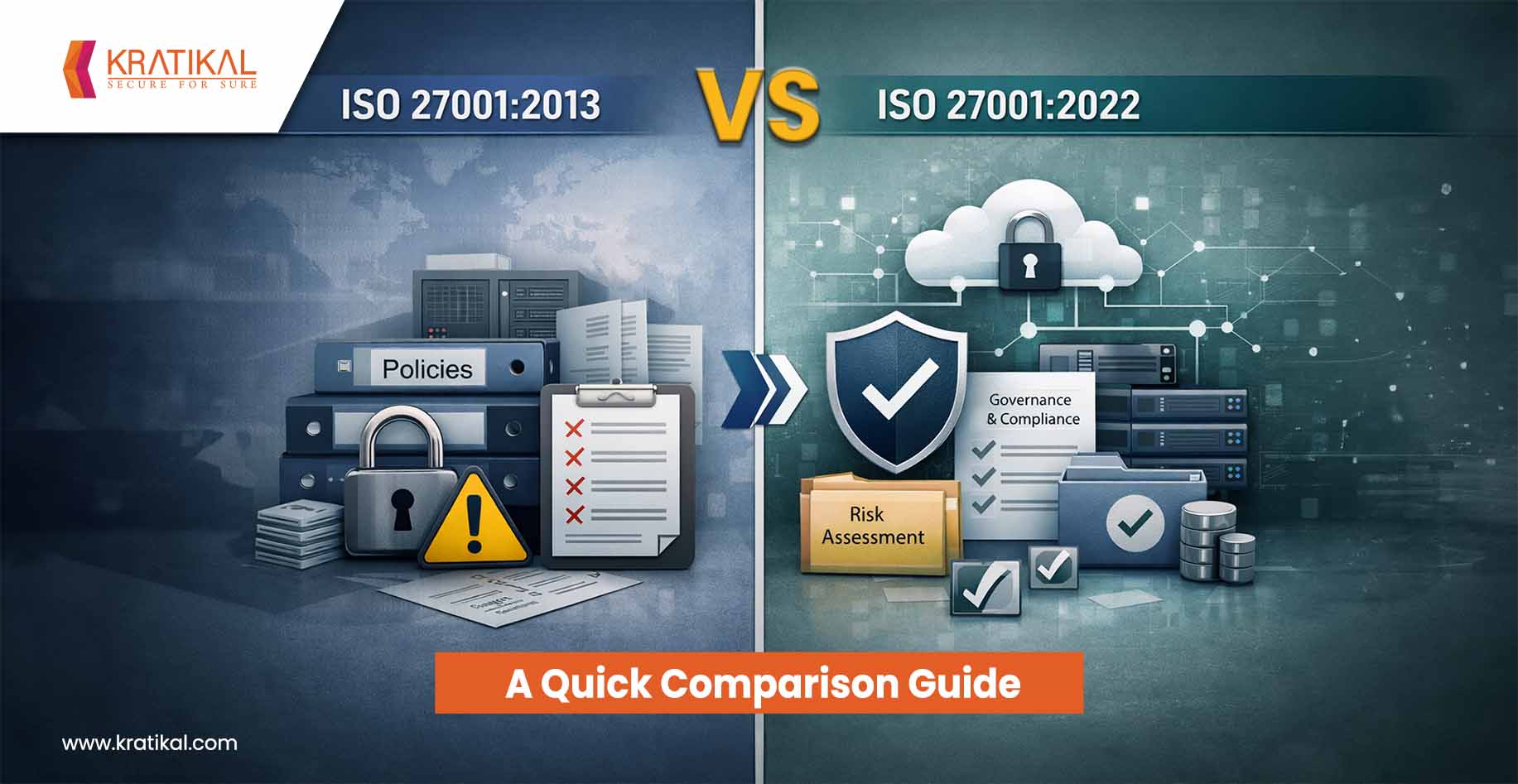
ISO 27001 is an internationally recognized standard that defines the requirements for establishing, implementing, maintaining, and continuously improving an Information Security Management System (ISMS) within an organization. First introduced in 1999, the standard has evolved through multiple revisions to address changing security needs. The most recent update, ISO 27001:2022, was released on October 25, 2022, introducing several updates compared to ISO 27001:2013. This blog explores the key differences between the two versions and helps organizations understand which one is more relevant today and why.
Detailed Comparison of ISO 27001: 2013 and ISO 27001: 2022
| User access review and removal are managed as separate controls. | ISO 27001: 2013 | ISO 27001: 2022 |
| Objective | Focuses on establishing an ISMS to systematically manage information security risks. | Enhances the ISMS to address modern challenges such as cloud adoption, remote work, and evolving cyber threats. |
| Core Clauses (4–10) | Structured but less streamlined, covering context, leadership, planning, and operations. | Refined for clarity and flexibility, with improved wording while retaining original intent. |
| Annex A Controls | 114 controls across 14 domains (A.5 to A.18). | 93 controls grouped into four themes: Organizational (37), People (8), Physical (14), Technological (34). |
| Control Structure | Broad domains with some overlap across controls. | Thematic grouping reduces redundancy and improves usability. |
| Example of Control Update | User access review and removal managed as separate controls. | Consolidated into a single access rights control for streamlined implementation. |
| New Controls | No specific focus on emerging areas like cloud or threat intelligence. | Introduces 11 new controls, including threat intelligence, cloud security, and secure coding. |
| Clause 4.2 – Interested Parties | General guidance without mandatory documentation. | Requires documented identification of interested parties including climate change issues and their requirements. |
| Clause 6.1.3 – Risk Treatment | High-level guidance with limited justification for controls. | Requires justification for control selection and alignment with Annex A. |
| Clause 9.1 – Monitoring | Limited direction on responsibility and frequency. | Clearly defines “who” and “when” for monitoring activities. |
| Key Benefits | Provides a solid baseline for security management. | Better aligned with modern technologies and frameworks like NIST and GDPR. |
Key Changes and Updates
The most notable updates in ISO 27001:2022 are reflected in Annex A, which outlines the security controls used to mitigate information security risks identified by an organization. The latest version streamlines the control set by reducing the number from 114 to 93 and reorganizing them into four thematic categories, replacing the earlier 14-domain structure.
These four themes are:
- Organizational: Covers governance, policies, roles, responsibilities, and ISMS-related processes.
- People: Focuses on awareness, training, competence, and user behavior within the ISMS.
- Physical: Addresses the protection of physical assets such as facilities, equipment, and storage media from unauthorized access or damage.
- Technological: Concentrates on safeguarding information systems, networks, and applications against cyber threats, malware, and attacks.
Updated Controls of ISO 27001 Compliance
ISO 27001:2022 introduces new controls while retaining the existing ones and consolidating several to create a more streamlined and practical structure. These updates are designed to better reflect modern security practices and improve implementation efficiency. Some of the newly introduced or enhanced controls include:
A.5.7 – Threat Intelligence
Organizations should collect, analyze, and use information about current and emerging cybersecurity threats to understand risks and take proactive security measures.
A.5.23 – Information Security for Use of Cloud Services
Ensures that appropriate security controls are defined and implemented when using cloud services, covering responsibilities of both the organization and the cloud service provider.
A.8.10 – Information Deletion
Defines how information should be securely and permanently deleted when no longer required, in line with legal, regulatory, and business requirements.
A.8.11 – Data Masking
Protects sensitive data by hiding or obfuscating parts of it, so that only authorized users can view the complete information.
A.8.12 – Data Leakage Prevention (DLP)
Implements controls to detect and prevent unauthorized sharing, transfer, or exposure of sensitive information.
A.8.28 – Secure Coding
Ensures that applications are developed using secure coding practices to prevent vulnerabilities such as SQL injection, cross-site scripting (XSS), and other common security flaws.
How Kratikal Can Help You With ISO 27001 Compliance?
Kratikal helps organizations achieve ISO/IEC 27001 compliance by guiding them through the entire compliance lifecycle with a structured, expert-led approach. Starting with a thorough gap and risk assessment, Kratikal identifies where your current information security practices fall short of ISO 27001 requirements and develops a tailored roadmap for implementation. Their team drafts essential ISMS policies, implements necessary controls, and conducts training to ensure your employees understand their roles in safeguarding information. Kratikal also performs internal audits and supports you through the formal certification process, helping you prepare for Stage 1 and Stage 2 audits and resolve any non-conformities. As a CERT-In empanelled cybersecurity partner trusted by 650+ SMEs and enterprises, Kratikal ensures your ISMS meets international best practices, strengthens risk management, and enhances overall security resilience as you pursue ISO 27001 certification.
FAQs
- Is ISO 27001 2013 still valid?
ISO 27001:2013 was officially withdrawn in October 2022 with the release of the updated standard, ISO 27001:2022. Organizations were given a three-year transition period to upgrade, which has now ended. As of 31st October 2025, all ISO 27001:2013 certifications have expired.
- Why is Bitcoin not ISO 20022 compliant?
A common misunderstanding is that some cryptocurrencies are “ISO 20022 compliant.” In reality, ISO 20022 does not apply to cryptocurrencies or blockchains at all. It is a standard for data messaging between financial institutions, defining how structured information is exchanged between systems, not which digital assets are recognized or supported.