


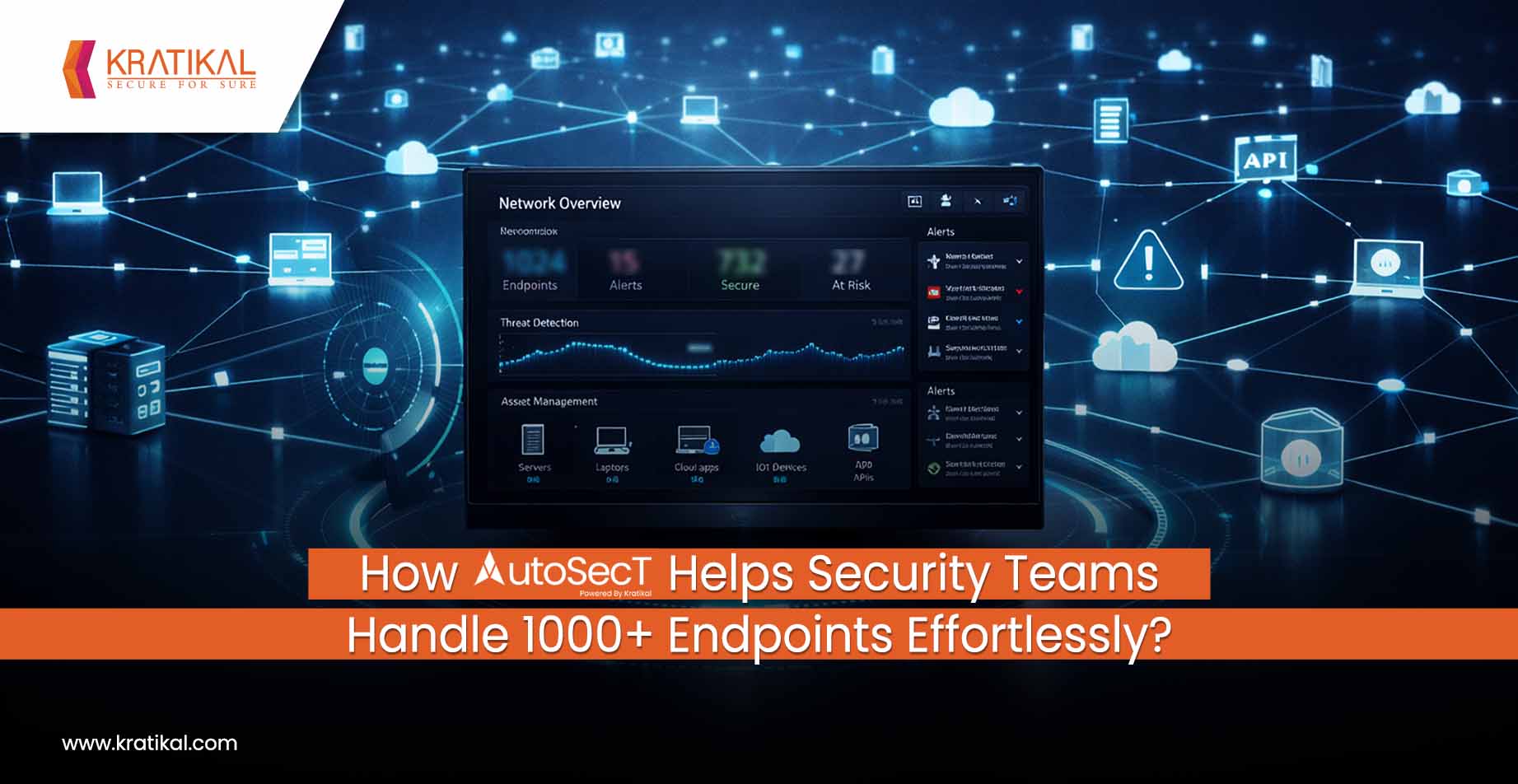
Managing security across 1000+ endpoints is no longer a scale problem alone; it is a complexity problem. Modern enterprise environments are dynamic, hybrid, and API-driven. Cloud workloads, remote employees, containerized services, and third-party integrations constantly introduce new endpoints. Traditional security tools struggle to keep pace, resulting in blind spots, alert fatigue, and delayed remediation. To maintain strong network security and endpoint security at scale, security teams require continuous visibility, real-time validation, and automated decision-making. This is where AutoSecT fundamentally changes how large environments are secured.
Endpoint Vulnerability Management as a Core Security Requirement
The data paints a stark picture. Nearly 68% of successful cyberattacks now originate at the endpoint, with ransomware incidents increasing by 41% year over year. This trend is not accidental; it reflects a deliberate attacker strategy. Endpoints consistently present the easiest entry point into enterprise environments due to inconsistent controls and limited visibility.
The challenge has escalated with the widespread adoption of remote and hybrid work models. Large organizations now manage an average of 135,000 endpoints, marking a 300% expansion of the attack surface. Devices connecting from home networks, public Wi-Fi, and shared workspaces operate beyond traditional perimeter defenses, significantly increasing exposure.
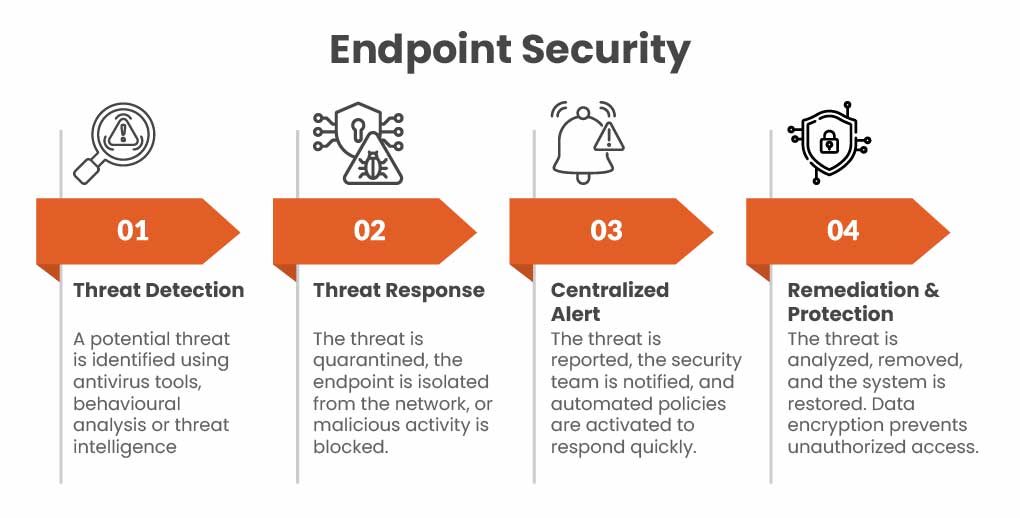
Equally concerning is the length of the vulnerability exposure window. On average, known vulnerabilities remain unpatched for approximately 97 days, providing attackers ample time to exploit these weaknesses. Threat intelligence data repeatedly confirms active exploitation of publicly disclosed vulnerabilities during this period.
Regulatory bodies have responded to this growing risk. Compounding these risks is the rise of shadow IT. Unauthorized apps, unmanaged devices, and mobile endpoints create major visibility gaps that traditional perimeter-based security can’t cover, making continuous exposure management essential.
An AI-Driven Approach to Managing Network and Endpoint Security at Scale
AutoSecT mitigates these issues through continuous asset discovery, exploit-based vulnerability validation, and AI-driven risk prioritization. With real-time visibility and focus on validated, high-impact risks, AutoSecT helps teams manage thousands of endpoints efficiently while strengthening endpoint and network security.
AI-Driven Network Security
AutoSecT leverages AI to continuously map and scan every device across the network, performing real-time IP- and MAC-level discovery to ensure no endpoint is overlooked, even as IP addresses change. With a single action, it generates a complete and continuously updated asset inventory, while credentialed scans using protocols such as SSH and Active Directory deeply assess each endpoint’s operating system, services, and configurations. Unlike traditional scanners, AutoSecT uses real exploit techniques to validate detected vulnerabilities, ensuring it reports only confirmed, exploitable issues and eliminates false positives while significantly reducing analyst triage time. Its fully agentless, cloud-based architecture allows the platform to scale effortlessly across large and complex environments, with proven capability to secure over 25,000 network assets and identify more than 1.2 million vulnerabilities annually.
Endpoint Security and Automation
Endpoint security – protecting servers, laptops, IoT devices, and other hosts – is often an overwhelming task when done manually. AutoSecT’s AI-driven validation means that once a vulnerability is detected on an endpoint, the platform attempts an exploit in a safe way to confirm it. This AI-verified scanning ensures that only true threats appear in reports.
For endpoints, this drastically cuts down noise: security teams spend less time chasing false alarms. When a genuine vulnerability is confirmed, AutoSecT goes further; it can automatically suggest or even initiate remediation. For instance, its agentic AI can propose patch updates or configuration changes and, in critical cases, isolate a compromised endpoint to prevent lateral movement. This closed-loop security automation means teams no longer need to manually track and patch each of 1000+ endpoints; the system handles the heavy lifting. In effect, AutoSecT brings enterprise-grade endpoint security to businesses of all sizes, securing devices continuously and transparently.
Integration and Workflow Simplification
AutoSecT consolidates critical security tasks into a single platform by automating workflows that allow teams to achieve more with less effort. Its Smart Scan Scheduler enables automated recurring scans, daily, weekly, or on demand across networks, servers, APIs, and web applications, with centralized policy management and hands-free execution. Built-in integrations with Jira, Slack, Microsoft Teams, and email ensure that confirmed vulnerabilities are automatically converted into actionable tickets or real-time alerts, while the dashboard updates dynamically as remediation progresses. The unified dashboard provides a centralized view of risk across all endpoints and asset types, and automatically generates customizable CISO and compliance-mapped reports, significantly reducing manual effort and simplifying regulatory audits and executive-level reporting with one-click export options.
Get in!
Join our weekly newsletter and stay updated
Core Elements of Endpoint Vulnerability Management
An effective vulnerability management program is built on several interdependent components working together.
- Continuous Vulnerability Scanning and Assessment
Continuous scanning solutions operate around the clock with minimal impact on endpoint performance. They use agentless or lightweight techniques to identify vulnerabilities as they arise and ensure critical exposure windows are not missed.
- Intelligent Risk Prioritization
Risk-based prioritization frameworks go beyond static severity ratings by incorporating real-world threat intelligence. By leveraging sources such as CISA KEV and commercial intelligence feeds, security teams can focus on vulnerabilities that are actively exploited in the wild, enabling prioritization based on actual threat activity rather than theoretical risk scores.
- Automated Response Capabilities
Security platforms incorporate automated vulnerability scanning and response capabilities that enable immediate containment of identified risks. When critical vulnerabilities are detected, these tools can automatically isolate affected endpoints, reducing exposure while security teams plan and implement full remediation strategies.
- Compliance and Reporting
Built-in compliance monitoring helps organizations meet requirements for frameworks such as NIST, ISO 27001, and SOC 2. Automated reporting enables security teams to easily demonstrate alignment with security best practices and regulatory obligations.
Book Your Free Cybersecurity Consultation Today!

Conclusion
The combination of dynamic infrastructure, remote work, shadow IT, and actively exploited vulnerabilities has made endpoint vulnerability management a core requirement for maintaining a strong security posture. Organizations need continuous visibility, accurate validation, and intelligent prioritization to stay ahead of real-world threats.
AutoSecT addresses these challenges by unifying network security and endpoint security into a single, AI-driven platform designed for scale. Through continuous asset discovery, exploit-based vulnerability validation, automated remediation, and seamless workflow integration, AutoSecT enables security teams to reduce noise, close exposure gaps, and respond faster to confirmed risks. By automating critical security operations and providing real-time, risk-focused insights, AutoSecT empowers organizations to manage 1000+ endpoints efficiently.
FAQs
- How is AutoSecT different from traditional vulnerability scanners?
Unlike traditional scanners that rely on signature-based detection, AutoSecT validates vulnerabilities using real exploit techniques, eliminating false positives and focusing only on exploitable, high-impact risks.
- In what ways does AI-driven prioritization optimize handling of vulnerabilities?
AutoSecT uses AI to correlate exploitability, asset criticality, and threat intelligence, ensuring teams focus on vulnerabilities that pose the highest real-world risk.





Leave a comment
Your email address will not be published. Required fields are marked *