



Security issues have always been the number one challenge for the e-commerce industry. Despite having a good marketing strategy and remarkable website design, your entire website, as well as your firm, can be easily ruined by a simple DDoS attack or other cyber threats. Threats to e-commerce security are rising day by day and have been compromising the data of both organizations and customers. A leading e-commerce platform disclosed a breach affecting 10M customer accounts. Exposed data included contact details, shipping addresses, and detailed order histories. The e-commerce industry is known to be the highest vulnerable industry in terms of cybersecurity.
Table of Contents
- 0.1 Cyber Security in e-Commerce: The Need
- 0.2 Top Cyber Threats to eCommerce Security
- 0.2.1 #1 Injection Attacks Across Checkout, Login, and Search Flows
- 0.2.2 #2 Broken Authentication and Business Logic Vulnerabilities
- 0.2.3 #3 API Vulnerabilities in Payment, Inventory, Cart, and Order Systems
- 0.2.4 #4 Third-Party Script & Supply Chain Weaknesses (Magecart, Formjacking)
- 0.2.5 #5 Server & Infrastructure Misconfigurations
- 1 Get in!
Cyber Security in e-Commerce: The Need
According to an Industry Threat Intelligence Report, a sharp increase, over 50% quarter-to-quarter, in ransomware attacks aimed at retail and e-commerce environments. Attackers focused on encrypting order-management systems and exfiltrating customer data, leveraging supply-chain access and weak internal segmentation. Without having the essential security procedures in place, the e-commerce companies are possibly at great risk of losing the data of customers and ultimately their revenue.
On the other hand, the fact that hackers are nowadays using sophisticated and advanced technologies to attempt cyber attacks doesn’t help either. They have found better ways to exploit security loopholes and confidential data of users from online stores. Over the past recent years, threats to e-commerce security have made a major impact on the industry. Here is a list of shocking statistics about the e-commerce industry found in the cybersecurity surveys and reports of the past recent years:
- E-commerce ranked 5th among industries targeted by ransomware worldwide in 2024.
- ~24% of all data breaches reportedly hit retail & consumer sectors in 2025.
- By 2025, projected that 45% of global organizations will have experienced a software supply-chain attack
- In an empirical study of 90 US-based e-commerce websites in 2024, 38.5% used over 50 cookies per session; many lacked MFA and proper input validation
- Statistical analysis of e-commerce cyberattack patterns shows significant spikes during holiday/peak shopping periods
These statistics indicate the high potential for e-commerce security threats soon. Apart from these impacts, various cybersecurity threats badly affect e-commerce security. Here are the top 5 cyber threats to e-commerce security:
Top Cyber Threats to eCommerce Security
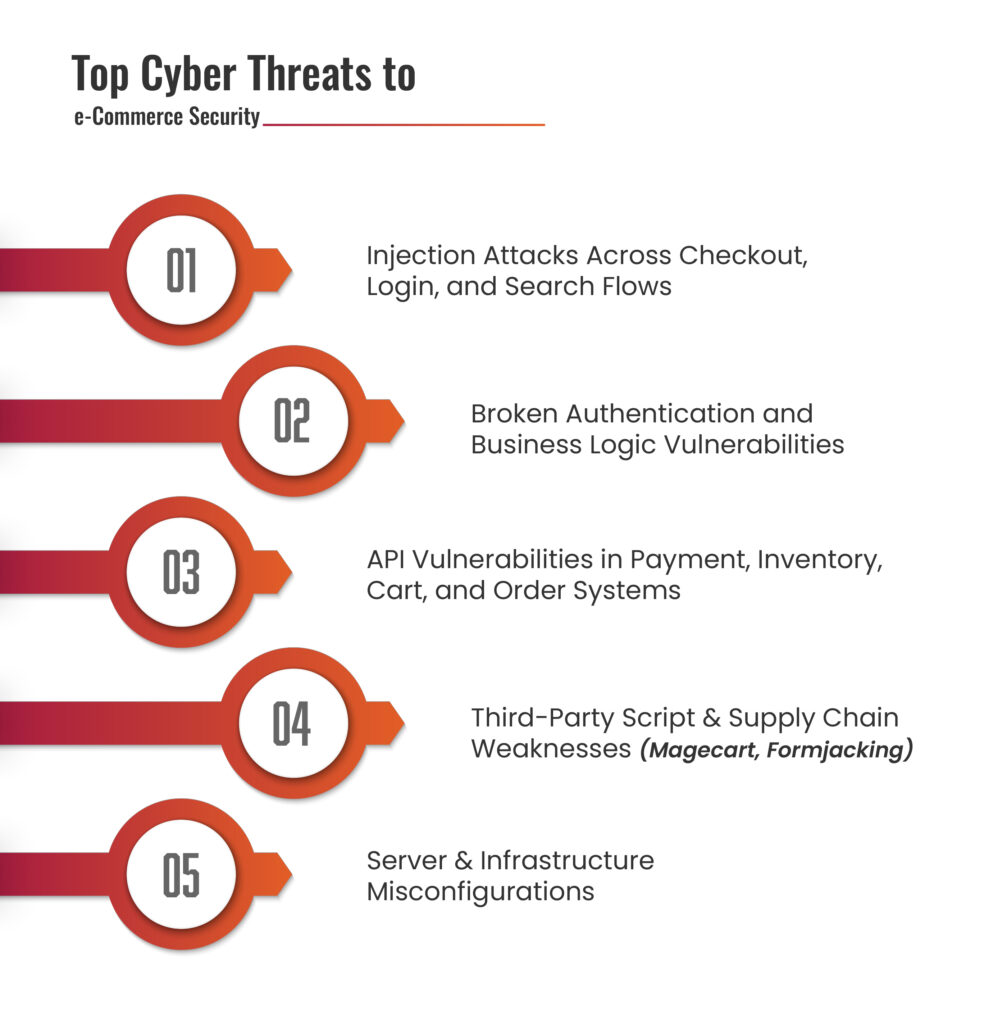
#1 Injection Attacks Across Checkout, Login, and Search Flows
Various e-commerce platforms handle sensitive customer data like payment details, addresses, and order history. These flows often include numerous user input fields: coupon boxes, search bars, order tracking forms, and login screens. Hackers weaponize poorly validated input to inject malicious code or extract backend data.
Common Attacker Techniques:
- Full database compromise (customer data, card tokens, PII)
- Checkout manipulation
- Website defacement or malicious script injection
- Session hijacking via stored XSS
How Can VAPT Mitigate It:
A thorough pentest simulates attacker behavior across every input surface. It:
- Identifies injectable parameters in checkout and login workflows
- Tests for reflected/stored XSS and template injection in product pages
- Exploits the vulnerability to confirm the impact
- Validates whether WAF rules actually block real attacks
- Provides exact payloads and sanitization fixes
#2 Broken Authentication and Business Logic Vulnerabilities
E-commerce logic is complex: carts, discounts, returns, wallet balances, loyalty points, OTP verification, multi-step checkout, and user roles. Hackers exploit blind spots and flawed assumptions in this logic.
Common Attacker Techniques:
- Bypassing OTP or password reset flows
- Abusing discount codes or modifying cart values
- Changing payment amounts through hidden fields
- Accessing other customers’ orders or invoices
- Privilege escalation to admin roles
How Can VAPT Mitigate It:
Business logic flaws are manual discoveries, not something you find with automated tools. VAPT testers intentionally try to break workflows by:
- Manipulating request parameters and hidden fields
- Trying unauthorized role access
- Testing rate limits on OTP and password reset
- Simulating fraud behaviors like negative quantity abuse
- Validating session handling and token expiry policies
#3 API Vulnerabilities in Payment, Inventory, Cart, and Order Systems
Modern eCommerce is API-heavy: mobile apps, warehouse systems, payment gateways, and admin dashboards all communicate through APIs. These APIs often expose sensitive operations without strong checks.
High-impact risks:
- BOLA (Broken Object Level Authorization) allows attackers to access someone else’s order or address
- Lack of authentication on “internal” endpoints
- Missing rate limits enabling bot-driven abuse
- Exposed admin APIs
- Manipulating cart, pricing, and inventory JSON schemas
How Can VAPT Mitigate It:
VAPT evaluates APIs in the exact way attackers do:
- Enumerating hidden and undocumented endpoints
- Testing authorization at object and function levels
- Stress-testing rate limits and throttling
- Attempting mass enumeration of order IDs, carts, users, etc.
- Validating schema, token handling, and authorization headers
#4 Third-Party Script & Supply Chain Weaknesses (Magecart, Formjacking)
Your e-commerce frontend includes payment plugins, chat widgets, analytics trackers, and marketing scripts. Every external script is a potential backdoor.
Common Attacker Techniques:
- Attackers compromise one vendor and silently skim credit card data across thousands of stores
- Malicious JS injects fake payment forms
- CDN-based malware spreads instantly
- Most eCommerce teams never audit external scripts
How Can VAPT Mitigate It:
A security test examines the entire client-side supply chain:
- Audits third-party scripts, plugins, and their versions
- Checks for tampering risks or unapproved script injection
- Validates whether SRI (Subresource Integrity) and CSP headers are enforced
- Inspects plugin configurations in WooCommerce, Magento, Shopify Apps, etc.
#5 Server & Infrastructure Misconfigurations
Most eCommerce breaches aren’t from “hackers” in a cinematic sense; they’re caused by sloppy configuration.
Common Attacker Techniques:
- Exposed admin pages or staging servers
- Misconfigured S3 buckets leaking assets or customer invoices
- Weak TLS, outdated CMS/plugins
- Overly permissive CORS policies that leak customer info
- Open ports exposing databases, Redis, and Elasticsearch
- Missing OS-level hardening
How Can VAPT Mitigate It:
Infrastructure testing uncovers critical operational cracks:
- Identifies externally reachable services
- Tests for privilege escalation on servers
- Simulates attacks against outdated software
- Identifies misconfigurations in cloud storage, CDN, DNS, and SSL
- Recommends hardening aligned with CIS/NIST/OWASP
Get in!
Join our weekly newsletter and stay updated
End Note
Remember, one critical failure can cost your company more than recoverable damages. These smart approaches will help you in securing and preventing e-commerce threats that are risking your immediate online environment. Besides, the best approach to protect from e-commerce threats is to invest in e-commerce security solutions the same way you invest in its marketing and website design.
FAQs
- What are the biggest cyber threats to e-commerce security today?
The top threats to e-commerce security include injection attacks, broken authentication, API vulnerabilities, supply-chain/script compromises, and server misconfigurations. These attacks can expose customer data, disrupt checkout flows, and damage brand trust.
- Why is VAPT important for securing an e-commerce website?
VAPT helps uncover hidden weaknesses in checkout flows, login systems, APIs, and third-party integrations. It simulates real attacker techniques, identifies exploitable flaws, and provides clear fixes, ensuring your e-commerce platform is secure before hackers find the gaps.
- How can online stores protect customers from rising e-commerce cyber threats?
Online stores should implement strong authentication, secure APIs, monitor third-party scripts, harden servers, and run regular VAPT assessments. These steps reduce the risk of data breaches, payment fraud, and account compromise.





Leave a comment
Your email address will not be published. Required fields are marked *