
Security leaders often spend millions on firewalls, endpoint protection, monitoring tools, and compliance audits. Yet despite all that investment, one uncomfortable truth remains: Organizations still miss vulnerabilities. You might be safe, but being secure needs more than that! Not because they don’t care about security. But because no internal team can see everything.
Every modern company runs hundreds of digital assets, be it web applications, APIs, cloud services, mobile apps, integrations, and third-party components. New features are deployed weekly. Infrastructure changes daily. And attackers are constantly probing for weaknesses.
In this reality, relying only on internal testing is not enough. That’s why forward-thinking organizations are adopting Vulnerability Disclosure Program (VDP). A structured framework that allows security researchers to report vulnerabilities before attackers exploit them safely.
And if implemented correctly, a VDP can become one of the most powerful layers in a modern cybersecurity strategy. Let’s break down why!
Behind Kratikal Vulnerability Disclosure Program (VDP): Vulnerabilities Exist Everywhere!
No software system is perfect. Every application, platform, and infrastructure component carries potential flaws like misconfigurations, insecure code, outdated libraries, exposed endpoints, or authentication weaknesses. Security assessments like VAPT are essential, but they happen periodically. The problem is that vulnerabilities don’t follow schedules.
They appear when:
- Developers release new features
- Infrastructure configurations change
- Third-party integrations are added
- Security patches introduce unexpected behavior
Even well-resourced security teams struggle to keep up. Research also consistently shows that external researchers discover a significant portion of vulnerabilities, sometimes more than internal teams do. This is not a failure of internal security programs. It simply reflects a basic reality: more eyes find more problems.
What is a Vulnerability Disclosure Program (VDP)?
VDP is a formal process that allows ethical hackers, researchers, and security professionals to report vulnerabilities responsibly. Instead of exposing the flaw publicly or worse, selling it on underground markets, researchers submit findings directly to the organization.
A well-designed VDP includes:
- A clearly defined disclosure policy
- Scope and testing boundaries
- A secure submission channel
- A responsible disclosure timeline
- Legal safe-harbor protections for researchers
This structure ensures that security issues are discovered and fixed responsibly. Without such a program, researchers often face uncertainty:
Will the company respond?
Will they face legal trouble for reporting a flaw?
Book Your Free Cybersecurity Consultation Today!

Why Organizations Without a Vulnerability Disclosure Program (VDP) Are Taking a Risk?
Here’s the uncomfortable truth.
If your organization does not provide a responsible disclosure channel, vulnerabilities will still be discovered. The difference is who finds them first. Malicious actors constantly scan the internet looking for misconfigurations, exposed services, and exploitable bugs. When vulnerabilities remain unreported, they silently become entry points for data breaches.
Many high-profile incidents began with simple issues:
- Misconfigured cloud storage
- Exposed APIs
- Authentication bypass flaws
- Insecure file uploads
These are the types of vulnerabilities that security researchers routinely identify. Without a VDP, those discoveries may never reach the organization until it’s too late.
The Value of Ethical Hackers
Ethical hackers play a crucial role in modern cybersecurity. Unlike traditional assessments, which follow predefined testing methods, independent researchers approach systems from countless angles. They may:
- Test unusual workflows
- Examine obscure API behaviors
- Identify logic flaws in application flows
- Detect security misconfigurations
This diversity of perspectives is invaluable. External researchers essentially act as an extended security workforce, constantly examining systems for weaknesses. And when supported through a structured disclosure process, their findings become a powerful defense mechanism.
Why Managing a Vulnerability Disclosure Program (VDP) Is Harder Than It Looks
Launching a disclosure program sounds simple in theory. Publish an email address. Ask researchers to report vulnerabilities. Problem solved, right? Not quite. Organizations that attempt unmanaged disclosure programs often encounter major challenges:
Noise and False Positives
Security teams receive hundreds of reports, many of which are incomplete, duplicates, or false alarms. Sorting through them becomes time-consuming.
Technical Validation
Every reported vulnerability must be verified and reproduced before remediation begins.
This requires skilled security engineers.
Communication Management
Researchers expect timely responses, updates, and acknowledgment. Without structured communication, relationships quickly deteriorate.
Policy and Legal Risk
Poorly defined disclosure policies can create legal ambiguity for both researchers and organizations.
Reporting and Metrics
Leadership teams expect visibility into risk trends, remediation timelines, and program effectiveness. Managing these elements manually becomes overwhelming.
This is exactly why many organizations move toward managed vulnerability disclosure programs.
How Managed Vulnerability Disclosure Program (VDP) Transform the Process?
A managed VDP takes the complexity out of running disclosure programs. Instead of burdening internal teams with triage and coordination, the program is operated by security experts who specialize in vulnerability management. The process typically includes:
Policy Creation
The disclosure policy defines the rules of engagement for researchers, including scope, testing guidelines, and responsible reporting procedures. This provides legal clarity and encourages responsible participation.
Vulnerability Intake
Researchers submit findings through structured channels that capture technical details, proof-of-concept information, and impact descriptions.
Validation and Verification
Security experts validate reported vulnerabilities to ensure they are genuine, reproducible, and relevant. This step removes duplicates and false positives.
Researcher Communication
Researchers receive acknowledgments, updates, and feedback, maintaining trust within the security community.
Reporting and Metrics
Security leaders gain visibility into:
- vulnerability trends
- severity distribution
- remediation progress
- program performance
These insights support strategic security decision-making.
The Role of Automation in Modern Vulnerability Disclosure Program (VDP)
One of the biggest advancements in vulnerability disclosure programs today is AI-assisted validation and vulnerability management platforms. Automation significantly improves the triage and verification process. With AutoSecT, you can:
- Validate technical findings
- Prioritize vulnerabilities based on severity and impact
- Correlate findings with threat intelligence
- Get AI-driven remediation guidance
The Business Benefits of a Vulnerability Disclosure Program (VDP)
Organizations often think of VDPs purely as security initiatives. But the benefits extend well beyond security.
- Reduced Security Workload
- Faster Remediation
- Broader Security Coverage
- Improved Compliance and Governance
- Stronger Brand Trust
Why Kratikal Managed VDP Complements Existing Security Programs?
Some organizations hesitate to launch a vulnerability disclosure program because they already conduct security assessments. But Kratikal managed VDP does not replace existing security practices. They enhance them.
Kratikal VDP operates continuously. It allows security researchers to discover issues between testing cycles, catching vulnerabilities that might otherwise remain hidden for months. This continuous feedback loop strengthens the overall security posture.
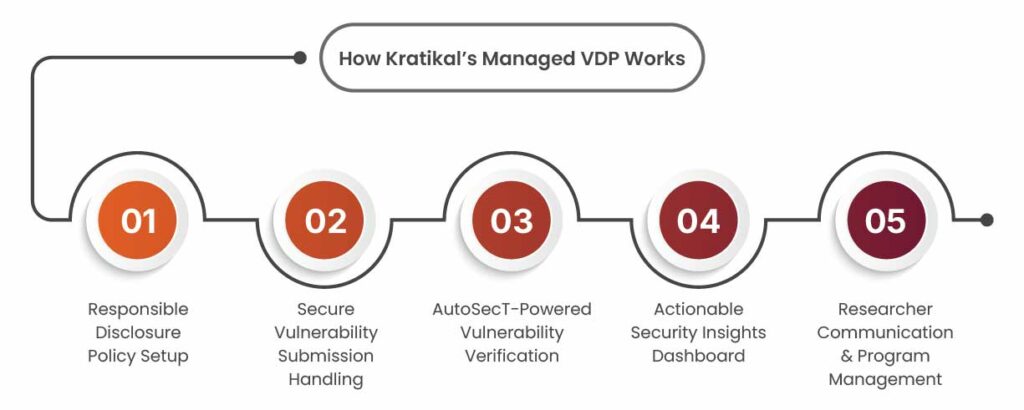
Kratikal’s managed Vulnerability Disclosure Program (VDP) brings these capabilities together in a streamlined framework. Their approach includes customized disclosure policies, centralized vulnerability intake, automated verification through their security platforms, and continuous reporting dashboards for leadership teams. By combining human expertise with AI-driven validation, organizations receive actionable, high-quality vulnerability intelligence without overwhelming internal security teams.
Join our weekly newsletter and stay updated
Kratikal Vulnerability Disclosure Program (VDP): Final Thoughts
A Vulnerability Disclosure Program turns the global security community into an ally, giving organizations early warning about security flaws that might otherwise go unnoticed. For companies managing complex digital ecosystems, this visibility is invaluable. Because in cybersecurity, the biggest risk is not the vulnerability you know about. It’s the one you don’t.
And the sooner you discover it, the better your chances of preventing the next breach.
Vulnerability Disclosure Program (VDP) FAQs
- What is Vulnerability Disclosure Program (VDP)?
A Vulnerability Disclosure Program (VDP) is a formal process that allows security researchers to responsibly report security flaws in an organization’s systems. It provides a safe channel to identify and fix vulnerabilities before attackers exploit them.
- Is Vulnerability Disclosure Program (VDP) mandatory?
VDPs are not legally mandatory for most organizations, but they are strongly recommended as a cybersecurity best practice. Many compliance frameworks encourage them to improve security and transparency.
- How will Vulnerability Disclosure Program (VDP) benefit my organization?
A VDP helps organizations detect vulnerabilities early and remediate them before they lead to breaches. It also improves security posture, builds trust with researchers, and reduces potential financial and reputational damage.