
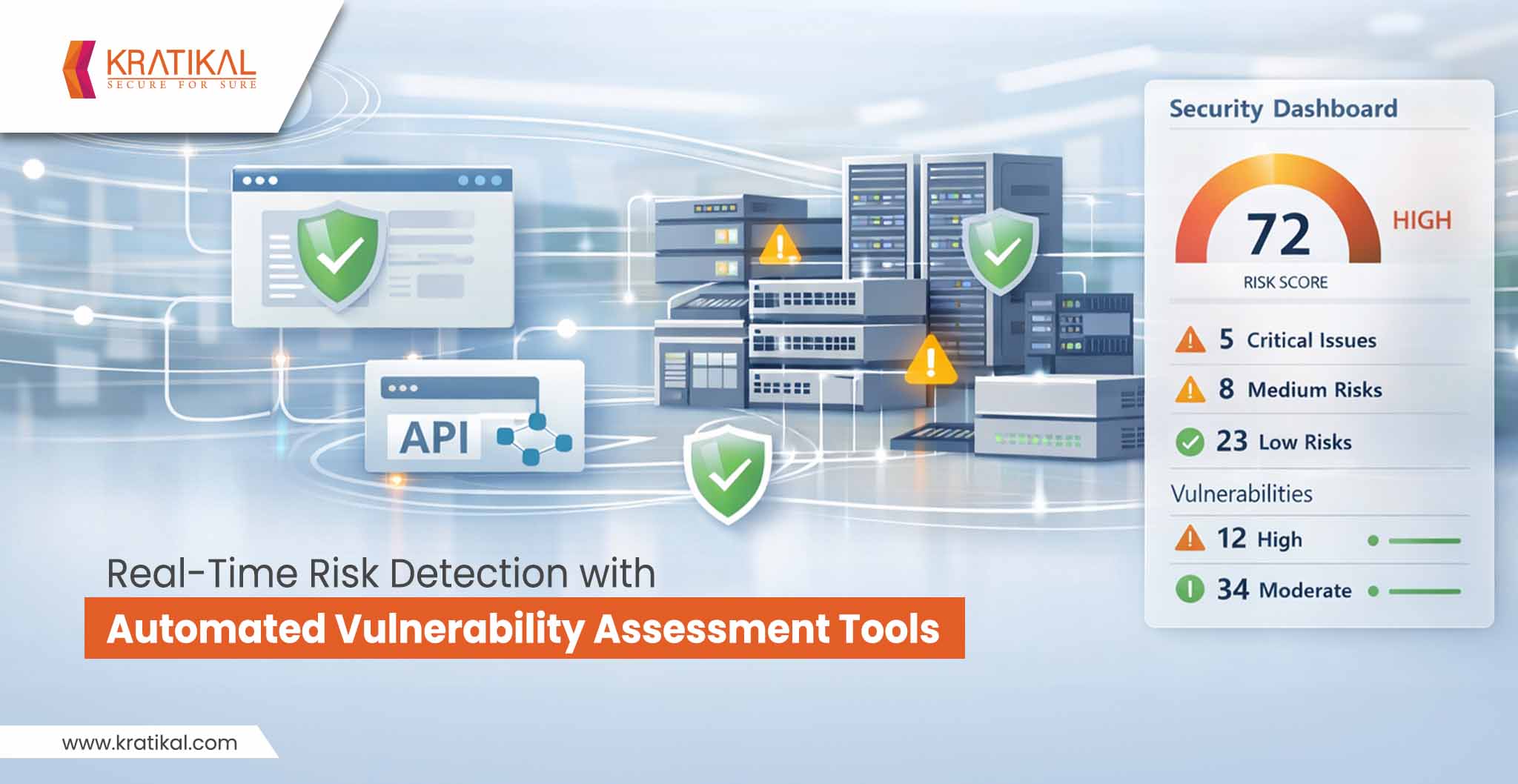
The global vulnerability landscape continues to expand rapidly, with thousands of new CVEs published every year. Thus, allowing hackers to weaponize newly disclosed flaws at an instant. Public reporting and threat intelligence analyses consistently show that exploitation often begins within days, and sometimes hours, of disclosure. That reality has fundamentally changed what “vulnerability assessment tools” must contribute to the threat-table.
Quarterly scans and static CVSS-based prioritization reduce risk, but we need something more than that. To ensure maximum security, you need real-time risk detection powered by automated vulnerability assessment tools, and not just saying that ‘we have it and use it from time-to-time’. They need tools that reduce exposure windows, suppress noise, and drive measurable remediation outcomes.
Real-Time Vulnerability Assessment Tools: Where Must Be The USP?
‘Real-time’ is now the new buzzword. Let’s clear out the haze and understand what it actually means and why security leaders keep using this term. ‘Real-time’ does not mean scanning everything every minute using vulnerability assessment and penetration testing tools. If such a thing happens, it will rather overwhelm infrastructure and security teams than do any good!
In practical terms, real-time risk detection needs a vessel that can carry out everything that is required. An automated vulnerability assessment tool with a real-time risk detection feature offers:
- Immediate detection of newly exposed assets
- Rapid correlation when a vulnerability is added to high-risk catalogs, such as CISA’s Known Exploited Vulnerabilities (KEV) list
- Automatic re-prioritization when exploit probability increases
- Instant visibility when internet exposure or privileged context changes
What is the objective? It’s simple!
“To shorten the exposure window, i.e., the time between vulnerability introduction and remediation.”
Modern attack campaigns exploit known vulnerabilities aggressively. According to data from CISA’s KEV catalog, hundreds of vulnerabilities have confirmed active exploitation in the wild. If a vulnerability appears on that list and exists in your environment, and you think it is a theoretical risk, there’s a flaw right there.
“It is an active exposure.”
Real-time vulnerability assessment tools must detect that alignment in the next 30 minutes and not in the next monthly report.
Book Your Free Cybersecurity Consultation Today!

Why is CVSS Alone Not Enough?
For years, organizations prioritized vulnerabilities using CVSS scores. While CVSS remains useful for understanding technical severity, it does not measure:
- Whether exploitation is happening in the wild
- Whether the asset is internet-facing
- Whether the asset inventory hosts critical business services
- Whether lateral movement is possible
Result? Overwhelming backlogs filled with “critical” vulnerabilities that rarely resulted in breaches.
Real-Time Vulnerability Assessment Tools: The Data Fusion Requirement
Real-time risk detection is impossible if vulnerability data lives in isolation. An effective automated assessment tools integrate the following:
| Features That Should Correlate | Highlight |
| Asset Inventory and Ownership Mapping | You cannot secure what you do not know exists. Dynamic environments, especially cloud and containerized workloads, introduce asset drift constantly. |
| Vulnerability Findings Across Layers | Cloud misconfigurations, Containers and Kubernetes, Network, Web Applications, Mobile Applications, and API endpoints |
| Threat Intelligence Feeds | KEV listings and exploit likelihood scoring (EPSS) ‘dramatically’ improve prioritization accuracy. |
| Exposure and Reachability Analysis | Analysing the following: Is the vulnerable system externally accessible?Does it connect to high-value data stores?Does it enable privilege escalation? |
Real-Time Vulnerability Assessment Tools – The Important Duo!
Noise Reduction and Validation
A common issue, yet with little to no solution, is that security teams frequently report that false positives and redundant alerts consume more time than actual remediation.
So, what must an effective automated vulnerability assessment and penetration testing tools must provide:
- Clear version evidence and software fingerprinting
- Confirmation that vulnerable components are actually installed and active
- Verification that remediation was successful
NIST’s guidance on enterprise patch management emphasizes verification as a core step. It highlights that deploying patches is just 50% work done; organizations must confirm effectiveness.
Operationalizing Remediation
Detection without action is wasted effort. High-performing vulnerability assessment and penetration testing tools directly to workflow systems, such as:
- Jira
- Slack
- Teams
- Google Chat
- Jenkins
- Zoho Cliq
Automation should support:
- Ticket creation with contextual evidence
- Ownership assignment
- Customizable SLA and tracking
- Maintenance window alignment
- AI-Driven recommendation against each vulnerability
The important factor that you, as an organization, need to keep in mind:
- A good vulnerability assessment tool does not promise zero false positives; instead guarantees ‘near-zero false positives’.
- A good vulnerability assessment tool does not let you waste remediation time just transferring the priority information from team to team; instead, it lets the concerned teams know about the risk priority at once in a single dashboard.
Vulnerability Assessment Tools – Get Metrics That Matter to Leadership
A blunt truth! Executives are no longer impressed by vulnerability counts. They care about measurable exposure reduction.
Now, metrics that matter in this case are:
- Mean Time to Remediate (MTTR)
- Median exposure window for exploitable vulnerabilities
- Percentage of KEV-listed vulnerabilities resolved within SLA
- Internet-facing critical vulnerabilities outstanding
- Asset coverage rate
Summary: A reduction in “critical vulnerabilities” is less valuable than a reduction in actively exploitable exposure.
The Hard Truth That Organizations Cannot Neglect
Effective vulnerability assessment tools cannot perform to their full potential if they have to compensate for poor governance. It happens if an organization lacks:
- Accurate asset inventory
- Defined ownership
- Patch governance policies
- Change management discipline
Result? Real-time risk detection will only generate faster chaos. Vulnerability management must function as preventive maintenance, embedded into operational processes. The cyberworld has enough effective solutions for reactive firefighting!
Vulnerability Assessment Tool Evaluation Checklist – The Top 6Qs
When selecting automated vulnerability assessment tools, organizations should demand clarity on:
Q1: “How quickly do risk scores update when KEV or EPSS data changes?”
Q2: “Whether reachability and exploit path analysis are included?”
Q3: “How does deduplication work across asset types?”
Q4: “How is remediation verification performed?”
Q5: “Whether coverage spans hybrid, cloud-native, and container environments?”
Q6: “What performance impact scanning introduces?”
What Does A Good Vulnerability Assessment Tool Prioritize?
Advanced vulnerability assessment tools must prioritize risks in a way that solves the real problem. A good tool must incorporate:
- CISA KEV Inclusion (actively exploited indicator)
- EPSS (Exploit Prediction Scoring System) Probability
- Risk Severity Categorization and Business Impact (Critical, High, Medium, Low
- Exposure Context (internet-facing, reachable, privileged)
- Customizable SLAs and Remediation SLA Progress
- Vulnerability Disclosure Status and Inventory Remediation Status
- Latest Inventory Risk Insights
The cybersecurity landscape has shifted from vulnerability discovery to vulnerability exploitation speed. And in a threat environment where exploitation can begin within days of disclosure, that transformation is the route to win. Because, without a vulnerability exploitability context, vulnerability assessment becomes the ‘slightly important section in a monthly review meeting’ rather than ‘a risk reduction strategy’.
Join our weekly newsletter and stay updated
Vulnerability Assessment Tools FAQs
- What are real-time Vulnerability Assessment Tools?
Real-time vulnerability management tools continuously detect new exposures, correlate KEV and EPSS data, and reprioritize risks to reduce active exploit windows faster than traditional periodic scans.
- Why is CVSS alone not enough for vulnerability prioritization?
CVSS measures severity, not exploitability; modern Vulnerability Assessment and Penetration testing tools combine threat intelligence, exposure context, and reachability analysis to prioritize real-world risk.
- What features should an automated Vulnerability Assessment Tool include?
The best tools provide real-time updates, exploit path analysis, remediation verification, workflow integration, and measurable metrics like MTTR to drive faster risk reduction.