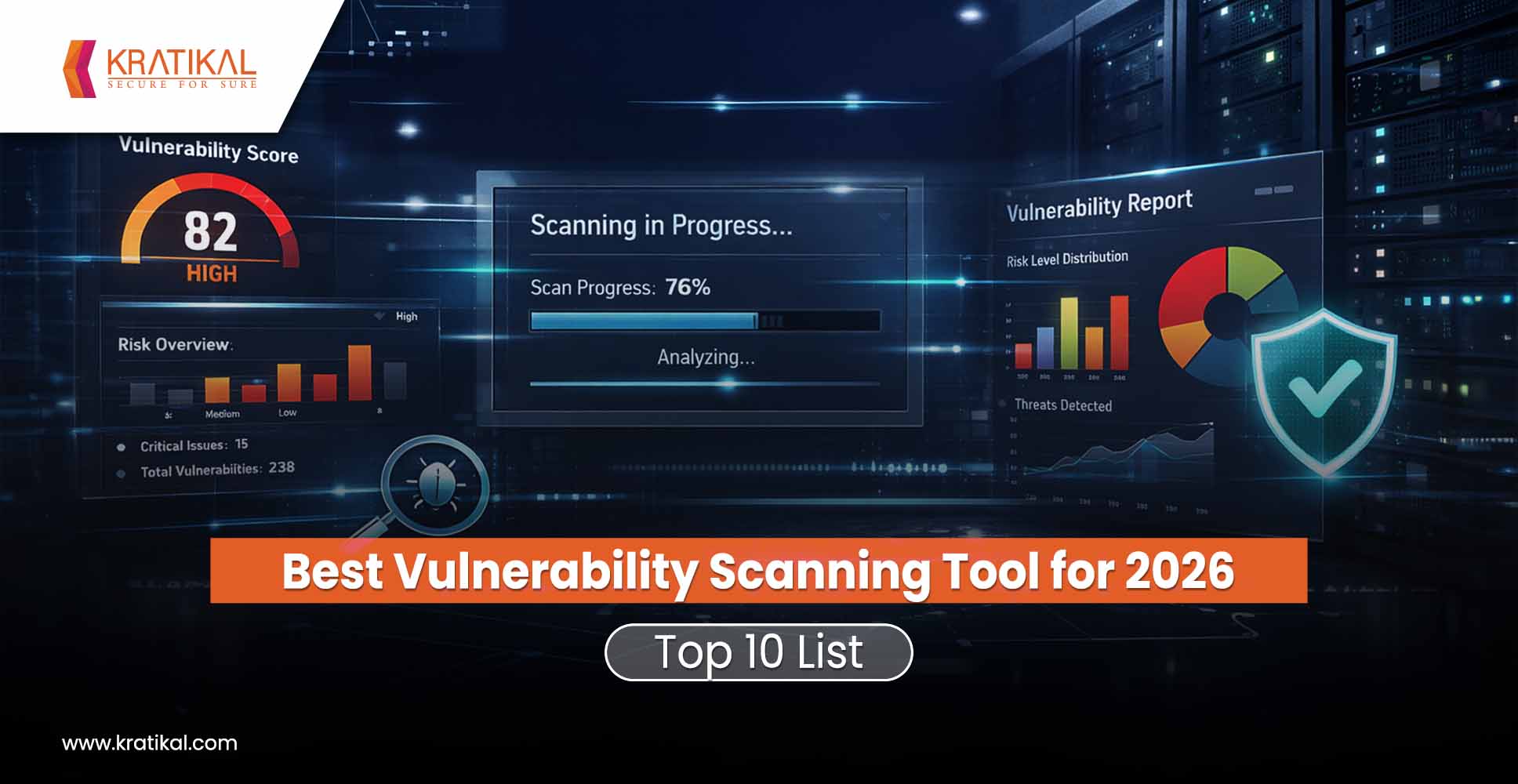
By 2026, vulnerability scanning will no longer be about running a weekly scan and exporting a PDF. Modern environments are hybrid, ephemeral, API-driven, and constantly changing. Tools that haven’t adapted are already obsolete, even if they still have brand recognition. Therefore, we present to you the top 10 Best Vulnerability Scanning Tools for 2026, which are well-known in the tech market, perform well today, and are realistically positioned to stay relevant in 2026 across network, cloud, web, mobile, and API security.
Let’s get into it. Starting with the list of ‘best vulnerability scanning tool’.
- AutoSecT (Kratikal)
- Qualys VMDR
- Tenable One
- Rapid7 InsightVM
- Checkmarx One
- Veracode
- Prisma Cloud (Palo Alto)
- CrowdStrike Falcon Exposure
- Acunetix (Invicti)
- FortiVM (Fortinet)
Now, a brief –
| Tool | Best Fit For | Key Limitation |
| AutoSecT (Kratikal) | Organizations wanting accuracy, near-zero false positives, and effective AI-powered remediation focus | Newer brand vs legacy giants |
| Qualys VMDR | Large enterprises, compliance-heavy orgs | High noise, tuning required |
| Tenable One | Hybrid IT + cloud environments | Complex UI, CVE-heavy |
| Rapid7 InsightVM | SOC-driven security teams | Cloud depth weaker than peers |
| Checkmarx One | DevSecOps & development teams | Not infra-focused |
| Veracode | Regulated app-heavy orgs | Weak network scanning |
| Prisma Cloud (Palo Alto) | Cloud-native enterprises | Weak on traditional networks |
| CrowdStrike Falcon Exposure | Endpoint-centric security stacks | Still maturing as VM tool |
| Acunetix (Invicti) | Web/API-heavy environments | No infra coverage |
| FortiVM (Fortinet) | Existing Fortinet customers | Ecosystem lock-in |
Top 10 Best Vulnerability Scanning Tool for 2026
AutoSecT (Kratikal) – The Most Advanced AI-Powered VMDR and Pentest Platform
AutoSecT leads this list of the best vulnerability scanning tool because it’s built for how environments actually work today, not how they worked ten years ago. Unlike traditional scanners that flood teams with CVEs, AutoSecT combines AI-driven pentesting, vulnerability management, and exposure prioritization in a single platform. It covers network, cloud, web, mobile, and APIs while focusing heavily on accuracy and reduction of false positives; a problem most legacy scanners still haven’t solved.
Why does AutoSecT stand out for 2026?
- Unified VMDR + AI-powered pentesting
- Cloud-native, agentless scanning across AWS, Azure, and GCP, along with CSPM
- AI Agentic Network Scanner
- AI-Driven Real-Time Vulnerability Analysis
- Risk-based prioritization instead of raw CVSS noise
- Strong DevSecOps and CI/CD integration
- Vulnerability Compliance Mapping
Reality check:
AutoSecT is not trying to be a “scanner.” It’s positioning itself as a decision-making platform for remediation, which is exactly where the market is heading.
Book Your Free Cybersecurity Consultation Today!

Qualys VMDR
Qualys remains the reference point for vulnerability management in large enterprises. Its VMDR platform is mature, scalable, and deeply embedded in regulated environments. It excels in asset discovery, continuous scanning, and compliance alignment, especially for large, distributed infrastructures.
Strengths
- Massive vulnerability database and research depth
- Strong cloud and container security capabilities
- Excellent compliance and reporting support
Limitations
- Can generate overwhelming volumes of findings
- Requires tuning and skilled teams to extract real value
Tenable
Tenable has successfully shifted from Nessus-era scanning to exposure management, which keeps it highly relevant. Its strength lies in correlating vulnerabilities with misconfigurations, identities, and cloud exposure, rather than treating issues in isolation.
Strengths
- Broad coverage across IT, cloud, OT, and APIs
- Strong analytics and attack path modeling
- Widely adopted across enterprises
Limitations
- UI and remediation workflows can feel complex
- Still CVE-heavy unless properly tuned
Rapid7 InsightVM
Rapid7’s advantage is its ability to connect vulnerability data with real-world exploitability and incident intelligence. InsightVM works best for organizations that want vulnerability scanning tightly linked to detection and response.
Strengths
- Excellent prioritization using exploit data
- Strong integrations with SIEM and SOC workflows
- Clear remediation guidance
Limitations
- Cloud-native depth lags behind newer platforms
- Pricing can escalate quickly
Checkmarx One
Checkmarx earns its spot because application security is no longer optional. While it’s not a traditional network scanner, its dominance in SAST, DAST, and API security testing makes it critical for organizations building modern software.
Strengths
- Deep web and API vulnerability detection
- Strong CI/CD integration
- Designed for DevSecOps teams
Limitations
- Limited infrastructure scanning
- Best when paired with a VMDR platform
Veracode
Veracode focuses heavily on secure-by-design development, making it a staple in enterprises with mature SDLCs. Its scanning capabilities are well-respected for web and API security, especially in regulated industries.
Strengths
- Strong developer-focused workflows
- Policy-driven vulnerability governance
- SaaS-first and scalable
Limitations
- Infrastructure and network scanning are not its core strengths
Palo Alto Prisma Cloud
Prisma Cloud is not just a vulnerability scanner; it’s a cloud security platform that includes vulnerability management as a core component. For organizations heavily invested in cloud-native architectures, it’s a serious contender.
Strengths
- Deep visibility into cloud workloads and containers
- Integrated with runtime and posture management
- Strong API and container scanning
Limitations
- Less effective for traditional on-prem environments
- Works best inside the Palo Alto ecosystem
CrowdStrike Falcon Exposure Management
CrowdStrike’s move into vulnerability and exposure management is aggressive and well-funded. Its strength lies in combining endpoint telemetry with vulnerability intelligence, offering context that many scanners lack.
Strengths
- Real-time exposure visibility
- Strong threat intelligence integration
- Lightweight and scalable
Limitations
- Still maturing compared to dedicated VMDR platforms
- Cloud and API depth are improving but uneven
Acunetix (Invicti)
Acunetix remains one of the most accurate web and API vulnerability scanners, especially for DAST. It earns a spot because web apps and APIs are still the #1 attack surface.
Strengths
- Extremely low false positives
- Strong automation for web/API testing
- Developer-friendly
Limitations
- Limited network and infrastructure scanning
FortiVM (Fortinet)
Fortinet’s vulnerability scanning works best when embedded into its broader security fabric. For organizations already running FortiGate, FortiSIEM, and FortiEDR, FortiVM offers seamless integration.
Strengths
- Strong network and infrastructure scanning
- Tight integration with the Fortinet ecosystem
- Cost-effective for existing customers
Limitations
- Not best-of-breed outside the Fortinet stack
- Limited innovation compared to newer platforms
Top 10 Vulnerability Scanning Tools for 2026 – Comparison Table
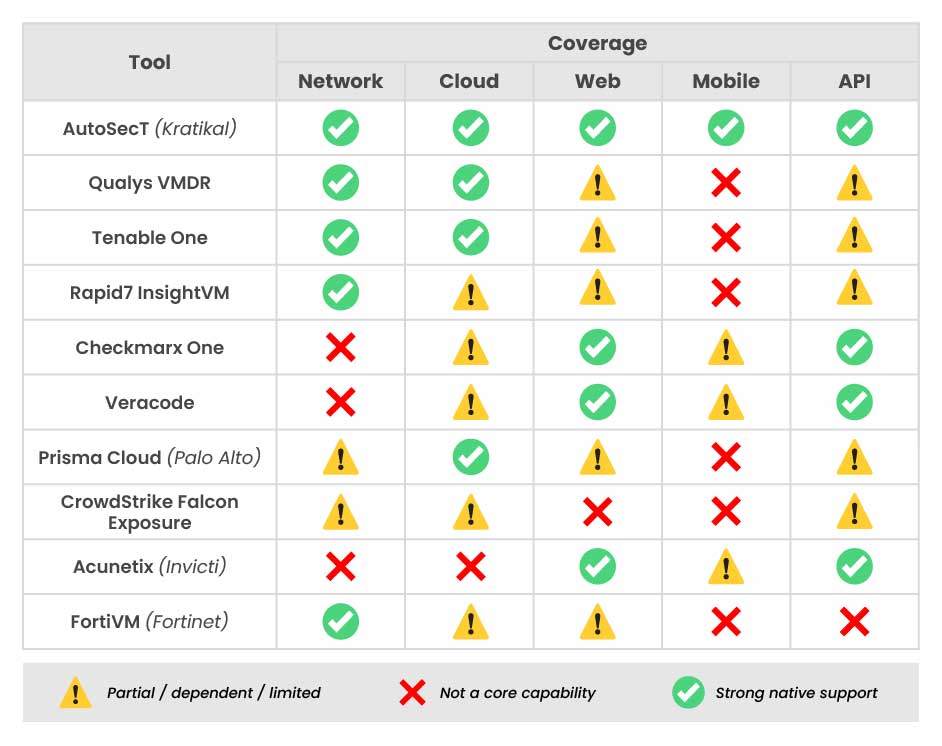
Based on Core Strength
| Tool | Core Strength |
| AutoSecT (Kratikal) | AI-powered VMDR, Near Zero False Positives, Compliance Mapping |
| Qualys VMDR | Enterprise-scale vulnerability management |
| Tenable One | Exposure & attack path modeling |
| Rapid7 InsightVM | Contextual prioritization, SOC alignment |
| Checkmarx One | AppSec (SAST, DAST, API) |
| Veracode | Secure SDLC & policy-driven AppSec |
| Prisma Cloud (Palo Alto) | Cloud workload & container security |
| CrowdStrike Falcon Exposure | Endpoint-driven exposure visibility |
| Acunetix (Invicti) | Web & API scanning accuracy |
| FortiVM (Fortinet) | Network vulnerability scanning |
Analysis: AutoSecT stands out with AI-powered VMDR, near-zero false positives, and built-in compliance mapping, making it outcome-driven and audit-ready. Others excel in specific domains like enterprise VM, exposure modeling, AppSec, cloud, endpoint, or web security, but often require multiple tools to achieve the unified risk, compliance, and remediation depth AutoSecT delivers.
Based on AI / Risk-Based Prioritization
| Tools | AI / Risk-Based Prioritization |
| AutoSecT (Kratikal) | Strong (AI + Exposure-based) |
| Qualys VMDR | Moderate (Rules + Threat Intel) |
| Tenable One | Moderate |
| Rapid7 InsightVM | Moderate |
| Checkmarx One | Limited |
| Veracode | Limited |
| Prisma Cloud (Palo Alto) | Moderate |
| CrowdStrike Falcon Exposure | Moderate |
| Acunetix (Invicti) | Limited |
| FortiVM (Fortinet) | Limited |
Analysis: AutoSecT leads with strong AI-driven, exposure-based risk prioritization that focuses on real exploitability and business impact. Most tools rely on moderate rule-based scoring or threat intelligence, while AppSec and scanning-focused tools offer limited risk context. This makes AutoSecT more actionable for faster, smarter remediation decisions.
Based on Cloud-Native Readiness
| Tool | Cloud-Native Readiness |
| AutoSecT (Kratikal) | Excellent (Agentless, Multi-Cloud) |
| Qualys VMDR | Good |
| Tenable One | Good |
| Rapid7 InsightVM | Moderate |
| Checkmarx One | Good |
| Veracode | Good |
| Prisma Cloud (Palo Alto) | Excellent |
| CrowdStrike Falcon Exposure | Moderate |
| Acunetix (Invicti) | Moderate |
| FortiVM (Fortinet) | Moderate |
Analysis: AutoSecT and Prisma Cloud lead with excellent cloud-native readiness. AutoSecT’s agentless, multi-cloud approach enables rapid visibility with minimal operational overhead. Others offer good support but are less seamless, while legacy VM and endpoint-focused tools remain moderate, limiting scalability and agility in dynamic cloud environments.
Based on DevSecOps / CI-CD Integration
| Tool | DevSecOps / CI-CD Integration |
| AutoSecT (Kratikal) | Strong |
| Qualys VMDR | Strong |
| Tenable One | Good |
| Rapid7 InsightVM | Good |
| Checkmarx One | Excellent |
| Veracode | Excellent |
| Prisma Cloud (Palo Alto) | Good |
| CrowdStrike Falcon Exposure | Moderate |
| Acunetix (Invicti) | Good |
| FortiVM (Fortinet) | Moderate |
Analysis: Checkmarx and Veracode dominate CI/CD with deep, native AppSec integrations. AutoSecT and Qualys offer strong DevSecOps support, balancing infrastructure and security workflows. Most others provide good-to-moderate integrations, often siloed, making continuous, pipeline-driven risk remediation less effective across the full attack surface.
Join our weekly newsletter and stay updated
Final Take: What Actually Defines “Best” in 2026
If you’re still choosing a vulnerability scanner based on how many CVEs it finds, you’re already behind. By 2026, the best tools will:
- Prioritize real exposure, not raw vulnerability counts
- Scan cloud, APIs, and ephemeral assets continuously
- Integrate directly into DevSecOps pipelines
- Reduce noise and accelerate remediation decisions
That’s why AutoSecT sits at the top as it aligns with where vulnerability management is going, not where it’s been.
FAQs
- What is the best vulnerability scanning tool for 2026?
The best vulnerability scanning tool for 2026 prioritizes real exposure, AI-driven risk analysis, cloud-native coverage, and DevSecOps integration making platforms like AutoSecT (Kratikal) stand out.
- How is vulnerability scanning in 2026 different from traditional scanning?
In 2026, vulnerability scanning is continuous, cloud-aware, and risk-based, moving beyond noisy CVE lists to focus on what’s actually exploitable.
- Why is AI important for vulnerability management in 2026?
AI reduces false positives, prioritizes real threats, and accelerates remediation, helping teams keep pace with fast-changing attack surfaces.